Friday, 30 December 2011

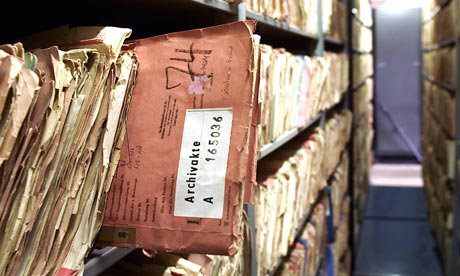
Should UK return Stasi files to Germany?


The Guardian is running an online poll on whether the British government should hand the East German secret police files over to Germany.

What do you think?

The Guardian (2011) Should the UK hand over Stasi files to Germany? [Online]
 http://www.guardian.co.uk/commentisfree/poll/2011/dec/29/uk-stasi-files-germany [30/12/2011]

Postcards from lost countries


This clip shows an interactive project due to launch on 10 Jan 2012, made from a collection of 25 postcards sent from 11 East European countries between 1975 and 1991 (Gebrüder Beetz Filmproduktion, 2011)

Gebrüder Beetz Filmproduktion (2011) Farewell Comrades! (Interactive) [Online]
Artline Films & Gebrüder Beetz Filmproduktion [2011] Farewell Comrades. [Online]

Wednesday, 28 December 2011

Fragments of Holocaust


"I think that we can only see the Holocaust in fragments, and these fragments are individual lives and individual deaths, and this is the only measure of things." (Bałka in Davies-Crook, 2011)
Mirosław Bałka's exhibition Fragment is about the collective experiences of the Holocaust with focuses on video works. He claims that the only way to understand life is through "the consciousness of the fragments" and not in "big numbers – the ones discussed by historians" (Bałka in Davies-Crook, 2011).

Davies-Crook, Susanna (2011) Disassembling Bambi. [Online]
 http://www.exberliner.com/articles/interview%3AMiros%C5%82aw-Ba%C5%82ka [27/12/2011]
Vernissage TV (2011) Miroslaw Balka: Fragment at Akademie der Kunste Berlin. [Online]
 http://www.youtube.com/watch?v=Pm455zOuVHY [28/12/2011]


Tate Channel (2009) The Unilever Series: Miroslaw Balka. [Online]
 http://channel.tate.org.uk/media/47872674001 [28/12/2011]
White Cube (2011) Miroslaw Balka at Akademie der Kunste, Berlin. [Online]
 http://whitecube.com/news/miroslaw_balka_at_akademie_der_kunste_berlin/ [28/12/2011]

Friday, 23 December 2011

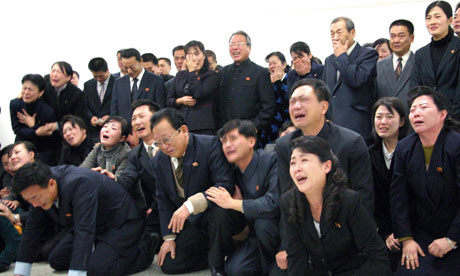
Minds of North Korea


"However he abused his long-suffering people, the fear they must now be feeling is surely real." (Taylor, 2011)
Kathleen Taylor, a neuroscientist and author of Brainwashing, claims that North Korea's control is "far from total" and the collapse of the government could be very rapid (Taylor, 2011). She concludes that "not all the tears are genuine" in mourning for Kim Jong-il, "but nor are they all fake", as he offered stability.

Taylor, Kathleen (2011) Has Kim Jong-il brainwashed North Koreans? [Online]
 http://www.guardian.co.uk/commentisfree/2011/dec/20/kim-jong-il-brainwashed-north-koreans
 [21/12/2011]

Thursday, 22 December 2011

Locked-up memories

Søren Lose's exhibition Relicts, on GDR-era Berlin and collective memories, was closed. 


Excerpt from the Brandts website.

The city of Berlin has been exposed to an unusually high number of historical events and periods which have been decisive for world history. This is what Relicts is all about: Berlin as the setting for the East-West conflict of the cold war years, of Communism and Capitalism; of past and present; regime versus the individual and the concept of Utopia – the notion of an ideal world.The exhibition features works, such as Curtain, 2011, which refers to an interior decoration from the East-German Unity Party’s assembly hall in Palast der Republik in the former GDR. The work is reminiscent of a stage curtain with strong authentic institutional aesthetics but at the same time also anonymous and neutral. Wall, 2011, consisting of reconstructed fragments of the Berlin Wall, embodies the post-war period and the segregation of East and West. After a narrow claustrophobic passage comes the work Flag, 2011, referring to a wall decoration in the aforementioned assembly hall, where one can see black and white photos. They form collages from an era, a particular period, a particular place. The earlier work Monument for Amnesia, 2009, mimics the helter-skelter like fashion of beams found in a construction site. Furthermore, the monumental Ghost, 2011, a reconstruction of a now demolished Lenin monument from 1970, is presented. Lose's fragmented version does not appear glorifying but rather abstract and dystopian. Finally, a number of objects, texts, photos are exhibited in display cases. The reinterpretation of Lose’s sculptures functions as a focal point for the exhibition; the sculptures act as relicts, as historical and situational signifiers for the GDR’s cultural and political ideologies.
Relicts combines several mythological narratives and significant historical buildings to unveil the fictitious,constructed and complex layers of meaning within history.

Brandts [2011] Søren Lose: Relics. [Online]
 http://www.brandts.dk/en/current-exhibitions?option=com_exhibitions&view=article&id=89 [18/12/2011]
e-flux [2011] Søren Lose's Relics. [Online]
 http://www.e-flux.com/announcements/soren-loses-relicts/ [18/12/2011]
Tuesday, 20 December 2011

"Being there but not there": In a Lonely Place


Gregory Crewdson's photographs are "projections of a story" he might have heard, "trying to search beneath the surface of things for an unexpected sense of mystery or something that's secret" [Crewdson in the Loyal Library, 2011]. They capture "the moment of transition between before and after" where he uses twilight for its evocative effects (Crewdson in Helmore, 2006).

Crewdson creates his scenes similarly to a film production using sets. In his interview projected in his exhibition In a Lonely Time, he also speaks about photography of truth and photography of fiction, and how the he merges the two approaches together to create tensions between detachment and intimacy, of "being there but not there" [Crewdson in the Loyal Library, 2011].

Amie Siegel also works on the relationship of documentary and fiction, which I will explore and experiment for my Berliners' project to raise questions about the coexistence of objective and subjective histories. 


Apperture Foundation [2011] Gregory Crewdson. [Online]
 http://www.aperture.org/crewdson/ [19/12/2011]
Fletcher, Kenneth R. (2008) Gregory Crewdson's Epic Effects. [Online]
 http://www.smithsonianmag.com/arts-culture/gregory-crewdson.html# [19/12/2011]
Helmore, Edward (2006) The witching hour. [Online]
 http://www.guardian.co.uk/artanddesign/2006/oct/04/photography [19/12/2011]
Royal Library, The [2011] Gregory Crewdson: In a Lonely Place. [Online]
 http://www.kb.dk/en/dia/udstillinger/crewdson.html [19/12/2011]

Wednesday, 7 December 2011

Delayed images of Palast der Republik


"The building was completely sealed," said Klapsch, "so an utter stillness lay over everything. It was a strange feeling." (Spiegel Online, 2010)

The photographer Thorsten Klapsch deliberately delayed publishing his Palast der Republik photographs until the demolition was completed, to avoid being seen as a "political gesture" (Spiegel Online, 2010).

Spiegel Online (2010) Memories of East Germany's Showcase: New Book Reveals Last Photographs of Berlin's Palast der Republik. [Online] http://www.spiegel.de/international/germany/0,1518,717697,00.html
 [07/12/2011]
Klapsch, Thorsten [2011] Palast der Republik. [Online]
 http://www.thorstenklapsch.de/architecture/palast-der-republik/ [07/12/2011]

Thomas Demand's National Gallery


Thomas Demand creates "a strudel of putting sculptures and photographs and concerns of painting into one" by constructing life-size scenes to photograph. He talks about his exhibition National Gallery which coincides with the anniversaries of the foundation of the Federal Republic of Germany and the opening the Wall, "two pivotal historical events in German history" (This is Tomorrow, 2009). Focusing on the collective memory of Germany, Demand describes his intention to capture "society falling apart and a new one forming" (Demand, in Bound, 2011) through a raided Stasi office. 

Office (1995)
"The tacit nature of this work's Germanness is striking. Imagine walking through an exhibition by Joseph Beuys devoted to the idea of the German nation without having to notice that this is the theme. Impossible. For Gerhard Richter, even more impossible. With Sigmar Polke, Hanne Darboven, Anselm Kiefer, Isa Genzken or Martin Kippenberger--for any of the photographers of the Becher school, too--a reflection on Germany and the traces of its history in the present could only be patent, unavoidable. Is this Demand's lesson: that Germany is now no different from anyplace else, that it is at last a normal, self-confident European nation like any other, unburdened of the memory of its historic tragedies, free of the guilt and resentment that have weighed so heavily on Demand's precursors? Has the effort of Vergangenheitsbewältigung (coming to terms with the past), a process as cumbersome as the word, been completed, or has it simply fizzled out?" (Schwabsky, 2009) 
"...What counts as destruction, and what counts as 'ours,' depends on your viewpoint. In 2002 the German Parliament voted to demolish the Palast der Republik, the grandiose seat of the former East German Parliament... It had been closed since 1990, and the idea was to replace it with a replica of the kaiser's castle that had once occupied the spot. The German Parliament sought to efface part of Berlin's living history in favor of sham historicism. Nothing that belonged to the GDR, according to powerful elements in Germany today, could possibly be 'ours.'" (Schwabsky, 2009) 
Bound, Robert (2011) News Report: Thomas Demand. [Online]
Schwabsky, Barry (2009) A Makeshift World: On Thomas Demand. [Online]
This is Tomorrow (2009) Thomas Demand: Nationalgalerie. [Online]
 [07/12/2011]

Illner, Peer [2011] Demand's Politics of Paper. [Online]
 http://introducingart.com/ISSUE%206/CONCEIVE/Peer%20Illner.html [06/12/2011]
MoMA [2011] Thomas Demand [Online]
 http://www.moma.org/visit/calendar/exhibitions/116 [06/12/2011]
Tate Channel (2008) Meet the Artist: Thomas Demand [Online]
 http://channel.tate.org.uk/media/26519199001 [06/12/2011]

Echo by Bettina Pousttchi


Bettina Pousttchi in 2009 created a photo installation of Palast der Republik on the facade of Temporäre Kunsthalle Berlin, a temporary gallery built where the Palast once stood. In her interview, Pousttchi talks about different times represented by two clocks, and her focus on media reality rather than factual reality. Pousttchi also notes that the Palast had changed its meaning after the fall of the Wall, to symbolising "reunified Germany and Berlin" (Pousttchi, 2009).

Echo (2009)

Pousttchi, Bettina (2009) Bettina Pousttchi: Echo / Temporäre Kunsthalle, Berlin / Interview. [Online]
 http://dai.ly/clCHFt [07/12/2011]
Pousttchi, Bettina (2009) Echo. [Online]
 http://www.pousttchi.com/index.php?option=com_content&view=article&id=94&Itemid=54
 [07/12/2011]

Sunday, 4 December 2011

Christoph Niemann on politics of immigration


"Too often in politics, very complex subjects are being turned into sound bites, so it’s easy to take them apart" (Niemann, in Kaneko & Mouly, 2011).
To provide context and "to help keep things in perspective" on immigration debate in America, Christoph Niemann drew "a parallel between current immigrants and early settlers" for the New Yorker magazine cover. The artist also claimed, "cartoonists, not politicians, should be the ones who condense political discussions into simple images"  (Niemann, in Kaneko & Mouly, 2011).

Kaneko, Mina & Mouly, Françoise (2011) Cover Story: Promised Land. [Online]
 http://www.newyorker.com/online/blogs/culture/2011/11/cover-story-christoph-niemann.html [04/12/2011]

Sanchez, Ray & Steiner, Laura (2011) The New Yorker Thanksgiving Cover Takes On Immigration. [Online] 
http://www.huffingtonpost.com/2011/11/23/the-new-yorker-thanksgiving-cover-takes-on-immigration_n_1109462.html#s495708&title=November_28_2011 [04/12/2011]

Forgotten town of Wünsdorf


In 1994, the population of Wünsdorf decreased from 60,000 to 6,000 as the Russian forces left. The town once hosted the headquarters of Soviet forces in East Germany, and was "a Soviet city in the heart of Germany" (Rüger, 2011) but is now forgotten.
"Walking around the empty rooms, halls and corridors, it takes some imagination to picture this rambling, deserted complex filled with thousands of people... The light falling on the faded pastel-colored walls and on the flaking paint of the doors give this military architecture a nostalgic atmosphere. Here and there, one finds objects left behind, such as a broken piano lying in the dust, its legs removed." (Rüger, 2011)
Rüger, Jörg (2011) Abandoned Soviet Outpost: Glimpses of a Forgotten, Forbidden City.
 [Online] http://www.spiegel.de/international/germany/0,1518,800658,00.html [03/12/2011]

Monday, 21 November 2011

Skhizein by Jérémy Clapin


Jeremy Clapin in his animation Skhizein created a character, Henry, who has been shifted 91cm from his physical self. It is an "exploration of the metaphysical implications of place" as well as self-separation highlighting Henry’s confounded psychological state. The "main character is ultimately hounded by his own displacement, reassuring himself, 'I am here, I am here, I am here...'" [Barnum-Swett, 2011].

Barnum-Swett, Daniel [2008] Skhizein: Jérémy Clapin 2008 [Online]

Sunday, 20 November 2011

Film by Tacita Dean


11 minutes Film by Tacita Dean is the first work in the Unilever Series devoted to moving image. Projected onto a 13 metres tall white monolith in the darkened Turbine Hall, it "celebrates the masterful techniques of analogue film-making as opposed to digital" [Tate, 2011a]. Dean explains one of the element of the Film to be "about everything that exists beyond the rational self" [Tate, 2011b].

Tate [2011a] The Unilever Series: Tacita Dean. [Online]
 http://www.tate.org.uk/modern/exhibitions/unilever2011/default.shtm [19/11/2011]
Tate [2011b] "It's all about metaphor": Tacita Dean. [Online] http://tacitadean.tate.org.uk/ [19/11/2011]

Monday, 31 October 2011

BBC Radio Norfolk interview


On 30th August I was interviewed by Matthew Gudgin on BBC Norfolk about the Berlin Wall - built 50 years ago that month - and my MA exhibition on Berliners' post-Wall perceptions.

My NUCA exhibition profile's been moved to another page.

Tuesday, 25 October 2011

Politics at Checkpoint Charlie


Stand off at Checkpoint Charlie in 1961 only affirmed "the Four Power status of the city," notes Colitt (2011). Military officials and diplomats of the Allies were able to cross the Wall after the hostile confrontation at the border 50 years ago, while Berlin remained divided. It takes 28 years for the Wall to open up.

Colitt, Leslie (2011) Berlin crisis: the standoff at Checkpoint Charlie [Online]
 http://www.guardian.co.uk/world/2011/oct/24/berlin-crisis-standoff-checkpoint-charlie [24/10/2011]

Saturday, 15 October 2011

Ruth Gwily for NYT OpEd


Ruth Gwily's illustration for the NYT OpEd. The image above is from the NYT article online. The image below creates a silhouette from negative spane.


Gwily, Ruth (2011) in Holmes, Anna "The Disposable Woman" [Online] 
VisualizeUs (2011) NY Times Op-ed design [Online]

Friday, 14 October 2011

Wall perspectives

Exhibition at Museum Villa Schöningen.

Golden Section Graphics News (2011) Mauerperspektiven [Online]
 http://goldensectiongraphics.blogspot.com/2011/09/mauerperspektiven.html [14/10/2011]

Bundeszentrale für politische Bildung [2011] Jugend Opposition in der DDR [Online]
 http://www.jugendopposition.de/index.php?id=1 [14/10/2011]

The Connected States


A map created from a data of mobile phone calls shows how people connect in the US, within states and across state borders.

MIT Sensible City Lab [2011] The Connected States of America [Online] http://senseable.mit.edu/csa/interact.html [14/10/2011]

Ratti, Carlo., Sobolevsky, Stanislav., Calabrese, Francesco., Andris, Clio., Reades, Jonathan., Martino, Mauro., Claxton, Rob. & Strogatz, Steven H. (2010) Redrawing the Map of Great Britain from a Network of Human Interactions [Online]
http://www.plosone.org/article/info%3Adoi%2F10.1371%2Fjournal.pone.0014248 [14/10/2011]
Calabrese, Francesco., Dahlem, Dominik., Gerber, Alexandre., Paul, DeDe., Chen, Xiaoji., Rowland, James., Rath, Christopher. & Ratti, Carlo (2011) The Connected States of America: Quantifying Social Radii of Influence [Online] http://senseable.mit.edu/papers/pdf/2011_calabrese_et_al_socialcom.pdf
[14/10/2011]

Friday, 7 October 2011

Ampelmännchen turns 50


The East German pedestrian icon Ampelmännchen, proposed by traffic psychologist Karl Peglau, turns 50. It first appeared in Unter den Linden and Friedrichstrasse in East Berlin, and was once scheduled to be removed from East German pedestrian lights after the unification, to be replaced by an updated design. It has since developed into a commercial brand and a symbol of Ostalgia.


Ampelman.de [2011] We are the People [Online]
 http://ampelmann.de/html/geschichte_english.html [07/10/2011]
Ampelmanshop [2011] http://ampelmannshop.com/ [07/10/2011]
Gödecke, Christian (2011) Ampelmännchen aus aller Welt: Auf mein Zeichen: los!
 http://einestages.spiegel.de/static/topicalbumbackground/23604/1/auf_mein_zeichen_los.html [07/10/2011]
Gödecke, Christian (2011) Men in Hats: East Germany's Cult Pedestrian Signal Turns 50 [Online]
 http://www.spiegel.de/international/zeitgeist/0,1518,790133,00.html [07/10/2011]

Saturday, 1 October 2011

Art Worlds After 1989


The Global Contemporary. Art Worlds After 1989 on globalization and geopolitical shift.

Jermolaewa, Anna (2008) Kremlindoppelganger, Fotoserie, je 50 x 35 cm, gerahmt, 2008 [Online]
 http://www.jermolaewa.com/works/kremlin_doppel.html [01/10/2011]
Zentrum für Kunst und Medientechnologie Karlsruhe [2011] The Global Contemporary. Art after 1989
 [Online] http://www.global-contemporary.de/en/[01/10/2011]