
Showing posts with label Self-Negotiated (a). Show all posts
Showing posts with label Self-Negotiated (a). Show all posts
Thursday, 10 December 2009
The Berlin Wall: 11.08.1990
Sunday, 6 December 2009
Berlin 89/09: Berlinische Galerie

Olaf Metzel, Fünfjahrplan, 1985
The exhibition carries out an investigation of the transformation the capital has experienced since the opening of the Wall, including work by artists who themselves have lived through these changes.
"When the Berlin Wall was opened, the city became the focus of international attention almost overnight: previously the symbol of two opposing political systems, it was now a barometer for the process of reunification and the test ground for new societal, cultural and architectural ideas." [Berlinische Galerie, 2009]
Berlinische Galerie [2009] Berlin 89/09: Art Between Traces of the Past and Utopian Futures. [online]
http://www.berlinischegalerie.de/index.php?id=667&L=0&L=1
Saturday, 5 December 2009
Fluid Text at Bestiario

{b.}bestiario [2009] http://bestiario.org/web/media/12/preview/index.php?id_proyecto=12
Friday, 4 December 2009
Sketches from the Less Bicknell Lecture
Sketches I made during my Core Unit lecture today. Les Bicknell presented some of his work, collaborating with residents of various communities, and above the door of the office's entrance he had painted the word "entrance" backwards. This was his perception to say that he should be out on the street (and it started up conversations too).
This linked with ideas I have about "the wall in the mind". When people say there is a psychological divide, they're referring to the cultural difference and conflict of values between former East and West Germans (Ossies and Wessies).
"Today's East and West Germans harbor deep mutual suspicion. The stereotypes are deeply ingrained and readily conjured: "Ossis" are racist, lazy, and self-pitying, while "Wessis" are self-centered, money-obsessed, and arrogant. Statistics show that Germans from opposite sides of the former border rarely marry, and they sometimes seem to make efforts to avoid mingling socially." (Abadi, 2009)
So people are still influenced by the concepts developed under the Codl War. Do Germans compare "the other side of the wall", against their own values? Is that the wall which still searve as a boundary? So I placed some words on a physical boudary.

If the wall of ideals seperated "us" and "them"... would printing the word "entrance" backwards help people see the values on the other side? (it would be "Eingang" in German, but I didn't think of this when I sketched this picture.)

Or is the word entrance too emotionally attached to them coming over and invading their culture or communities? Should the backward text be "Ausgang" (exit)? Maybe there should be different words facing each side of the Wall. Perhaps it should be a question mark.
Abadi, C. (2009) The Berlin Fall. [online] http://www.foreignpolicy.com/articles/2009/06/18/the_berlin_fall
Thursday, 3 December 2009
Google Mapping Search Results

Brin, S. & Page, L. (2007) Sergey Brin and Larry Page on Google. [online] http://www.ted.com/talks/lang/eng/sergey_brin_and_larry_page_on_google.html
Wednesday, 2 December 2009
Notes from 2/12/09
Wall Projection
digital projection:


digital projection:
- project onto gel sheets
- could this filter certain words?
- use mobile - Alexander Calder
- LCD screen
- text projection gun thing
- texture... concrete, brick, wood (materials that were used for the Wall?)
- Bill Viola: water screen, "haunch of venison" .com
- pinhole cam
Calder Foundation (2009) Calder's Work. [online] http://calder.org/work/category/hangingmobile/30
Saturday, 28 November 2009
"Ich bin ein Wordler"
These are similar to the ideas I have about projecting texts onto the Wall. This is a Wordle image of John F.Kennedy's 1963 speech, where he claimed:
"All free men, wherever they may live, are citizens of Berlin, and, therefore, as a free man, I take pride in the words 'Ich bin ein Berliner'" (BBC, 2003).

Wordle is a website where it translates texts into "word clouds". Words that are frequently used are represented bigger than the ones less used (Wordle, 2009). The image below is created from the 1987 speech by Ronald Reagan, where he called "Mr. Gorbachev, tear down this wall" (American Rhetoric, 2009).

Little has changed over 24 years: Berlin, city and freedom are the key words regularly used. Both presidents were also criticized for being too confrontational, although some claim they were ahead of their time (Dolan, 2009, and Mann, 2009). This following is a prepared speech of senator Barack Obama, when he visited Berlin during his presidential campaign in 2008. The words world, people and Berlin are most frequently used.

American Rhetoric (2009) Ronald Reagan: Remarks at the Brandenburg Gate. [online]
http://www.americanrhetoric.com/speeches/ronaldreaganbrandenburggate.htm
BBC (2003) Text: Kennedy's Berlin Speech. [online] http://news.bbc.co.uk/1/hi/world/europe/3022166.stm
Dolan, A.R. (2009) Four Little Words. [online] http://online.wsj.com/article/SB10001424052748704795604574522163362062796.html
Mann, J. (2009) Reagan at the Berlin Wall. [online] http://www.latimes.com/news/opinion/commentary/la-oe-mann6-2009nov06,0,5455746.story
New york Times (2008) Transcript: Obama’s Speech in Berlin. [online] http://www.nytimes.com/2008/07/24/us/politics/24text-obama.html
Wordle (2009) http://www.wordle.net/
Friday, 27 November 2009
SMS Guerrilla Projector by Troika

SMS Guerrilla Projecter is a homemade device that projects text messages its integrated mobile phone receives, and encourages participation on a mass scale as well as enabling people to "share their reflections in an unexpected and versatile way" (Freyer et al, 2008). It emerged as a reaction to constant exposure to adverts and the aim to "re-appropriate" this field at grass-roots.

Freyer, C., Noel, S. & Rucki, E. (2008) Design by Digital: Crafting Technology for Products and Environments. London: Thames & Hudson.
Counter Void by Tatsuo Miyajima
This is a installation in a form of wall outside a TV station in Tokyo, and also has a theme linked to night, and day.

"The wall is made with neon light as background of digital counters and it changes in day and night. In daytime, background's neon light is turned off and digital counters of white neon light are displayed. It turns over the scenery in nighttime. It displays black digital counters on background of white bright light" (Miyajima, 2003).
Miyajima (2003) claims that Counter Void shows a contrast of day and night; and life and death. The image below is another installation on a wall titled Mega Death (Kim, 2005).

Kim, S.-J. (2005) Tatsuo Miyajima. [online] http://www.cacsa.org.au/cvapsa/2005/8_Miyajima/miyajima.html
Bit.Fall by Julius Popp

Julius Popp is at "the cross-roads between art and Science" (Freyer et al, 2008, p.116). Bit.fall is an installation in 320 nozzles, controlled by computer software and electromagnetic valves, creates waterdrops which creates words. The display of this "giant water printer" is 8 metres wide, and can be interpreted as a critical perspective towards "our society's permanent quest to achieve an objectifiable representation of reality by means of technological advances" (Freyer et al, 2008, p.116).
"As each message drips into a collection tank, its feeds back into the cycle, creating a metaphor for the impermanence and flux of the perception of ‘reality’ [Saatchi Gallery, 2009].
Bit.flow is Popp's second installation which immiscible liquids are pumped into a 45 metre long tube on a wall. A Computer program sets out a pattern which only at certain points form readible image, and each image "disintegrates in to chaos" (Freyer et al, 2008, p.116).

Freyer, C., Noel, S. & Rucki, E. (2008) Design by Digital: Crafting Technology for Products and Environments. London: Thames & Hudson.
Saatchi Gallery [2009] Selected Works by Julius Popp. [online] http://www.saatchi-gallery.co.uk/artists/julius_popp.htm
See also:
Bit.Fall - Discovery Channel Short Film. [Online] http://www.youtube.com/watch?v=AICq53U3dl8
Wednesday, 25 November 2009
John Gossage's Wall


Bell, A. [2009] Putting Back the Wall. [online] http://www.adambbell.com/blog/2007/10/putting-back-wall.html
Katzman, L. (2007) John Gossage's Berlin. [online] http://www.artpapers.org/feature_articles/feature2_2005_0102.htm
Light work (2008) Past Exhibitions: John Gossage. [online] http://www.lightwork.org/exhibitions/past/gossage.htmlMuse-ings (2008) Putting Back the Wall - John Gossage. [online] http://photo-muse.blogspot.com/2008/02/putting-back-wall-john-gossage.html
Muse-ings (2006) A New Blog for a New Year. [online] http://photo-muse.blogspot.com/2006/12/new-blog-for-new-year.html
Richard, P. (2005) Depth of Field: John Gossage Tears Down the Wall Between Photography and Art. [online] http://www.washingtonpost.com/wp-dyn/articles/A32901-2005Apr6.html
Chris De Witt's Wall and Platforms

The Brandenburg Gate, from the Western side, 1986

Viewing Platform at Neiderkirchnerstrasse

Heidelberger Strasse

Viewing platform at Stalschreiber Str

A closer view of the Platform
De Witt, C. [2009] Edition 8 Images. [online] http://www.appropriatesoftware.com/BerlinWall/Images8.html
Opening by Brian Rose
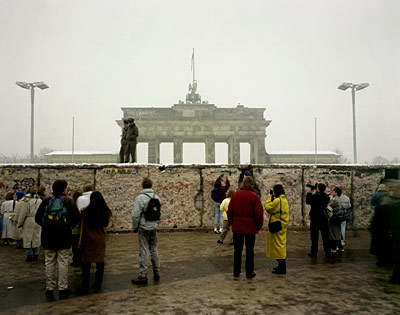
The Brandenburg Gate, Berlin, 1989
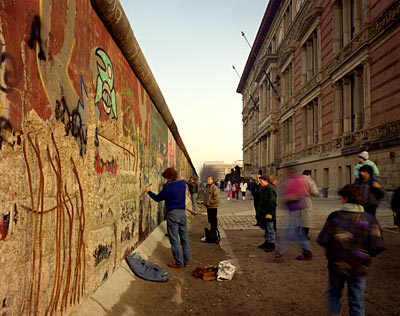
Niederkirchnerstrasse, Berlin, 1989
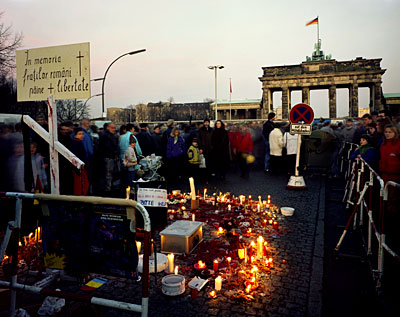
The Bradenburg Gate, Berlin, 1989
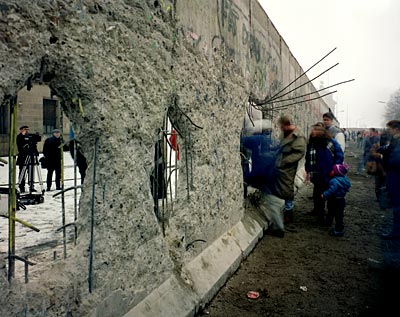
Ebertstrasse, Berlin, 1989
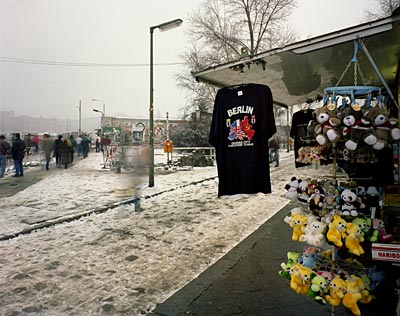
Potsdamer Platz, Berlin, 1989
Rose, B. [2009] Opening. [online] http://www.brianrose.com/lostborder/opening.htm
Ruins by Brian Rose
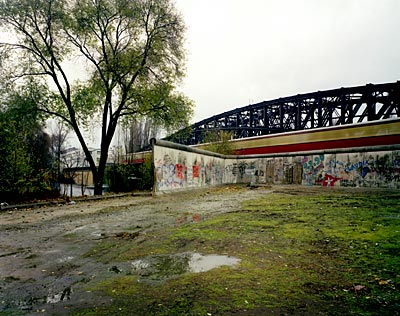
Berlin, 1990
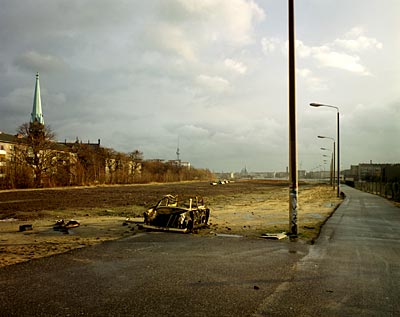
Berlin, 1990
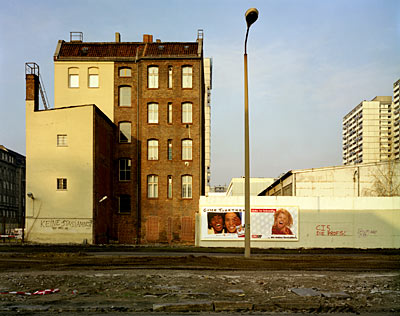
Zimmerstrasse, Berlin, 1990
Rose, B. [2009] Ruins. [online] http://www.brianrose.com/lostborder/ruins.htm
Wall by Brian Rose
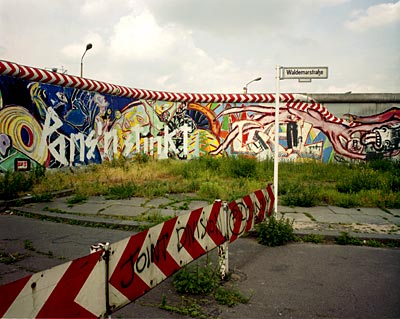
Waldemastrasse, Berlin, 1985
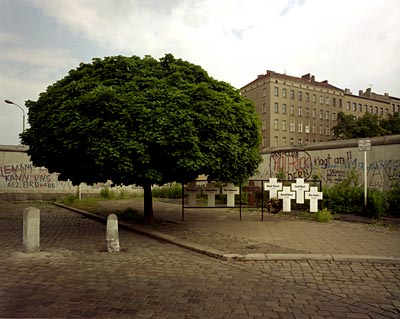
Bernauer Strasse , Berlin, 1985
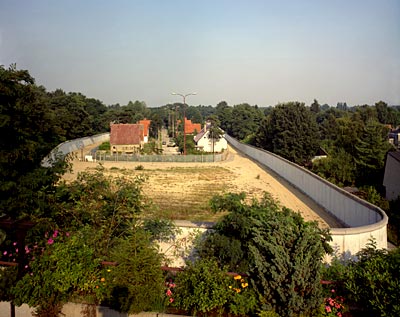
Am Zandkrug , Berlin, 1985
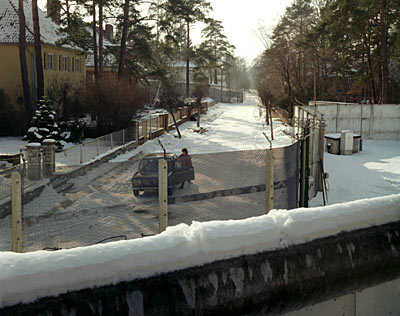
Stubenrauchstrasse, Berlin, 1987
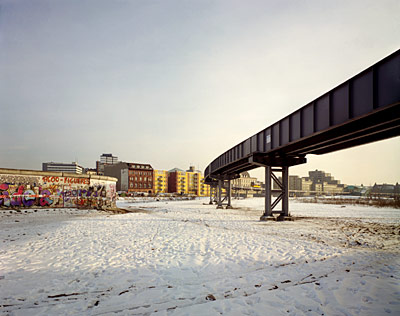
Potsdamer Platz, Berlin, 1987
Rose, B. [2009] Wall. [online] http://www.brianrose.com/lostborder/wall.htm
Monday, 23 November 2009
The Berlin Twitter Wall

Digital media is playing an important part of the 20th anniversary of the Berlin Wall's opening (Bunz, 2009). As well as websites with historical and narrative footage, people can "share your thoughts on the historic Fall of the Wall and post a wish for the future" at the Berlin Twitter Wall, a project run by Kulturprojekte Berlin as part of the 20th anniversary of the opening of the Wall [The Berlin Twitter Wall, 2009]. The project also focuses on "which walls still have to come down to make our wold a better place" and allows 5 posts daily to prevent spam (Bunz, 2009).
Bunz, M. (2009) The Fall of the Berlin Wall in Digital Media. [online] http://www.guardian.co.uk/media/pda/2009/nov/09/fall-of-berlin-wall-digital-media-social-networks
Fest der freiheit [2009] http://www.mauerfall09.de/
Kulturprojekte Berlin [2009] http://www.kulturprojekte-berlin.de/
The Berlin Twitter Wall [2009] http://www.berlintwitterwall.com/
Sunday, 22 November 2009
Listening Post

Science Museum [2009] Listening Post. [online] http://www.sciencemuseum.org.uk/about_us/about_the_museum/art/listening_post.aspx
http://www.flickr.com/photos/thisisstar/2508579169/in/photostream/
http://www.nytimes.com/2007/10/25/arts/design/25vide.html?_r=1
http://atc.berkeley.edu/bio/Ben_Rubin/
Art and Politics
Hutnyk, J. (2009) Eleven Theses on Art and Politics, #10 & #11 (not the last). [online]"In 2009, the commemoration involves recreations of some of the art work – controversially – and the Goethe Maurriese project which also, not without problems, focus only upon artistic elements and wholly ignore, for various politically sensitive reasons, questions about the political wall, the place of the former DDR in contemporary Germany, the changes since unification, and the ways this symbol of division has become a marketing tool for a new (hygienic) Berlin." (Hutnyk, 2009)
http://hutnyk.wordpress.com/2009/11/08/eleven-theses-on-art-and-politics-10-11-not-the-last/
Saturday, 21 November 2009


Subscribe to:
Posts (Atom)
