Saturday, 21 January 2012

The corrosion of time and being "too late"


When Tacita Dean tried to film the Chalon-sur-Saône Kodak factory in France, which had stopped producing film, she was told she had come too late. "I like too late," she replied (Schama, 2011) and went on to create her work Kodak (2006) which Simon Schama describes "one of the most visually compelling of her works". Six years after Dean's Kodak, the company has filed for bankruptcy accumulating debates about film and digital media. 
"While the television tower filmed in Fernsehturm owes its continued survival to its suitability for adaptation to tourism, the government building whose windows provide the screen for Palast was demolished a few years after Dean made her film. Similarly, although the Kodak factory in France continued to make X-ray film for a short time after it stopped 16mm production, its premises were demolished in December 2007 to make way for new industries." (Manchester, 2009)
Manchester, Elizabeth (2009) Kodak (2006) [Online]
 http://www.tate.org.uk/servlet/ViewWork?workid=91369&tabview=text  [21/01/2012]
Schama, Simon (2011) Tacita Dean talks to Simon Schama. [Online]
 http://www.ft.com/cms/s/2/b94bfcb4-e973-11e0-af7b-00144feab49a.html#axzz1k5RDnVhM [21/01/2012]

Moss, Ceci (2010) Kodak (2006) - Tacita Dean. [Online]
 http://rhizome.org/editorial/2010/apr/14/kodak-2006-tacita-dean/ [21/01/2012]
Sunday, 15 January 2012

Accuracy of collective/collaborative memories


"Memories are always being negotiated, fought over and shaped by the memories of others." (Fernyhough, 2012)
We sometimes "wrongly incorporate information that has been provided by other people into our own memories," notes Fernyhough (2012). This is also known as "social contagion" caused by the "pressure to fall in line with the memories of family, friends and colleagues" which we often resist, but we occasionally fully believe in "other people's mistaken recollections of the past" (Fernyhough, 2012). In a study conducted at the universities of Hull and Windsor showed that "non-believed memories" (beliefs we no longer think are true but keep experiencing as memories) are reported by more than 20% of adults, showing that we constantly edit our memories, rely on others while "sometimes rejecting their veracity altogether".  Memories are shaped and reconstructed by the self who is doing the remembering, and the stories change when the person's beliefs and emotions change (Fernyhough, 2012).
"Collective memory has an extraordinary power, and it stems from the collaborative, reconstructive nature of memory itself." (Fernyhough, 2012)
We are engaging in "collective remembering" when we mark Remembrance days or anniversaries and there are other less formal ways of "publicly remembering the past". Social remembering, or "memory collaborations" can "diminish the accuracy of our memories, and groups of people sometimes remember things less effectively" than the individuals' remembering. How communal memories and its relation to personal memories or how collaboration helps and hinders memory" are still unresolved.

Fernyhough, Charles (2012) Shared memories and the problems they cause. [Online]

Collective and public memories


"Memory has always been a social activity... and our appetite for collective nostalgia is undiminished." (Bell, 2012)
Memory has long been stored "outside of our own individual bodies" and has been social, claims Bell (2012). The changes we are seeing today shifts where the information is stored, from a note on a shelf or a camera to "behind small screens". Bell argues that "our appetite for collective nostalgia" has always been aided by social events, memorial days and monuments such as statues and plaques. The web has become an accessible and very public "repository for our lives: a place to store memories, to be reminded, and to find other people's memories too".

Collective memory can connect and reconnect "us to things we need or want and would otherwise be without," Bell claims, and further argues that we might become more open and honest about our personal and complex histories as we get used to digitised memories.
"After all, memories aren't just about recalling singular facts, but making connections within a complex network. Why not use technology to help extend and enrich this network?" (Bell, 2012)
Bell, Alice (2012) Memory in the Digital Age. [Online]
 http://www.guardian.co.uk/lifeandstyle/2012/jan/14/memories-in-the-digital-age [14/01/2012]

Monday, 9 January 2012

Your present vs. future self


Daniel Goldstein claims that "there's two heads inside one person" - cool and hot - or the present self and the future self, and they are engaged in "an unequal battle". The present self is tempted by various present desires and is in control, whereas the future pursue higher reasoning although it is absent and weak (Goldstein, 2011). He also talks about commitment devices, which are ways individuals try to commit to the future good, how we pursue something we can't see or feel and try to diverge ourselves from temptations: over-spending, or eating donuts.

Goldstein, Daniel (2011) Daniel Goldstein: The battle between your present and future self. [Online] 
 http://www.ted.com/talks/daniel_goldstein_the_battle_between_your_present_and_future_self.html
 [08/01/2012]

Friday, 6 January 2012

GDR lost generation


Lothar de Maizière, the last GDR prime minister, attending the Korean-German Consultation Committee on Reunification, says the South Koreans are uninterested in what the North wants.
"They say: 'It's up to us in the South to solve the unity problem. We have the money.' Well, it was no different with us. That was, of course, the German problem. Afterwards there can be a very pronounced feeling of colonization... Historical ruptures always leave behind a lost generation." (De Maizière in Gutsch, 2012a)
De Maizière also notes that "the Koreans basically don't want unity to cost too much, and I tell them it will cost much more than you can imagine."

The last GDR defense minister Rainer Eppelmann, another German delegate, says "I've realized that the South Koreans are trying to figure out a way for the North Koreans to remain in the North after unification... The South Koreans were talking about border controls. I'll be damned! They seriously intend to close the border after the wall has fallen!" Kim Chun Sig, South Korea's deputy unification minister, says "that is also a very sensitive question. Let's put it this way: Perhaps the North Koreans could remain in their homeland, yes? And we will help them" (Gutsch, 2012a).

Kim doesn't seem to know whether the North Koreans want reunification, as he claims "we have no information about this... we don't know. We only have the defectors who tell us that the conditions in the country are very poor" (Gutsch, 2012b). According to Kim, around 35% of the 19 to 40-year-olds see Korean unification as an important political issue.
"The desire to unite is continuously ebbing. South Korea's older generation has long since lost touch with friends and relatives north of the border. The younger generation has never had a chance to meet. Viewed from the South, North Korea is a distant, uninhabitable planet. It's not even possible to hop across the border for a quick look, as West German schoolchildren used to do on field trips to East Berlin." (Gutsch, 2012b)
Gutsch, Jochen-Martin (2012a) Seoul Searching: Germans Give Pep Talks on Korean Unification. [Online]
 http://www.spiegel.de/international/world/0,1518,807123,00.html [06/01/2012]
Gutsch, Jochen-Martin (2012b) Part 2: 'I Will Live To See Korean Unifiaction [Online]
 http://www.spiegel.de/international/world/0,1518,807123-2,00.html [06/01/2012]

Thursday, 5 January 2012

Erasing the border of art and life


The Global Contemporary exhibition at ZKM in Karlsruhe showcases post-1989 art practices that have emerged as a result of political changes.

Guy Ben-Ner shot Drop the Monkey (2009) with all materials cut live on camera while the artist made over 25 trips between Berlin and Tel Aviv [Site Gallery, 2012]. Ben-Ner "picking out the conditions and the process involved in the production of the work itself along with arguments for the pros and cons of the mingling of art and life as a central theme" and highlights "the present-day state of (artistic) diasporic identity as marked by inner conflict and melancholy" (Marten, 2011) with a messsage he writes onto his T-shirt "I WISH, I WAS SOMEWHERE ELSE".
"At the time of Drop the Monkey I was living in Tel Aviv and my girlfriend was living in Berlin. I decided to use that commission as means to see her every once in a while and create a movie that should talk about the proper or improper use of art. The constraints were quite unique, erasing the border between my life and the piece I was working on." (Ben-Ner in Donovan, 2010)
Donovan, Thom (2010) Guy Ben-Nerby. [Online]
 http://bombsite.com/issues/111/articles/3443 [05/01/2012]
Marten, Antonia [2012] Guy Ben-Ner. [Online]
 http://globalcontemporary.de/en/artists/94-guy-ben-ner [05/01/2012]
Site Gallery [2012] Guy Ben-Ner: Spies. [Online]
 http://www.sitegallery.org/archives/3163#.TwYMZTX4WSo [05/01/2012]

Wednesday, 4 January 2012

Creating Photo Opportunities


"They linger in and as memory; as we look at them we reflect, try to make something out. Images seen from a railway carriage or car; flicked over in a magazine, or flickered in front of us on a television screen... Each image makes distinctive, subtle but insistent interplay with us, with our memories, desires, hopes and feelings." (Crouch, 2009)
Photo Oppotunities by Corinne Vionnet is a collection of images of tourists' destinations around the world. Images are created from around 100 photographs posted online. Vionnet wondered if "we were trying to reproduce the image that we already know. How much does the image - through films, advertisements, postcards, the internet - influence our gaze? Are we trying to reproduce the image of an image?" 

David Crouch notes that viewers are "affected by the image, usually but not always visual, that someone else has already taken and that we have seen" and that photographs provide a referencing point to "a memory or something we wish was in our memory, like a longing, or provocation amongst others". He also claims that images "enrich the mixture in which we place our own experience" as they "share mindspace with stories, with sounds, with friends who have shared with us of these same places and other similar ones they have, or want to visit- and why they want to do so". 
"Our photographs are personal and shared reminders, and come alongside the making of myths in a popular visual culture of our own, sharing experience of 'being there', in vivo. Shared popular visual culture includes friends' photographs and stories, postcards we have received and sent; narratives that background their pictures." (Crouch, 2009)
Crouch, David (2009) Photographs, experiences and memories. [Online]
 http://www.corinnevionnet.com/site/1-photo-opportunities.html [04/01/2012]
Vionnet, Corinne [2012] Photo Opportunities. [Online]
 http://www.corinnevionnet.com/site/1-photo-opportunities.html [04/01/2012]

Tuesday, 3 January 2012

Documentation and live imprisonment at Hohenschönhausen


Franziska Vu's exhibition Detained [Inhaftiert] combines photographs with interviews of Stasi prisoners, to create an exhibition to reflect on recent German history. Vu's collaborative "live-imprisonment" (DPA/The Local, 2009) project in 2009 at the Stati prison Berlin-Hohenschönhausen Stasi prison, with former prisoner Carl-Wolfgang Holzapfel planning to live in a cell for a week, ended with Holzapfel's psychological distress [Gedenkstätte Berlin-Hohenschönhausen, 2012].

DPA/The Local (2009) Emotional strain ends former Stasi prisoner's live re-enactment [Online]  http://www.thelocal.de/society/20091102-22971.html [03/01/2012]
Gedenkstätte Berlin-Hohenschönhausen [2012] 24/7 Stasi-Live-Haft [Online] http://www.stiftung-hsh.de/page.php?cat_id=CAT_1&con_id=CON_1516&page_id=867&subcat_id=CAT_1&recentcat=&back=
 [03/01/2012]
Kulturring in Berlin [2012] Inhaftiert/Detained. [Online]
 http://www.kulturring.org/konkret/inhaftiert/index.htm [03/01/2012]

B
Herschdorfer, Nathalie (2011) Afterwards: Contemporary Photography Confronting the Past. London: Thames & Hudson.
Rosenberg, Steve (2009) Reliving Stasi isolation - for art. [Online]
 http://news.bbc.co.uk/2/hi/europe/8333148.stm [03/01/2012]

Sunday, 1 January 2012

UK should hand over Stasi files: poll


Three out of four participants of the Guardian poll said that the British government should hand over the files containing the names of Britons who spied for the Stasi to Germany. 1056 (75.8%) were in favour and 337 (24.2%) against. The poll is now closed.

The Rosenholz (Rosewood) microfilm images "contain 280,000 files giving basic information on employees of the foreign intelligence arm of the former GDR" and were obtained by the CIA shortly after the opening of the Wall. The "files relating to Stasi activity in the UK were given to MI5 by the Americans in the 1990s" and "they will be made available, unredacted, to scholars and historians" if the files are returned to Germany, disclosing British Stasi collaborators for the first time (Pidd, 2011).
"Asked by the Guardian why Britain refused to hand over the Rosenholz files, the Foreign Office, which handles press requests for MI5 and MI6, said: "We don't comment on intelligence matters." (Pidd, 2011)
Pidd, Helen (2011) Stasi files row as Britain refuses to return documents to Germany. [Online]

Friday, 30 December 2011

Should UK return Stasi files to Germany?


The Guardian is running an online poll on whether the British government should hand the East German secret police files over to Germany.

What do you think?

The Guardian (2011) Should the UK hand over Stasi files to Germany? [Online]
 http://www.guardian.co.uk/commentisfree/poll/2011/dec/29/uk-stasi-files-germany [30/12/2011]

Postcards from lost countries


This clip shows an interactive project due to launch on 10 Jan 2012, made from a collection of 25 postcards sent from 11 East European countries between 1975 and 1991 (Gebrüder Beetz Filmproduktion, 2011)

Gebrüder Beetz Filmproduktion (2011) Farewell Comrades! (Interactive) [Online]
Artline Films & Gebrüder Beetz Filmproduktion [2011] Farewell Comrades. [Online]

Wednesday, 28 December 2011

Fragments of Holocaust


"I think that we can only see the Holocaust in fragments, and these fragments are individual lives and individual deaths, and this is the only measure of things." (Bałka in Davies-Crook, 2011)
Mirosław Bałka's exhibition Fragment is about the collective experiences of the Holocaust with focuses on video works. He claims that the only way to understand life is through "the consciousness of the fragments" and not in "big numbers – the ones discussed by historians" (Bałka in Davies-Crook, 2011).

Davies-Crook, Susanna (2011) Disassembling Bambi. [Online]
 http://www.exberliner.com/articles/interview%3AMiros%C5%82aw-Ba%C5%82ka [27/12/2011]
Vernissage TV (2011) Miroslaw Balka: Fragment at Akademie der Kunste Berlin. [Online]
 http://www.youtube.com/watch?v=Pm455zOuVHY [28/12/2011]


Tate Channel (2009) The Unilever Series: Miroslaw Balka. [Online]
 http://channel.tate.org.uk/media/47872674001 [28/12/2011]
White Cube (2011) Miroslaw Balka at Akademie der Kunste, Berlin. [Online]
 http://whitecube.com/news/miroslaw_balka_at_akademie_der_kunste_berlin/ [28/12/2011]

Friday, 23 December 2011

Minds of North Korea


"However he abused his long-suffering people, the fear they must now be feeling is surely real." (Taylor, 2011)
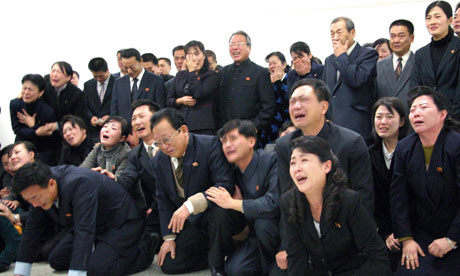
Kathleen Taylor, a neuroscientist and author of Brainwashing, claims that North Korea's control is "far from total" and the collapse of the government could be very rapid (Taylor, 2011). She concludes that "not all the tears are genuine" in mourning for Kim Jong-il, "but nor are they all fake", as he offered stability.

Taylor, Kathleen (2011) Has Kim Jong-il brainwashed North Koreans? [Online]
 http://www.guardian.co.uk/commentisfree/2011/dec/20/kim-jong-il-brainwashed-north-koreans
 [21/12/2011]

Thursday, 22 December 2011

Locked-up memories

Søren Lose's exhibition Relicts, on GDR-era Berlin and collective memories, was closed. 


Excerpt from the Brandts website.

The city of Berlin has been exposed to an unusually high number of historical events and periods which have been decisive for world history. This is what Relicts is all about: Berlin as the setting for the East-West conflict of the cold war years, of Communism and Capitalism; of past and present; regime versus the individual and the concept of Utopia – the notion of an ideal world.The exhibition features works, such as Curtain, 2011, which refers to an interior decoration from the East-German Unity Party’s assembly hall in Palast der Republik in the former GDR. The work is reminiscent of a stage curtain with strong authentic institutional aesthetics but at the same time also anonymous and neutral. Wall, 2011, consisting of reconstructed fragments of the Berlin Wall, embodies the post-war period and the segregation of East and West. After a narrow claustrophobic passage comes the work Flag, 2011, referring to a wall decoration in the aforementioned assembly hall, where one can see black and white photos. They form collages from an era, a particular period, a particular place. The earlier work Monument for Amnesia, 2009, mimics the helter-skelter like fashion of beams found in a construction site. Furthermore, the monumental Ghost, 2011, a reconstruction of a now demolished Lenin monument from 1970, is presented. Lose's fragmented version does not appear glorifying but rather abstract and dystopian. Finally, a number of objects, texts, photos are exhibited in display cases. The reinterpretation of Lose’s sculptures functions as a focal point for the exhibition; the sculptures act as relicts, as historical and situational signifiers for the GDR’s cultural and political ideologies.
Relicts combines several mythological narratives and significant historical buildings to unveil the fictitious,constructed and complex layers of meaning within history.

Brandts [2011] Søren Lose: Relics. [Online]
 http://www.brandts.dk/en/current-exhibitions?option=com_exhibitions&view=article&id=89 [18/12/2011]
e-flux [2011] Søren Lose's Relics. [Online]
 http://www.e-flux.com/announcements/soren-loses-relicts/ [18/12/2011]

Tuesday, 20 December 2011

"Being there but not there": In a Lonely Place


Gregory Crewdson's photographs are "projections of a story" he might have heard, "trying to search beneath the surface of things for an unexpected sense of mystery or something that's secret" [Crewdson in the Loyal Library, 2011]. They capture "the moment of transition between before and after" where he uses twilight for its evocative effects (Crewdson in Helmore, 2006).

Crewdson creates his scenes similarly to a film production using sets. In his interview projected in his exhibition In a Lonely Time, he also speaks about photography of truth and photography of fiction, and how the he merges the two approaches together to create tensions between detachment and intimacy, of "being there but not there" [Crewdson in the Loyal Library, 2011].

Amie Siegel also works on the relationship of documentary and fiction, which I will explore and experiment for my Berliners' project to raise questions about the coexistence of objective and subjective histories. 


Apperture Foundation [2011] Gregory Crewdson. [Online]
 http://www.aperture.org/crewdson/ [19/12/2011]
Fletcher, Kenneth R. (2008) Gregory Crewdson's Epic Effects. [Online]
 http://www.smithsonianmag.com/arts-culture/gregory-crewdson.html# [19/12/2011]
Helmore, Edward (2006) The witching hour. [Online]
 http://www.guardian.co.uk/artanddesign/2006/oct/04/photography [19/12/2011]
Royal Library, The [2011] Gregory Crewdson: In a Lonely Place. [Online]
 http://www.kb.dk/en/dia/udstillinger/crewdson.html [19/12/2011]

Wednesday, 7 December 2011

Delayed images of Palast der Republik


"The building was completely sealed," said Klapsch, "so an utter stillness lay over everything. It was a strange feeling." (Spiegel Online, 2010)

The photographer Thorsten Klapsch deliberately delayed publishing his Palast der Republik photographs until the demolition was completed, to avoid being seen as a "political gesture" (Spiegel Online, 2010).

Spiegel Online (2010) Memories of East Germany's Showcase: New Book Reveals Last Photographs of Berlin's Palast der Republik. [Online] http://www.spiegel.de/international/germany/0,1518,717697,00.html
 [07/12/2011]
Klapsch, Thorsten [2011] Palast der Republik. [Online]
 http://www.thorstenklapsch.de/architecture/palast-der-republik/ [07/12/2011]

Thomas Demand's National Gallery


Thomas Demand creates "a strudel of putting sculptures and photographs and concerns of painting into one" by constructing life-size scenes to photograph. He talks about his exhibition National Gallery which coincides with the anniversaries of the foundation of the Federal Republic of Germany and the opening the Wall, "two pivotal historical events in German history" (This is Tomorrow, 2009). Focusing on the collective memory of Germany, Demand describes his intention to capture "society falling apart and a new one forming" (Demand, in Bound, 2011) through a raided Stasi office. 

Office (1995)
"The tacit nature of this work's Germanness is striking. Imagine walking through an exhibition by Joseph Beuys devoted to the idea of the German nation without having to notice that this is the theme. Impossible. For Gerhard Richter, even more impossible. With Sigmar Polke, Hanne Darboven, Anselm Kiefer, Isa Genzken or Martin Kippenberger--for any of the photographers of the Becher school, too--a reflection on Germany and the traces of its history in the present could only be patent, unavoidable. Is this Demand's lesson: that Germany is now no different from anyplace else, that it is at last a normal, self-confident European nation like any other, unburdened of the memory of its historic tragedies, free of the guilt and resentment that have weighed so heavily on Demand's precursors? Has the effort of Vergangenheitsbewältigung (coming to terms with the past), a process as cumbersome as the word, been completed, or has it simply fizzled out?" (Schwabsky, 2009) 
"...What counts as destruction, and what counts as 'ours,' depends on your viewpoint. In 2002 the German Parliament voted to demolish the Palast der Republik, the grandiose seat of the former East German Parliament... It had been closed since 1990, and the idea was to replace it with a replica of the kaiser's castle that had once occupied the spot. The German Parliament sought to efface part of Berlin's living history in favor of sham historicism. Nothing that belonged to the GDR, according to powerful elements in Germany today, could possibly be 'ours.'" (Schwabsky, 2009) 
Bound, Robert (2011) News Report: Thomas Demand. [Online]
Schwabsky, Barry (2009) A Makeshift World: On Thomas Demand. [Online]
This is Tomorrow (2009) Thomas Demand: Nationalgalerie. [Online]
 [07/12/2011]

Illner, Peer [2011] Demand's Politics of Paper. [Online]
 http://introducingart.com/ISSUE%206/CONCEIVE/Peer%20Illner.html [06/12/2011]
MoMA [2011] Thomas Demand [Online]
 http://www.moma.org/visit/calendar/exhibitions/116 [06/12/2011]
Tate Channel (2008) Meet the Artist: Thomas Demand [Online]
 http://channel.tate.org.uk/media/26519199001 [06/12/2011]

Echo by Bettina Pousttchi


Bettina Pousttchi in 2009 created a photo installation of Palast der Republik on the facade of Temporäre Kunsthalle Berlin, a temporary gallery built where the Palast once stood. In her interview, Pousttchi talks about different times represented by two clocks, and her focus on media reality rather than factual reality. Pousttchi also notes that the Palast had changed its meaning after the fall of the Wall, to symbolising "reunified Germany and Berlin" (Pousttchi, 2009).

Echo (2009)

Pousttchi, Bettina (2009) Bettina Pousttchi: Echo / Temporäre Kunsthalle, Berlin / Interview. [Online]
 http://dai.ly/clCHFt [07/12/2011]
Pousttchi, Bettina (2009) Echo. [Online]
 http://www.pousttchi.com/index.php?option=com_content&view=article&id=94&Itemid=54
 [07/12/2011]

Sunday, 4 December 2011

Christoph Niemann on politics of immigration


"Too often in politics, very complex subjects are being turned into sound bites, so it’s easy to take them apart" (Niemann, in Kaneko & Mouly, 2011).
To provide context and "to help keep things in perspective" on immigration debate in America, Christoph Niemann drew "a parallel between current immigrants and early settlers" for the New Yorker magazine cover. The artist also claimed, "cartoonists, not politicians, should be the ones who condense political discussions into simple images"  (Niemann, in Kaneko & Mouly, 2011).

Kaneko, Mina & Mouly, Françoise (2011) Cover Story: Promised Land. [Online]
 http://www.newyorker.com/online/blogs/culture/2011/11/cover-story-christoph-niemann.html [04/12/2011]

Sanchez, Ray & Steiner, Laura (2011) The New Yorker Thanksgiving Cover Takes On Immigration. [Online] 
http://www.huffingtonpost.com/2011/11/23/the-new-yorker-thanksgiving-cover-takes-on-immigration_n_1109462.html#s495708&title=November_28_2011 [04/12/2011]

Forgotten town of Wünsdorf


In 1994, the population of Wünsdorf decreased from 60,000 to 6,000 as the Russian forces left. The town once hosted the headquarters of Soviet forces in East Germany, and was "a Soviet city in the heart of Germany" (Rüger, 2011) but is now forgotten.
"Walking around the empty rooms, halls and corridors, it takes some imagination to picture this rambling, deserted complex filled with thousands of people... The light falling on the faded pastel-colored walls and on the flaking paint of the doors give this military architecture a nostalgic atmosphere. Here and there, one finds objects left behind, such as a broken piano lying in the dust, its legs removed." (Rüger, 2011)
Rüger, Jörg (2011) Abandoned Soviet Outpost: Glimpses of a Forgotten, Forbidden City.
 [Online] http://www.spiegel.de/international/germany/0,1518,800658,00.html [03/12/2011]