Saturday, 18 February 2012

Finding Lenin


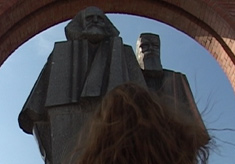
Rick Minnich goes photographing statues of Lenin in his work The Book of Lenins (1993-96), which documents his journey to publish a book about Lenin monuments. Minnich digs up the 60 foot Lenin statue which stood in East Berlin until 1992 and was buried by the new German government (Minnich, 2011).

According to a Spiegel report, Berlin plans to dig up this statue for an exhibition at Spandau Citade, to be displayed among statues of various German era (Crossland, 2010).

Crossland, David (2010) 'Hello Lenin': Berlin to Resurrect its Disgraced Monuments [Online]
 http://www.spiegel.de/international/zeitgeist/0,1518,674218,00.html [16/02/2012]
Minnich, Rick (2011) The Book of Lenins - English version [Online]
 http://www.youtube.com/watch?v=hPoejKEuc_Y [16/02/2012]

Friday, 17 February 2012

Longing for Germany in exile


Margot Honecker, the GDR education minister between 1963 to the autumn of 1989 and the widow of former leader Erich Honecker, "lives with her mind in Germany" reportedly missing forests and mushrooms (Spiegel Online, 2012). 

Spiegel Online (2012) Exile in Chile: Former East German Leader's Wife Is Homesick. [Online]
 http://www.spiegel.de/international/germany/0,1518,813785,00.html [13/02/2012]

Thursday, 16 February 2012

Architecture and memory in films


Brutalität in Stein [Brutality in Stone] (1961) by Alexander Kluge connects history and memory through architecture and speeches by Hitler. Kluge has also directed Abschied von Gestern/Yesterday Girl (1966)  about a an East German refugee trying and failing to get a foothold in West Berlin (Lee, 2010). The film opens with the text "what separates us from yesterday is not a rift but a changed position".


bluaCONVAIR880 (2011) 1 - Abschied von gestern - 1966 - Kluge [Online]
 http://www.youtube.com/watch?v=MMa5TvLpPVA [14/02/2012]
Brody, Richard (2010) The Way West. [Online]
 http://www.newyorker.com/arts/events/revivals/2010/05/24/100524gomo_GOAT_movies_brody [13/02/2012]
dekonstrukcija (2010) Brutalitat in Stein - 1961 - Alexander Kluge & Peter Schamoni. [Online] http://www.youtube.com/watch?v=islUtYwOOx8 [13/02/2012]
Lee, Kevin B. (2010) 993 (129). Abschied von Gestern—(Anita G.) / Yesterday Girl (1966, dir. Alexander Kluge) [Online] http://www.slantmagazine.com/house/2010/01/993-129-abschied-von-gestern%E2%80%94anita-g-yesterday-girl-1966-dir-alexander-kluge/ [14/02/2012]

Wednesday, 15 February 2012

Mitch Epstein in Berlin


"Berliners have chosen to leave traces of the worst of themselves in their architecture and landscape. They have understood what a largely amnesiac America has not: reform relies on memory." [Epstein, in Steidl, 2012]
Winning the Berlin Prize in Arts and Letters in 2008, Mitch Epstein photographed the city's "layered and famously tormented history" by photographing its war and postwar histories and remnants, capturing "unique capacity for the contradictory and surreal. [Epstein, 2012].


Epstein, Mitch [2012] Berlin [Online] http://mitchepstein.net/work/berlin/index.html [09/02/2012]
Steidl [2012] Berlin [Online] http://www.steidlville.com/books/1183-Berlin.html [09/02/2012]

Kippenberger, Susanne [Trans. Hofmann, Jennifer] (2008) Epstein's Berlin [Online] http://mitchepstein.net/writing/reviews/2008_dertagesspiegel.pdf [09/02/2012]
[Online]  [09/02/2012]

Wende Museum


A short clip about the Wende Museum in LA.

ReasonTV (2012) Wende Museum: An Archive of the Cold War.

Tuesday, 14 February 2012

Siegfried Zielinski on Now


Siegfried Zielinski tells us "we can't lose time, because we never possessed it. Time is the only thing, perhaps, we can't possess. We do not have [it] - time has us". He talks about perceptions of time, melancholy and paranoia based on negative theology of time Michael Theunissen, and discusses attempts by Danny Hillas' clock "stretch the now... into eternaty" (Zielinski, 2010). He concludes that we can only "intervene in the rhythm and velocity" and organise it.

Zielinski, Siegfried (2010) Siegfried Zielinski (de) in Atemporality - A Cultural Speed Control? [Online] http://www.transmediale.de/de/siegfried-zielinski-de-atemporality-cultural-speed [13/02/2012]

Monday, 13 February 2012

Memories and revisits


Red Tours (2010) by Joanne Richardson and David Rych focuses on statue parks, museums and theatrical re-enactments of communism - which are "not places of remembering, but ciphers of active forgetting" - in a "docu-fiction" approach with three parts and perspectives, "Red Tours seeks to question the meaning of documentary and the politics of montage" [Richardson, 2012c].

In Transit (2008) by Richardson is "a diary of a journey through space and time, made up of subjective impressions of the present and childhood memories of the past", with a reflecting monologue on "transition, the re-writing of history and the relation between images and memory" [Richardson, 2012a]. In a travelogue highlighting "the problematic nature of travel discourse and its affirmation of cultural superiority by portraying traveling to the East as a journey back in time," Letter to Moldova (2009), also by Richardson, is narrated through ten letters that reflect on the collapse of the Soviet Union, also revealing "the limits of the tourist gaze through the narrator’s own misunderstandings and inherited prejudices" [Richardson, 2012b].

The films Red Tours (in 3 sections), In Transit and Letter to Moldova are available online.

Richardson, Joanne [2012a] In Transit. [Online]
 http://subsol.c3.hu/joanne/video_transit.html [11/02/2012]
Richardson, Joanne [2012b] Letter from Moldova. [Online]
 http://subsol.c3.hu/joanne/video_moldova.html [11/02/2012]
Richardson, Joanne [2012c] Red Tours. [Online]
 http://subsol.c3.hu/joanne/video_redtours.html [11/02/2012]

Hering, Tobias [2012] Joanne Richardson Counter-documentary and making Art Politically. [Online]
http://www.no-w-here.org.uk/index.php?cat=1&subCat=docdetail&id=265 [11/02/2012]

Saturday, 11 February 2012

Registred time®


Tempelhof Collection by Askania, are watches fit with "the robust stainless steel housing" - its "daily usage" design "follows simply and clearly the basic forms of the airport" [Askania, 2012c].

The company that built aircraft instruments also manufactures the series Alexanderplatz, with a hand-winding mechanism and was inspired by "films, spies, the Cold War, tears and joy" [Askania, 2012a], and Quadriga, with concepts of "separation, fear, hope and the reunification of Berlin and Germany" a design for second time zone [Askania, 2012d].

Askania seems to have registered the word Hauptstadtuhr® [Askania, 2012b].

Askania [2012a] Alexanderplatz Collection. [Online] http://www.askania-uhren.de/collection.php?c=6
 [09/02/2012]
Askania [2012b] Hauptstadtuhr® [Online] http://www.askania-uhren.de/ebook/ASKANIA_Katalog_2011/#/10
 [09/02/2012] 
Askania [2012c] Tempelhof Collection. [Online] http://www.askania-uhren.de/collection.php?c=7 [09/02/2012]
Askania [2012d] Quadriga Collection. [Online] http://www.askania-uhren.de/collection.php?c=8 [09/02/2012]

Art, architecture and memories


The Architektonika exhibition illustrate the ways in which artists since the 1960s have reflected "at the cross-roads between art and architecture," with focuses the architectural design of buildings and urban spaces as well as the social and economic implications [Hamburger Bahnhof, 2012]. The artists include Sophie Calle, Nina Fischer & Maroan el Sani, Thomas Florschuetz, Dieter Roth & Björn Roth, Peter Fischli & David Weiss, Thomas Struth and Jeff Wall, whose "works unlock the door on imaginary spaces, stir memories of well-known buildings or revive various visions of the future that may now seem dated" [Hamburger Bahnhof, 2012].

Hamburger Bahnhof [2012] Architektonika [Online] http://www.hamburgerbahnhof.de/exhibition.php?id=34328&lang=en [09/02/2012]

Friday, 10 February 2012

Invisible reservour of the GDR


Filmmaker Phil Collins talks about his installation and short film marxism today (prologue) (2010), new video use! value! exchange! (2010) and teachers he interviewed for his work. Collins highlights melancholy and loss in the former-GDR, where icons or symbols associated to individuals' biographical history fall away and create "invisible  reservour" [Collins, in BFI, 2012].

BFI [2012] Phil Collins. [Online] http://www.bfi.org.uk/live/video/590 [09/02/2012]

Thursday, 9 February 2012

Global contemporary art, since 1989

1989 was an eventful year, with the military crackdown on the pro-democracy protest in Tiananmen Square, the uprising in South Africa prior to the reforms that ended apartheid, the opening of the Berlin Wall following mass protest rallies and emigration in the GDR. 

The Global Contemporary exhibition also highlights shifts in contemporary art in 1989, noting: Xiao Lu who fired a gunshot at her installation Dialogue at the exhibition China/Avant-Garde in Beijing, and providing "voice to a form of contemporary art that was not rooted in western Modernism"; Centre Pompidou in Paris opened the exhibition Magiciens de la Terre, where "for the first time works by artists from countries such as Haiti, India, Madagascar, Australia and South Africa were displayed alongside their counterparts" and including series of works that previously "would have been labeled 'World Art' and confined to ethnographic museums"; and in London, the Other Story focusing on the Afro-Indian artists' contribution to British modern art, curated by Pakistani artist Rasheed Areen, whose Third Text Journal "had already begun rewriting art history from a 'Third World' perspective" in 1987 (ZKM, 2011).

ZKM (2011) Face the Facts: 1989 & the Arts [Online]
 http://www.global-contemporary.de/en/room-of-histories/172-face-the-facts-1989-and-the-arts [09/02/2012]

Images over time

"A millimeter this way or that can make all the difference. The transient quality of light and atmosphere. The passing stray cat, the discarded soda can, the random interplay of people moving through the scene. All these variables give the image its uniqueness. But what’s equally important, I think, is not the individual photograph, but the gradual accretion of images made over an extended period of time by a particular photographer." (Rose, 2011)
Brian Rose, a photographer and author of The Lost Border and In from the Cold, also has an online photographic chronicle which covers the city from 1985 to 2009.

Rose, Brian [2012] Berlin: In from the Cold. [Online]
 http://www.brianrose.com/infromthecold.htm [09/02/2012]
Rose, Brian (2011) New York/Uniquity. [Online]
 http://www.brianrose.com/blog/2011/03/new-yorkuniquity/ [09/02/2012]
Rose, Brian (2010) Berlin: In from the Cold. [Online]
 http://www.blurb.com/books/1235115 [09/02/2012]

Wednesday, 8 February 2012

Architecture and contemporary photography


Envisioning Buildings exhibition, with eight thematic chapters on Restoration, Reanimation, Dwelling, Utopian Visions, Refraction, Deconstruction, Critique, and Systems Analysis [MAK, 2012], reviews discourses and "major conceptual, theoretical, and visual concerns of photography as a specific contemporary art medium" [e-flux, 2012]. The exhibition presents works of camera-based artists who, since the 1980s, "have changed discourses about the production and reception of photography" [e-flux, 2012] along with debates throughout January and April. 


Deutsches Bundesarchiv (2009) File:Bundesarchiv Bild 183-1986-0417-414, Berlin, XI. SED-Parteitag, Eröffnung.jpg [Online] http://en.wikipedia.org/wiki/File:Bundesarchiv_Bild_183-1986-0417-414,_Berlin,_XI._SED-Parteitag,_Er%C3%B6ffnung.jpg [08/02/2012]
Deutsches Bundesarchiv (2008) File:Bundesarchiv Bild 183-R0821-400, Berlin, Palast der Republik.jpg. [Online]
http://en.wikipedia.org/wiki/File:Bundesarchiv_Bild_183-R0821-400%2C_Berlin%2C_Palast_der_Republik.jpg [08/02/2012]

e-flux [2012] Envisioning Buildings: reflecting architecture in contemporary art photography. [Online] 
http://www.e-flux.com/announcements/envisioning-buildings-reflecting-architecture-in-contemporary-art-photography/ [08/02/2012]
MAK [2012] Envisioning Buildings: Reflecting Architecture in Contemporary Art Photography. [Online] http://www.mak.at/e/jetzt/f_jetzt.htm [08/02/2012]

A memorial in Tallinn

"Memory has to belong to people and not the government" (Norman, in Tulca Festival, 2011)
After-War by Kristina Norman is "a case study of the conflict" [Norman, 2012] surrounding the removal of a monument in Tallinn, in 2007. Although for the Russian residents the statue of a solder from 1947 symbolized victory over Nazism and positive identity, it signified the following Soviet occupation and political repression for many Estonians [Norman, 2012]. The Estonian government relocates the Bronze Soldier from central Tallinn to a military cemetery 2.5 km away, in a move according to Norman, to distance the Russian minority community from the majority Estonians, two "memory collectives" (Norman, in Tulca Festival, 2011).

On the Victory Day two years after these events, "I brought a full-size golden replica of the sculpture to its former location, which still remains a sacred place, although the government claims it is now profane. With this act I visualized my argument that although the upstaged problems surrounding the Bronze Soldier and the drama of its relocation are now neatly tucked away and removed from the public space, they nevertheless continue to exist and they should be dealt with" [Norman, 2012].

Norman, Kristina [2012] After-War. [Online]  http://www.cca.ee/?id=11280#Kristinatekst  [08/02/2012]
Tulca Festival (2011) Kristina Norman Tulca 2011. [Online] http://vimeo.com/30189884 [08/02/2012]

Higgie, Jennifer (2010) 10th Baltic Triennial. [Online]
 http://www.frieze.com/issue/article/10th_baltic_triennial/ [08/02/2012]

Tuesday, 7 February 2012

Sediments of the Wall


From top: How long is now; Mit Sicherheit keine Freiheit; Die Grenze verläuft nicht zwischen oben und unten, sondern zwischen dir und mir; and When you're strange
"The series of four panoramic views of the Berlin wall form their own group of works. Walls as a symbol for separation and boundary setting, and also as an artistic element, have formed a common thread in Mona Breede’s works for many years now. In Berlin the wall is inextricably linked to the history of Germany and the few remains are traded today as relics for tourists or are accordingly set in a new context.In the artist’s group of works the Berlin Wall is merely a reminiscence, a historical transparency and resonating space for further reflections on walls and the conflict potential that can arise in a society confronted with a wide range of social upheavals. In this way, the work “Mit Sicherheit keine Freiheit” (Freedom cannot be secured), a slogan taken from an advertising poster from the organisation Aktion Mensch, broaches the subject of a conflict in our society in which an increase in surveillance can result in a danger to our freedom." [ArtDaily.com, 2012]

ArtDaily.com [2012] Berlin: Sediments of a City by Mona Breede at Galerie Dittmar in Berlin. [Online]
 http://www.artdaily.com/index.asp?int_sec=11&int_new=43664&int_modo=1 [06/02/2012]
Galerie Dittmar [2012] Mona Breede II [Online]
http://www.galerie-dittmar.de/artist/breede2/ [06/02/2012]

Monday, 6 February 2012

Joshua Lutz and borderlands


Joshua Lutz's series The Border focuses on the lives by the US-Mexico border. Below are the photographs from his work Meadowlands.

"As fond as I am of documentary photography I think that we have come to a point in the history of photography where we need to think about photographs more in the way we do paintings and less in the traditional sense of a document. For that reason I generally don’t caption or title my work and I try not to say too much about the process of making my work. I like the ideas of possibilities and the more I talk about them the less experiences people can have with looking at them." (Lutz in Hulin, 2008)


"One of my first assignments was to travel the Texas-Mexico border. It came as a welcome relief from the Meadowlands project I had been struggling with. There was something really nice about the massiveness of this task, and the impossibility of coming to any conclusions on a place I knew so little about." [Lutz, 2012]

Hulin, Rache (2008) Shoot! Interview: Joshua Lutz and The Meadowlands. [Online] 
Lutz, Joshua [2012] The Border. [Online]

Last Call by Cathrin Schulz


Schulz, Catharin [2012] Last Call. [Online] http://virtual-exhibition.deconarch.com/cathrinschulz-lastcall/ [06/02/2012]

Sunday, 5 February 2012

Lenin tour 2009


"l show Lenin to my contemporaries. And the 21st century to Lenin. Who will explain it to him?" (Herz, 2009: 78)
The city council in Dresden decided to remove its Lenin statue, a in a move to move away from the GDR past. In 2004, Rudolf Herz from a stonemason borrowed the decommissioned torso of Lenin and drove around Europe with two other anonymous statues. In the evening the truck would stop in cities asking artists, sociologists and economists to give their views on Lenin in the twenty-first century. The tour was filmed and photographed.
"I am searching for images, I am exploring the life in our globalised, capitalist world, am enquiring after memories and current views of utopia... Our journey takes us through contemporary everyday life, high-tech zones, and desolate industrial areas in the East and the West. A change of locale engenders a change of references and perspectives, Prage is not Zurich, Dresden is not Rome."  (Herz, in Museum Ludwig, 2012)

Herz, Rudolf (2009) Lenin w Trasie / Rudolf Herz. Lenin on Tour. [Online]
 http://www.erasedwalls.eu/erasedwalls.pdf [04/02/2012]
Museum Ludwig (2012) Rudolf Herz. Lenin on tour. [Online]
 http://www.museenkoeln.de/museum-ludwig/default.asp?s=2665 [04/02/2012]

Artimageslibrary (2010) Rudolph Herz Dachau Museumsbil
 http://www.flickr.com/photos/artimageslibrary/4954051621/ [04/02/2012]

Friday, 3 February 2012

Remembering is "re-remembering"

"Memory is endlessly creative, and at one level it functions just as imagination does... endlessly rewriting the self." (Fernyhough, 2012)
Memories are constructed when needed "according to the demands of the present" claims Fernyhough (2010). And as a result they are "soberingly fragile" (Fernyhough, 2010). He argues that memories are "nifty multimedia collages of how things were" which are mental reconstructions and are "shaped by how things are now" (Fernyhough, 2012). 
"If the experimental conditions are set up correctly, it turns out to be rather simple to give people memories for events that never actually happened. These recollections can often be very vivid... [Kim Wade at the University of Warwick] colluded with the parents of her student participants to get photos from the undergraduates' childhoods, and to ascertain whether certain events, such as a ride in a hot-air balloon, had ever happened. She then doctored some of the images to show the participant's childhood face in one of these never-experienced contexts, such as the basket of a hot-air balloon in flight. Two weeks after they were shown the pictures, about half of the participants 'remembered' the childhood balloon ride, producing some strikingly vivid descriptions, and many showed surprise when they heard that the event had never occurred. In the realms of memory, the fact that it is vivid doesn't guarantee that it really happened." (Fernyhough, 2012)
"Remembering is always re-remembering" (Fernyhough, 2012) and it's the the assembly of memory and the resulting editing process that may distort how things actually were. He also notes that "contamination by visual images, such as photographs and video" may alter our memories and "when we look back into the past, we are always doing so through a prism of intervening selves".

Memories are "curiously susceptible to distortion, and often not nearly as reliable as we would like", however, knowing uncertainties in remembering makes memory into a kind of storytelling which "contain a rather wonderful kind of truth" (Fernyhough, 2010).

Fernyhough, Charles (2012) The story of the self. [Online]
 http://www.guardian.co.uk/lifeandstyle/2012/jan/13/our-memories-tell-our-story [03/02/2012] 
Fernyhough, Charles (2010) Ideas for modern living: memory. [Online]
 http://www.guardian.co.uk/lifeandstyle/2010/aug/22/charles-fernyhough-school-life-memory [03/02/2012]

Thursday, 2 February 2012

Errol Morris on truth and reenactment

The documentary film director Errol Morris claims that he "can't know for sure" whether an interviewee is telling the truth or not, and further notes how a reenactment can create "a kind of strange abstract world around a photograph" for his documentary films.

Morris claims that there is a line between the "mistaken idea about reenactments in general that you're showing somebody what really happened" and "a little world where people can think about a problem or a set of questions". which gets "the audience to think about certain questions about who was where, when, and what did they see" and "forces you into a position where you are asked to think about something or to think about something the way I am thinking about it".

"If the idea is entering history through a photograph," he notes on his work Standard Operating Procedure, "if you're somehow going through the surface of that photograph and going beyond, the reenactments help you to do that". He slows everything down, "almost, but not quite, to that instant of photography and ask you to reflect, to listen to what people are saying about that moment when the photograph was taken and the circumstances under which it was taken."

He argues it's simply wrong "that you can only talk about the real world in one way, that journalism has to be conducted according to a certain set of styles"  and claims "the pursuit of truth, the underlying reality of what happened, and anything which is in service of that is fair game."
"The photographs that fascinate me the most are the photographs that were posed, where they created some odd tableau vivant for the camera. It's almost as if in some strange way the soldiers were reenacting the essence of the war on a very private level. I guess that's the sick reading of it."
In the following interview he argues against the notion of subjective and varying truths, that there is truth based "in the real world" different to that of a personal opinion.

"What is true? What is false? What really happened?"


Columbia Journalism Review (2008) Recovering Reality: A Conversation with Errol Morris. [Online]
Spiegel Online (2008) Interview with Abu Ghraib Documentary Director Errol Morris: 'I'd Like to See a Lot of People in the Administration Indicted'. [Online]