Friday, 20 April 2012

Framework of time


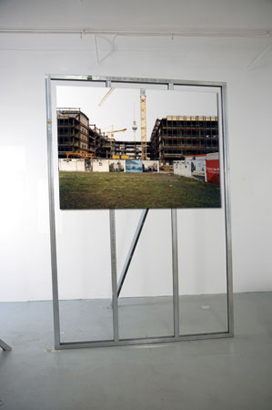
Bettina Pousttchi speaks about her installation Framework at Schirn Kunsthalle in frankfurt.

Schirn Kunsthalle (2012) Bettina.Pousttchi. Framework (Trailer) [Online] http://www.youtube.com/watch?v=DcEqOWGFPtk&list=UUluPrWhowqErgMLkMNTVwAw&index=1&feature=plcp [20/04/2012]
Schirn Kunsthalle (2012) Bettina.Pousttchi. Framework [Online]
 http://www.schirn-magazin.de/kontext/bettina-pousttchi-framework/ [20/04/2012]

Tuesday, 17 April 2012

Creating memories

Maryanne Garry and Matthew P. Gerrie show that memories can be altered by photographs, creating false memories, in their "false-memory implantation" research (Garry & Gerrie, 2005).

Garry, Maryanne & Gerrie, Matthew P. (2005) When Photographs Create False Memories [Online]
 http://cdp.sagepub.com/content/14/6/321.abstract [16/04/2012]

Sunday, 15 April 2012

Psychology of art


Paul Bloom from MIT talks about why we prefer original over reproduced artworks, and what values we enjoy within them.

Bloom, Paul (2011) The Origins of Pleasure. [Online]
 http://www.youtube.com/watch?v=RPicL1AWrs8 [15/04/2012]

Saturday, 14 April 2012

A Conversation from the Post-Communist Universe

A discussion between Simon Rees, Diana Artus and Jan Serych.

Apexart (2009) Three Moons of Jupiter:A Conversation from the Post-Communist Universe. [Online]
 http://www.apexart.org/events/reestalk.php [14/04/2012]
Frieze (2009) Nostalgia: What’s the Role of the Past in Fashioning the Future? [Online]
 http://www.friezefoundation.org/talks/detail/nostalgia_whats_the_role_of_the_past_in_fashioning_the_future/ [14/04/2012]

Friday, 13 April 2012

Collective memory and potential of monuments

The panel at a Frieze Talk, Mark Godfrey (Curator, Tate Modern) Edit András (Art historian and critic) Marko Luliç (Artist) Chair: Simon Rees (Curator, Contemporary Art Centre, Vilnius), addressed "the legacies and potential of monuments and public sculptures... and collective memory with which these objects interact" (Frieze Foundation, 2009).

Frieze Foundation (2009) CAC Vilnius presents: Memories, Monoliths, Monsters? [Online]
 http://www.friezefoundation.org/talks/detail/cac_vilnius_presents_memories_monoliths_monsters/ [13/04/2012]

Tuesday, 3 April 2012

Margot Honecker defends East Germany


Margot Honecker notes that "it is a tragedy that this land [East Germany] no longer exists" and that "there was no need for them to climb over the wall, to pay for this stupidity with their lives" as the protests in 1989 was driven by the GDR's enemies (Connolly, 2012).

ARD-Dokumentation: Der Sturz - Honeckers Ende [Online]
 http://www.youtube.com/watch?v=AmhXh61N-SI [03/04/2012]
Connolly, Kate (2012) Margot Honecker defends East German dictatorship [Online]
 http://www.guardian.co.uk/world/2012/apr/02/margot-honecker-east-germany-interview [03/04/2012]

Poems animated


Animated poems by Billy Collins, Forgetfulness and Budapest. Melancholic to different degrees but both poems reflect upon personal memories, thoughts and longing.

I've been busy writing up my PhD proposal on memories of the divide in Berlin, in Stuttgart, and not been able to record my thoughts or ideas as much... 


Collins, Billy (2012) Everyday moments, caught in time [Online]

Monday, 5 March 2012

Eastern times in transition


"While there's still time, I would like to make a grand journey across Eastern Europe. To Russia, Poland, Hungary, Czechoslovakia, the former East Germany, and back to Belgium." (Akerman, in Anderson, 2009)
Akerman documents her journey from the end of summer to deepest winter, for D'Est/From the East reconstructing "her impressions in the manner of a documentary on the border of fiction" [Icarus Films, 2012].

Akerman, Chantal (2008) Chantal Akerman: Moving through Time and Space. [Online]
 http://mitworld.mit.edu/video/592 [04/03/2012]
Anderson, Melissa (2009) Eastern Promisses [Online]
http://artforum.com/film/id=23865 [04/03/2012]
Icarus Films [2012] From The East D'Est [Online]
 http://homevideo.icarusfilms.com/new2003/from.html [04/03/2012]

Friday, 2 March 2012

Aftermath


Berlin 1031, 2009

Berlin 423, 2006

Palast Hotel Berlin 274, 2001

Three images of Berlin from Jörn Vanhöfen's book Aftermath

Artnet.com [2012] Berlin # 1031 [Online]

Robert Mann Gallery [2012] Berlin 423, 2006 [Online]
Robert Mann Gallery [2012] Palast Hotel Berlin 274, 2001 [Online]

Thursday, 1 March 2012

November, 1990

Excerpts from Brian Rose's journal, who captured images of East/West European borders. In 1990 he was on his way back to Berlin to photograph the aftermath and what once was the Wall.

Rose, Brian (1990) Journal Excerpts: November, 1990 [Online]
 http://www.brianrose.com/lostborder/journal.htm [26/02/2012]

Wednesday, 29 February 2012

Memories back in the USSR


Boris Mikhailov, born in Ukraine made his series At Dusk in his hometown of Kharkov following the collapse of the USSR, using twilight to "record a society in transition and to evoke childhood memories" [V&A, 2012]. The monochrome photographs tinted blue refer to the 'blue hour' of twilight. The artist had been developing "a visual cosmos" since 1960s when photography was controlled by strict rules, which Mikhailov turned away from and focused on the private and the personal (Barbara Gross galerie, 2007). 


Overlapping motifs and leading multifaceted interpretations, Mikhailov hung social issues and living situations are disguised. The montage of images of opposing meanings reveal "contradictions and ambivalences in Russia in general" with layered "motifs featuring shots of surfaces that have been exploded or are crumbling is symptomatic for the collapse of Soviet society" (Barbara Gross galerie, 2007).


Looking back, Mikhailov notes that it was a period of "hidden meanings and coded messages in all genres... Given the scarcity of real news, everyone was on the lookout for the smallest piece of new information, hoping to uncover a secret or read between the lines. Encryption was the only way to explore forbidden subjects such as politics, religion, nudity" (Mikhailov, in Fredrickson, 2008).


Barbara Gross Galerie (2007) "Sandwich" [Online]
Fredrickson, Lori (2008) Boris Mikhailov's Dual Reality [Online]
V&A [2012] Photographs by Boris Mikhailov. [Online]

Tuesday, 28 February 2012

Beyond singular point of view


Isidro Ramirez explores limitations in photography, that it can only see the surface, by layering photographs from four sides of East Berlin buildings. Ramirez attempts to view "a place in its totality" and questions, "would I know more if I saw this building from all different angles?" (Ramirez, in TroikaEditions, 2009)


Laurent Dequick similarly layers multiple photographs, as he argues there is no single frame of photograph that could capture "the streets, the lights, the sounds, the traffic, the swarms of people, the mixture of smells" in post-Wall Berlin (Dequick, in Weidmann, 2012).


Isidroramirez.com [2012] FOUR CORNERS. [Online]
 http://www.isidroramirez.com/fourcorners/fourc.html [25/02/2012]
TroikaEditions (2009) Isidro Ramirez on photographing the whole building [Online]
 http://www.youtube.com/watch?v=imIhMbcIK3c [25/02/2012]
Weidmann, Ericka [2012] EXHIBITION: A Fresh Face for the Galerie Claude Samuel. [Online]
 http://lalettredelaphotographie.com/archives/by_date/2012-02-10/5496/a-fresh-face-for-the-galerie-claude-samuel [25/02/2012]


Projections.fr [2012] BERLIN POLARITÄT: Photographies de Laurent Dequick [Online]
 http://www.projections.fr/regards/berlin_polaritat/accueil.html [25/02/2012]

Monday, 27 February 2012

Berlin elucidated


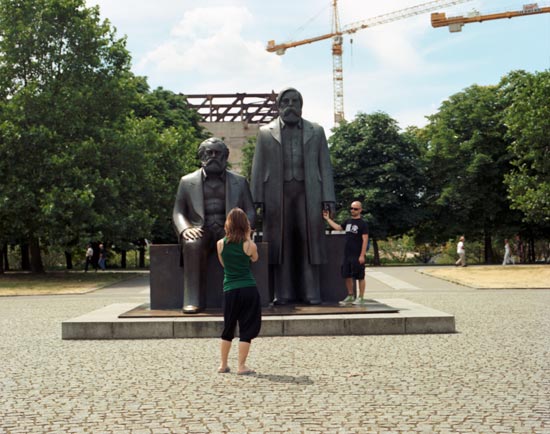
Photographer Warren Naidich notes that the opening of the Berlin Wall delivered immediate and long-term consequences: "this once important monument depicting two famous philosophical figures has become nothing more than a backdrop for staged photographs by tourists visiting the city elucidating the ideological changes that have resulted form the fall of Communism and the rise of Capitalism" [Neidich, 2012b]. 

Neidich created a series Marx and Engels (2008-09) from photographs he took between 2008 and 2009. Installed in 1986, the Marx and Engels statue has moved about in Alexanderplatz, and can be seen in his series as a tourist backdrop with the disappearing Palast der Republik. He has also created an installation Undoing the Palast der Republik (2007) capturing the Palast being demolished. 


For the Black Square, Triangle, Circle Fragment 2 (2007), which he describes "a series of performative sculptures that reenact the memory of itself as a fragment of a once enacted performative space," Neidich states that "altogether the undoing of the Palast is metonymic for the process of undoing of Architecture as a cultural act. The Palast was not demolished but is being slowly and meticulously taken apart. The cultural undoing, assimilation and subsuming of the communist block by Capitalism after the fall of the Berlin is re-enacted in this work" [Neidich, 2012a].

Neidich, Warren [2012a] Black Square, Triangle, Circle Fragment 2 (2007) [Online]
 http://www.warrenneidich.com/black-square-triangle-circle-fragment-2-4/ [17/02/2012]
Neidich, Warren [2012b] Marx and Engels (2008-09) [Online]
 http://www.warrenneidich.com/marx-and-engels-2008-09/  [17/02/2012]
Neidich, Warren [2012c] Undoing the Palast der Republik (2007) [Online]
 http://www.warrenneidich.com/undoing-the-palast-der-republik/ [17/02/2012]

Saturday, 25 February 2012

European borders


Border, an exhibition of works by Martin Sigmund, is on display until 28 March in Stuttgart. The photographs show a collection of deserted border checkpoints across Europe made redundant by the Schengen Agreement, and express a sense of the past and nostalgia.


I wondered if the description "D-DDR" on the label for the Dreilinden Checkpoint Bravo photo was intentional (as opposed to saying "BRD-DDR"). Although it made me think about the FRG-GDR relationship, the photographer later told me that he chose to use D and DDR based on car national identification stickers, which I think is appropriate as these checkpoints were inspecting cars crossing the border.

Photo Presse (2012) Martin Sigmund. Border [Online]
 http://www.photopresse.de/content/view/10162/52/ [15/02/2012]
Sigmund, Martin [2012] Border [Online]
http://www.martinsigmund.com/ [15/02/2012]
TREFFPUNKT Rotebühlplatz (2012) Martin Sigmund | Border [Online]
 http://www.treffpunkt-rotebuehlplatz.de/ausstellungen/ [15/02/2012]

Friday, 24 February 2012

Reynolds' time


"The building's dazzling public lobby, surrounded by several tiers, was once the center of social life in East Berlin with thousands of sparkling lamps filling the open space of the lobby's grand staircase. Many Berliners recall attending a play in one of the theaters or dancing the night away in the underground disco, others seeing their first rock concert, or being married. Later, thousands of citizens demonstrated against the planned demolition and hoped the building would be protected against historical censorship, but alas, one day, twenty years after the fall of the Berlin wall, the Palace completely disappeared." (Artstudio Reynolds, 2011a) 
Reynold Reynolds' film Letzter Tag der Republik / Last Day of the Republic (2010) captures the destruction of the Palast, opened in 1976 as "an emblem of the future" of East Germany [Reynold-reynolds.com, 2012a]. Reynolds has also produced Stadtplan (2004),  "a personal and hypnotic, split-screen and time-lapsed trip through Berlin," using the divide between the images to signify Germany's divide (Artstudio Reynolds, 2011b).


The Secrets Trilogy, composed of Secret Life (2008), Secret Machine (2009) and Six Easy Pieces (2010) (HKW, 2011), questions time and space. For the final production of Six Easy Pieces, Reynolds moved his entire studio into the Haus der Kulturen der Welt producing the film live before the audience, combining filming with performance [Node Berlin, 2012].


Artstudio Reynolds (2011a) Letzter Tag der Republik/ Last Day of the RepublicGermany (2010) [Online]
 http://vimeo.com/26032322 [17/02/2012]
Artstudio Reynolds (2011b) Stadtplan. [Online]
 http://vimeo.com/16743958 [19/02/2012]
HKW (2011) Labor Berlin 4: Reynold Reynolds: The Secrets Trilogy. [Online]
 http://www.hkw.de/en/programm/2011/labor_berlin_2011/veranstaltungen_53773/Veranstaltungsdetail_53537.php [17/02/2012]
Node Berlin [2012] Labor No. 4, Reynold Reynolds. [Online]
 http://nodeberlin.com/archive/labor-no.-4--reynold-reynolds [17/02/2012]

Reynold-reynolds.com [2012a] Letzter Tag der Republik (Last Day of the Republic) [Online]
 http://www.reynold-reynolds.com/pages/documentary.htm [17/02/2012]
Reynold-reynolds.com [2012] Secret Life. [Online]
 http://www.reynold-reynolds.com/pages/secret_life.htm [19/02/2012]
Reynold-reynolds.com [2012] Secret Machine. [Online]
 http://www.reynold-reynolds.com/pages/secret_machine.htm [19/02/2012]
Reynold-reynolds.com [2012] Six Easy Pieces. [Online]
 http://www.reynold-reynolds.com/pages/six-easy-pieces.htm [19/02/2012]
transmediale.de [2012] [Online] http://www.transmediale.de/content/letzter-tag-der-republik [17/02/2012]

Thursday, 23 February 2012

Transition and time over Berlin


In David Lamelas' silent film Time As Activity: Berlin (1998) shot from a helicopter flying over the city from West to East, the viewers witness large scale rebuilding of the city. The work "prompts a meditative reverie on the passage of time and how history is formed" and combines "the personal, individual histories of betrayal, loss and families torn apart to the more recent formation of a new Germany bringing its own set of problems" and leading us to question "who decides what remains" (Holt, 2005a). The film also brings into question "the significance of the notated time" as it allows "loose formulation to be transposed across time and space" creating different resonant with each location and becomes "a profound reflection on the passing of time, that transcends individual experience and incorporates the great swathes of historical change" (Holt, 2005b).

Holt, Jacqueline (2005a) David Lamelas. [Online] 
 http://www.luxonline.org.uk/artists/david_lamelas/essay(1).html [22/02/2012]
Holt, Jacqueline (2005b) David Lamelas. [Online] 
 http://www.luxonline.org.uk/artists/david_lamelas/essay(4).html [22/02/2012]
Lux Online (2005) Time as Activity (Berlin). [Online] 
 http://www.luxonline.org.uk/artists/david_lamelas/berlin_time_as_activity.html [22/02/2012]

Comer, Stuart (2005) David Lamelas: The Limits of Documentary [Online]
http://www.luxonline.org.uk/articles/the_limits_of_documentary(1).html [22/02/2012]
Tate Channel (2008) TateShots: David Lamelas [Online]
 http://channel.tate.org.uk/media/26515690001 [22/02/2012]

Wednesday, 22 February 2012

Eve Sussman, in the flow of time


Thinking back on exhibitions at Haunch of Venison... the film whiteonwhite:algorithmicnoir by Eve Sussman is an "expedition to unravel utopian promise". The film was being edited in real time by a software from 2637 video clips, creating "the narrative through unexpected juxtapositions" of endless and never repeated scenes (Haunch of Venison London, 2011).


Sussman with Angela Christlieb created How to tell the future from the past v.2, shot during a 72 hour train journey across Central Asia. The three screen video work conceptualises passing time with "the manifestation of humanity as the constant, as daily life runs backwards and forwards simultaneously" [Haunch of Venison, 2012]. Wintergarden by Sussman and Simon Lee focus on and merges Soviet windows in 3 channel video showing the shift of time. The curator and director of HoV Nina Miall calls it "a meditation on how the current inhabitants of old Soviet housing blocks today assert their individuality... by personalizing the decaying totalitarian balconies" (Redstone, 2011).


Haunch of Venison [2012] London: Eve Sussman | Rufus Corporation [Online]
 http://haunchofvenison.com/exhibitions/past/2011/eve_sussman_rufus_corporation/ [21/02/2012]
Haunch of Venison London (2011) Eve Sussman | Rufus Corporation  whiteonwhite:algorithmicnoir. [Information sheet]. p.1.
Redstone, Elias (2011) London Underground | Urban Narratives. [Online]
 http://tmagazine.blogs.nytimes.com/2011/04/28/london-underground-urban-narratives/ [21/02/2012]
rufus corporation [2012] How to tell the future from the past v.2 [Online]

Loop [2012] Eve Sussman & Simon Lee [Online]
 http://www.loop-barcelona.com/eng/fitxa.php?id=496 [21/02/2012]

Tuesday, 21 February 2012

Fictional reality by Nicolas Provost


"The film starts with an off-screen dialogue between a young couple, ready to embark on a romantic adventure. What happens next? Provost will tell their story by using nothing but stock footage exterior shots of a Boeing plane, flying towards a sunset." [Moving Stories, 2012]
Nicolas Provost created Untitled (2010) entirely from stock footage. The artist shows that prefabricated clips often used by filmmakers to cut cost can bring aesthetic and cinematic values and narrate a story [Moving Stories, 2012]. 


Provost has also produced Stardust [above], second part of the trilogy where Provost explores the boundaries between fiction and reality, "by using cinematographic and narrative codes from the Hollywood film language" [Nicolasprovost.com, 2012a], as well as Storyteller [below], in which the artist "manoeuvres and influences the interpretation of images, carefully balancing between the figurative and the abstract" [Nicolasprovost.com, 2012].


Moving Stories [2012] Untitled. [Online]
Nicolasprovost.com [2012a] Stardust [Online]
Nicolasprovost.com [2012b] Storyteller [Online]

Monday, 20 February 2012

DOUBT


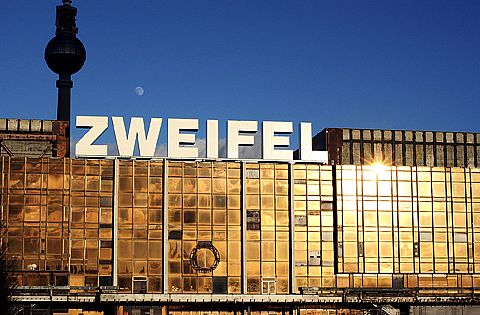
Palast der Republik was abandoned for 15 years after the fall of the GDR. Monitoring debates about the future of the building, Lars Ø Ramberg developed the idea where doubt has become a proof of democracy, and to symbolize this phenomenon in 2005 he created Palast des Zweifels – the Palace of Doubt [Larsramberg.de, 2012]. Ramberg had been collecting newspaper articles with the word "Zweifel" (doubt) in the headline, and printed  Zweifel Allgemeine with the headlines of these articles [Node Berlin, 2012].


Larsramberg.de [2012] Palast des Zweifels [Online]
http://www.larsramberg.de/1/viewentry/3890 [17/02/2012]
Node Berlin [2012] Zweifel Allgemeine [Online]
 http://nodeberlin.com/archive/zweifel-allgemeine [17/02/2012]

Saturday, 18 February 2012

Finding Lenin


Rick Minnich goes photographing statues of Lenin in his work The Book of Lenins (1993-96), which documents his journey to publish a book about Lenin monuments. Minnich digs up the 60 foot Lenin statue which stood in East Berlin until 1992 and was buried by the new German government (Minnich, 2011).

According to a Spiegel report, Berlin plans to dig up this statue for an exhibition at Spandau Citade, to be displayed among statues of various German era (Crossland, 2010).

Crossland, David (2010) 'Hello Lenin': Berlin to Resurrect its Disgraced Monuments [Online]
 http://www.spiegel.de/international/zeitgeist/0,1518,674218,00.html [16/02/2012]
Minnich, Rick (2011) The Book of Lenins - English version [Online]
 http://www.youtube.com/watch?v=hPoejKEuc_Y [16/02/2012]