Thursday, 11 March 2010

Critical Evaluation for Collaborative Unit

"No one can expect the spirit of involvement and partnership to flourish without an abundance of information available", stated Semler (1999, p.128), as he claimed that "advantages of openness and truthfulness far outweigh the disadvantages" of arguments and demands based on those information. The owner of Semco, who introduced participatory management to his company, has managed to increase production by encouraging individuals to actively engage in decision making and to determine the course of the organisation.
"I don’t feel like participating and collaboration is fundamental. But I do feel like it’s certainly one of the more exciting parts of the digital age." [Frank, in Glei, 2010]
When asked how collaboration influenced his work, Frank stated collaboration was a characteristic of creativity, even though he did not see it as crucial process. Frank also claimed that by carrying out work with others, in a mass-collaboration based on internet and his audience, he realised the opportunity "to explore this creative process that normally all happens internally, in a different way where you release work, and then you allow the frameworks that emerge from the way people respond to the work as some kind of feedback cycle" [Glei, 2010].


I have set up the picture book group based on my knowledge and experiences of collaboratively running projects at Summerhill School and other organisations: the philosophy was that every member had equal voice, information was to be open, and everyone shared responsibilities. The idea of collaboration linked well with the opening of the Berlin Wall and the unification of Germany, that a lot can be achieved when people work together, and I wanted to illustrate that people can respect individual differences and coexist. I had similar ideas to use the photographs and illustrations of the Berlin Wall to narrate a story of Berliners previously, and this was an opportunity to materialise this idea.

I began to investigate effective ways translating facts into stories, narrating it effectively and to express emotions of Berliners. The outcome of this research lead to using animals to portray human behaviour, to both enable the audience to relate and engage, and to objectify human behaviour. Bears, the Berlin mascot, was to symbolise Berliners. After discussions in December 2009 with with the author Albert Lamb, the idea of two bears, one from East and the other from West, were to meet in Berlin came about. The bear from the former-East Berlin had overslept for 20 years, and was not aware of the opening of the Berlin Wall (as in the film Good Bye Lenin!) or the German unification, and the two bears were to explore the new city without the divide, as well as having to face their new neighbours who had diverse values and opinion. 

Since January 2010, I have placed file-sharing programs such as Dropbox and Google Docs to the hub of the project, as well as Skype, emails and text-messaging to establish frequent communication. To an extent, these tools have served their purpose, however, communication was not as effective as originally thought, and the project is still far from completion.

There are various elements that explain this problem. The group formed and progressed largely based on people I have worked with previous to this project, and most importantly, how well I knew them - in other words, how well I could communicate with the members. I have known Albert and Andrew for over 15 years, and brain-storming meetings I had between December 2009 and January 2010 effectively produced numerous ideas for the picture book story. I have also worked with Terry, Ting and Tink on several projects in a school community in the past, and I feel we are able to communicate. In contrast, my communication with Lee was not as fluent, even though we have been talking in class and socially, and this possibly is related to joining the already existing group that is used to working with one another [Navone, 2010]. There were frequent miscommunication between me and Lee, and I have acknowledged its impact on the rest of the group and their work throughout the process. 

In retrospect, this seems like an easy mistake which could have been prevented. Throughout the course, my tutor could not have emphasised enough about communication. I was aware of the importance of communication when Lee asked me if I wanted to collaborate with him on this project. I could not have known our character or working styles, without actually going through the collaborative process with him. Some ideas Lee presented at group discussions, I had not been informed previously - I expect Lee had similar kinds of shock from ideas I had expressed. This is not to say that I expect all ideas to be consulted before being made public. 
"The fall of the wall was a European earthquake, but in Washington and Moscow, miscommunication and suspicion meant the leaders were badly out of sync. While Soviet leader Mikhail Gorbachev was eager to move on cutting nuclear arsenals, President George H.W. Bush was cautious and uncertain, and a promising moment slipped away." (Hoffman, 2009)
The picture book collaboration, with its philosophy of participation, is of course different from the Cold War politics of control, but this issue of inter-personal relation is a clear symbol of miscommunication. The structure of communication was based around me. For example, a group meeting on Skype would not take place unless I organised the time and attended, and even though I had shared everyone's email and Skype contacts, communication between other members were limited [fig.1]. This caused conflict with the philosophy of sharing control and tasks, as I tried to remain an equal member of the team and chose not to assert power over other artists.

[fig.1] Group structure. The numbers show the chronicle
order of contacts that were made regarding the project.

Some of these obstacles I have mentioned can be traced to the original intention of mine to combine two projects - the picture book production and the MADA Collaborative unit - together, and its correlation: the former aims to produce and latter research and explore collaborative processes. Even though my initial idea of producing (or at least starting) a picture book through collaboration seemed a logical process, I currently see the two projects as not conflicting but of diverse nature. Through observation, I have noticed that Lee did not have the time or the opportunity to get to know other artists fully, and the project relied on communication between me and Lee. Of course, "it is always easier to identify... in retrospect than as you are living through it" (Hoffman, 2009) and I was unable to perceive such situation when Lee first talked to me about collaborating on a project in January. 
"I usually try to say ‘make it as quickly and faithfully as possible.’ ‘Quickly’ and ‘faithfully’ kind of pull in opposite directions. I find that that’s a nice tension to work in – try and get it out as fast as possible, but don’t take shortcuts just for time. Try to stay true to the original concept." [Frank, in Glei, 2010]
The time element as a result of my communication issues added strain on the group, although I have decided to continue the project in the shape closer to what I originally intended outside the course. I had often spoken of coexisting with differences of opinion, however, working together with diverse characters and working styles have been difficult. This also is one of the problems of unified Germany, which has long suffered from cultural and psychological division after the opening of the Berlin Wall and the unification (MSM/CGH, 2006). A situation where "tongue-in-cheek calls for the Wall to be rebuilt come from both sides" (MSM/CGH, 2006) of the former German border illustrates that collaborative work requires time and interactive trials and errors [Welsh et al, 2010].

Verena Postweiler

An image created by Verena Postweiler illustrates how the process of German unification, attempting to combine two diverse cultures and sets of values, was rushed, with its main aim being unity itself. The result of this rapid unification is that groups that share similar values on both sides of the Iron Curtain feel mistreated and there is also growing mistrust [Welsh et al, 2010]. With their shared goals of unification being achieved, former neighbours still feel alienated from one another (Mitchell, 2000).

Weiss & Hughs (2005) claim avoiding conflicts should not be the focus of a collaborating group, but instead, manage what is natural and inevitable. Effective and productive teamwork is based on clear tools and steps that allow participants to move on, having gained from the experience of disagreements and disputes. It is an asset for groups that know how to manage it (Weiss & Hughs, 2005). The picture book project within the framework of the course is now over, and I will develop the group into a linear group to enable close and effective communication. This will lead the group back to its original form I had in mind, which will embrace the issues that the previous group encountered. 

Depardon, R. (1989) The Rise and the Fall of the Berlin Wall. [online] http://www.time.com/time/photogallery/0,29307,1631993_1383237,00.html [11/03/2010]
Glei, J.K. [2010]  Ze Frank on Imaginary Audiences. [online] http://the99percent.com/articles/5923/ze-frank-on-imaginary-audiences [28/02/2010]


Hoffman, D.E. (2009) 1989: The Lost year. [online] http://www.foreignpolicy.com/articles/2009/11/04/1989_the_lost_year [11/03/2010]
Mitchell, D. (2000) Cultural Geography: A Critical Introduction. Oxford: Blackwell Publishers Ltd. 
MSM/CGH (2006) Beasts from the East, Pests from the West. [online] http://www.spiegel.de/international/0,1518,410770,00.html [11/03/2010]
Navone, V. [2010] Inside Dailies at Pixar: Expressing Your Opinion About Changes in Animation. [online] http://www.animationmentor.com/newsletter/0909/feature_geek.html#tipTrick [24/02/2010]

Postweiler, V. (2005) Wir sind ein Volk. Berlin: Berliner Technische Kunstschule.
Semler, R. (1999) Maverick! The Success Story Behind the World's Most Unusual Workplace. London: Random House Business Books. 
Weiss, J. & Hughes, J. (2005) "Want Collaboration? Accept - and Actively Manage - Conflict" in Harvard Business Review. March, Vol.83, No.3, pp. 92-101.
Welsh, H.A. & Jarausch, K.H., translated by Brailovsky, A. [2010] Volume 10. One Germany in Europe, 1989 – 2006. [online] http://germanhistorydocs.ghi-dc.org/pdf/eng/Volume%2010%20Intro_English.pdf [11/03/2010]

Rainer Eppelmann and Egon Krenz on 20th Anniversary


Rainer Eppelmann, a former-East German dissident leader, and the leader of the ruling party Egon Krenz give interviews reflecting on the 1989 event (Connolly, 2009).
Connolly, K. (2009) Voices of Berlin's 1989 Revolution. [online] http://www.guardian.co.uk/world/2009/nov/10/berlin-wall-1989-voices [11/03/2010]

Wednesday, 10 March 2010

Lego Walls


Lego Making History is an idea developed by Jung von Matt/Alster (The Inspiration Room, 2009). 
The Inspiration Room (2009) Lego Making history. [online] http://theinspirationroom.com/daily/2009/lego-making-history/ [10/03/2010]
Rayome, C. [2010] The Rise and Fall of the Berlin Wall. [online] http://www.youtube.com/watch?v=NHgU5ZjRGUE&feature=related [10/03/2010]

The Berlin Wall at Garry's Mod


"After a huge anticipation for almost 2 months, the little sketch by Stene was soon made real by a group of talented modders" [Garry's Mod, 2010]. The player is a citizen of the East Berlin wishing to flee to the west, and you are to find a way, and can "roam through dirty tunnel, or have a little gunfight with the guards". Schweizer (2009) claims the map lacks social and political tensions although it has a documentary quality.
"Even though there's no built-in win condition for the game, it is clear that staying in East Berlin is not an option. It could be interesting to see how players of different nationalities approach the mod to see how cultural heritage influences their decisions." (Schweizer, 2009)
Garry's Mod [2010] Berlin Wall. [online] http://www.garrysmod.org/downloads/?a=view&id=49861 [10/03/2010]
Schweizer, B. (2009) Berlin Wall Map for Garry's Mod. [online] http://jag.lcc.gatech.edu/blog/2009/04/berlin-wall-map-for-garys-mod.html [10/03/2010]

Sonnenallee by Leander Haußmann

Sonnenallee is a comedy about a group of kids who grow up on the East side of Sonnenallee, a street divided by the Berlin Wall. Its director, Leander Haußmann, has also directed the film Herr Lehmann which also involves lives of people and the Wall.


Columbia.edu [2010] Deutsches Haus Columbia Film Series Fall 2009. [online] http://www.columbia.edu/~rak23/berlinwall-films/filmplan.html [10/03/2010]
Sonnenallee.de [2010] Ein Leander Haußmann Film. [online] http://www.sonnenallee.de/start.html [10/03/2010]

Liebe Mauer, Go Trabi Go and Peter Timm

Liebe Mauer is a romcom by Peter Timms, who has also directed a comedy, Go Trabi Go [Bundes Verband Regie, 2010].


Bundes Verband Regie [2010] Peter Timm BVR. [online]
http://www.regieguide.de/index.php [10/03/2010]
Warner Bros. Entertainment Inc. [2010] Liebe Mauer. [online] http://wwws.warnerbros.de/liebemauer/ [10/03/2010]

The Berlin Wall by Paul Cotter

The Berlin Wall (Die Berlinermauer) by Paul Cotter is a short film by Paul Cotter about a man who starts building a wall. Neighbours speculate and interpret the reasons behind this actions as he continues. The film was shot in Berlin and was a finalist for the Berlin Today Award at Berlinale, the Berlin International Film Festival (Cotter, 2010).


Cotter, P. (2010) [online]

Tuesday, 9 March 2010

Art inside the CIA

The Central Intelligence Agency, Art
CIA Original Headquarters Building
Langley, Virginia

"It is speculated that some of the CIA’s involvement in the arts was designed to counter Soviet Communism by helping to popularize what it considered pro-American thought and aesthetic sensibilities. Such involvement has raised historical questions about certain art forms or styles that may have elicited the interest of the Agency, including abstract expressionism." [Simon, 2010]
Simon, T. [2010] The Central Intelligence Agency, Art: CIA Original Headquarters Building: Langley, Virginia. [online]
http://www.tarynsimon.com/tarynsimon8_cia.html [09/03/2010]

Monday, 8 March 2010

Gerhard Seyfried, Berlin and Unification

Gerhard Seyfried is a cartoonist based in Berlin, illustrating social issues including the unification of Germany. He has also collaborated with Franziska Riemann (Schneider, 2005).

Flucht aus Berlin, 1990

Zusammen wächst ..., 1990

Wahlkampf in Berlin, 1990
Schneider, M. (2005) Gerhard Seyfried. [online]
http://www.goethe.de/kue/lit/prj/com/cgp/cgse/enindex.htm [08/03/2010]
Seyfried, G. [2010] http://www.seyfried-berlin.de/index.php [08/03/2010]

Steve McCurry at the Wall

These photographs were taken by Steve McCurry in November 1989 (McCurry, 2009). 


McCurry, S. (2009) Unpublished, Unseen. [online] http://stevemccurry.wordpress.com/2009/11/06/unpublished-unseen/ [08/03/2010]

Sunday, 7 March 2010

Disney Pins


Two pins to mark the unification day

PinPics (2007) Holiday Pins - Foreign National Holidays and Celebrations. [online] 

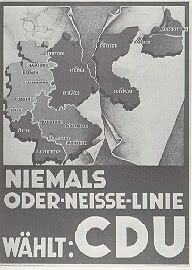
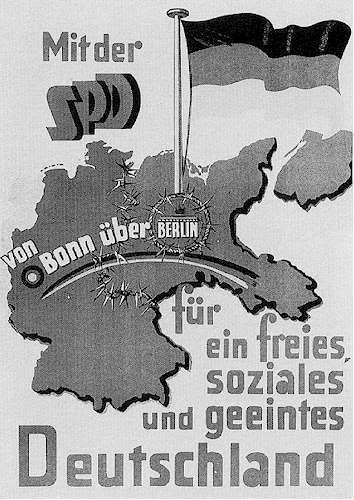
CDU and SPD Posters


Both the Cristian Democtrats and the Social Democrats claimed the territory beyond the Oder-Neisse Line, according to these election posters, now a recognised border between Germany and Poland.


Ederic O (2009) Re: Thatcher (and Mitterand, and Bush I) Opposed German Reunification. [online] http://forum.dune2k.com/index.php?PHPSESSID=no2nb6begjchnpj2pv3nguiul0&topic=21995.msg346918#msg346918 [05/-3/2010]
I wonder if it's useful to count the number of text messages, emails, Skype conversations, for the presentation. It'd need to be more than just adding numbers, I suppose.

Saturday, 6 March 2010

Baaa by David Macaulay

Animals are often used in picture books to illustrate human behaviour in a society. In Baaa, David Macaulay shows how sheep built up culture similar to humans, after humans.

Around this time, leaders arose from the sheep
population. Some had charisma, others connections.

One evening, between commercials, a news sheep
announced that things were being used up too fast.
But nobody paid much attention.

Macaulay, D. (1985) Baaa. New York, N.Y.: Houghton Mifflin.


Two Half Nations into One Car


This car was reassembled from Tranbant and VW Golf, two halves which also represent the former East and West Germanys. The cars were bought online for under 1000 Euro and went on sale on ebay. It is not allowed to be driven on German roads (The German Car Blog, 2005). 


The German Car Blog (2005) The Gobbi: A Car to Celebrate the German Unification. [online] http://www.germancarblog.com/2005/09/gobbi-car-to-celebrate-german.html [06/03/2010]

Point Alpha: Between Germany and Germany


Point Alpha, on the border of Hessen and Thüringen, was a point on intra-German border. Now there is a memorial, and a piece of the Berlin Wall (Point Alpha Stiftung, 2009) at a location on Fulda Gap (Somaskanda, 2009).

Point Alpha Stiftung (2009) For Peace and Freedom in Europe. [online] http://www.pointalpha.com/home [05/03/2010]
Somaskanda, S. (2009) Cold War Tourism at Fulda Gap. [online] 
http://www.globalpost.com/dispatch/germany/090530/cold-war-tourism [05/03/2010]

Stefan Strumbel

Berlin Wall, Offenburg

Stefan Strumbel has worked on the concept of German "Heimat". The word loosly translates to homeland, which its definition has suffered due to the Nazi past of Germany (Williams, 2010). Strumble, who used to work as a graffiti artist now focuses on clocks, and plans to publish the book What the Fuck is Heimat? (Strumble, 2010).

Strumbel, S. (2010) Strumbel. [online] http://www.stefanstrumbel.com/en/work [05/03/2010]
Williams, G. (2010) A Clockmaker's Retreat. [online] http://www.nytimes.com/2010/02/04/realestate/04location.html [05/03/2010]

Wednesday, 3 March 2010

Tutorial with Shaun

Focus + Reflect
 Unpick how the project worked, not worked, wasn't as successful as originally planned
  communication
  roles: who does what, when
  instigator, facilitator: me
  size of group (5): did it require a hub/administrative role to control the project... was there a need to "control" it, when I saw the project as a group collaboration?
inter-relationship
 process of collaboration

talk to Lee about presentation

Where is this project positioned?

tools: Dropbox, Google Docs, emails, texts, Facebook, Skype, project blog

Critical evaluation and research portfolio: at BmB blog

Border Film Project


The Border Film Project handed disposal cameras to migrants and minutemen volunteers on the U.S.-Mexico border. The project has received 73 cameras: 38 from migrants and 35 from minutemen, and nearly 2000 photographs [Border Film Project, 2010]. There is a similar project taking place at the South Africa-Zimbabwe border also.

The Project is an art collaborative of undocumented migrant workers on one side of the border, and minutemen who are trying to stop the workers from entering the U.S. Visits to humanitarian aid groups and shelters on the Mexican side were approached to recruit migrant photographers. This process included showing the photographers what postboxes looked like in the U.S., so that they were able to send the disposal cameras back to the project.

Although the groups on each side of the U.S.-Mexico border have different interests/stakes, both sides have a common view, that they are documenting a situation which should not be happening.

Border Film Project [2010] Photos by Migrants & Minutemen on the U.S.-Mexico Border. [online] http://www.borderfilmproject.com/en/index.php [03/03/2010]
Adler, R., Criago, V. & Huneycutt, B. (2007) Border Film Project. New York, N.Y.: Abrams.

Mapping Ideas

If the Nazis had won the WWII, the map of Europe could have looked like the one above. Of course, this never happened and the map is a fiction. There are maps which don't simply show the geological facts, but help visualise cultures or a phenomenon also.

 
Mengisen, A. (2009) Maps: Fighting Disease and Skewing Borders. [online] http://freakonomics.blogs.nytimes.com/2009/11/09/maps-fighting-disease-and-skewing-borders/ [03/03/2-1-]
Strange Maps. [2010] http://strangemaps.wordpress.com/ [03/03/2010]

Enclaves, Exclaves

West Berlin was an enclave located in the middle of the GDR, detatched from West Germany. This geological characteristic of the city lead to historical events such as the Berlin Airlift and the construction the Wall. This dilemma resolved when Germany was unified in 1990 and Berlin became one city, but there are numerous enclaves and exclaves scattered across the world.


Robinson, R. (2010) Enclaves of the World. [online] http://enclaves.webs.com/ [03/03/2010]
Krogh, J.S. (2010) Enclaves, Exclaves and the Likes. [online] http://geosite.jankrogh.com/ [03/03/2010]

Monday, 1 March 2010

The Wall by Peter Sis

The Czech author Peter Sis illustrates his life behind the Iron Curtain.

Markus, L.S. (2007) The Cold War Kid. [online]

Sunday, 28 February 2010

Walking Collaboration


These Overkill and New Balance collaborative product comes with printed insoles featuring the Berlin Wall.


Another collaborative project, by Adidas, bares a logo of two hands in a collaborative handshake. It seems to resemble the logo of the former East German ruling party, SED. 


SED (Sozialistische Einheitspartei Deutschlands), or the Socialist Unity Party, was founded by a merger of the communists and the social democrats in 1946, symbolised in by the handshake.

High Snobiety (2009) Overkill x New Balance “Berlin Wall” Pack Release Details. [online] 
High Snobiety (2009) New Balance x Overkill Berlin Wall Pack 2009. [online] http://www.highsnobiety.com/news/2009/10/16/new-balance-x-overkill-berlin-wall-pack-2009/ [28/02/2010]
Hyperbeast (2009) Adidas Originals Consortium Rod Laver Collection – Drop 2. [online]

The Green Iron Curtain

This is a cross border conservation which also aims to develop local communities socio-economically. 

European Green Belt (2006) The Green Belt Initiative. [online] 
http://europeangreenbelt.org/indoor.html
[28/20/2010]

Mödlareuth, Little Berlin

A small village on the border of East and West Germany, Mödlareuth, was also divided and had a wall cut through it. Now there is a museum displaying its wall and history.


Deutsch-Deutsches Museum Mödlareuth [2010a] http://moedlareuth.de/ [28/02/2010]
Deutsch-Deutsches Museum Mödlareuth [2010b] http://www.stadt-gefell.de/Museum/museum.htm [28/02/2010]
Martino, E. [2010] Germany-Bavaria, DDR and Wall's Museum. [online] 
http://www.photoshelter.com/c/enricomartino/gallery/Germany-Bavaria-DDR-and-Walls-Museum/G0000MNLSBA0sHSw/ [28/02/2010]


Divided Village Mödlareuth: 
[28/02/2010]
Hof und die Region. http://www.ipa-hof.de/hudr.htm [28/02/2010]

The Right Number by Scott McCloud

The Right Number
An idea for the pages. By clicking on the arrow or the frame in the middle of the image, the next frame expands, which has the next frame in the centre again (McCloud, 2003). The viewers can also click on the page numbers, or space bar.


Maybe a photo could appear inside the photo once the page is ready to be turned. Could that possibly work with Lee's idea of mosaic? By clicking on P2 that appears on P1 [fig.1], the page turns/expands to P2 [fig.2].

fig.1

fig.2

McCloud, S. (2003) The Right Number. [online] http://www.scottmccloud.com/1-webcomics/trn/index.html [28/02/2010]

Saturday, 27 February 2010

Vinni Pukh, the Soviet Pooh


Vinni Pukh is Russian. The story is identical to Winnie the Pooh's. 

Animator.ru [2010] «Winnie the Pooh» [online]
Niffwan [2010] Animatsiya in English. [online]
http://niffiwan.livejournal.com/15761.html [27/02/2010]

Personas: How Internet sees Me


This is how internet sees me, apparently.

Personas "scours Internet looking for characterizing statements to use in its analysis" and visually displays it [Personas, 2010]. So according to this data analysis, internet seems I'm an arty professional, spends time online and doing sports... and it thinks I'm more into aggression than design.  I did notice Personas picking up others during its processing, so perhaps there's an aggressive me out there somewhere. I take no responsibilities for his (or her) actions.

Personas was created at MIT Media Lab by Aaron Zinman, Alex Dragulescu, Yannick Assogba and Judith Donath.

Personas [2010] http://personas.media.mit.edu/personasWeb.html [27/02/2010]

A Skype Meeting: 26/02/2010

with Lee, Ting and Terry

We talked, and typed, about how we could use the images. It was a follow up of an idea I'd heard from Lee at the group critique, which I'd not heard before. I felt we needed to talk to the group about it. His idea was to have the photos that have been manipulated separate from text and Ting's illustration. I'd thought about it after he mentioned it, and it sounded like it would work.

In the meeting we discussed this idea and everyone seemed to think this way, and this is what we're going to do.

Another topic on manipulating images. I'd seen Lee's images and was impressed by them, but wasn't aware of his idea of collaboration, which was that I would then add a photograph on top of what he had done, like a collage. I said I'd give it a go and see how they look. I'm not much of a Photoshop type, so I don't know how much I could do to satisfy myself and others.

I'm starting to see the limitations of Skype, where it often cuts people out. It is possibly related to internet connections participants have, but most of us were affected by it over a 40 minutes period. Which is frustrating. What other conferency methods can we use that's free...


I don't need to talk to 5 artists Skype has chosen - I just want to talk with my creative partners.