Sunday, 9 May 2010

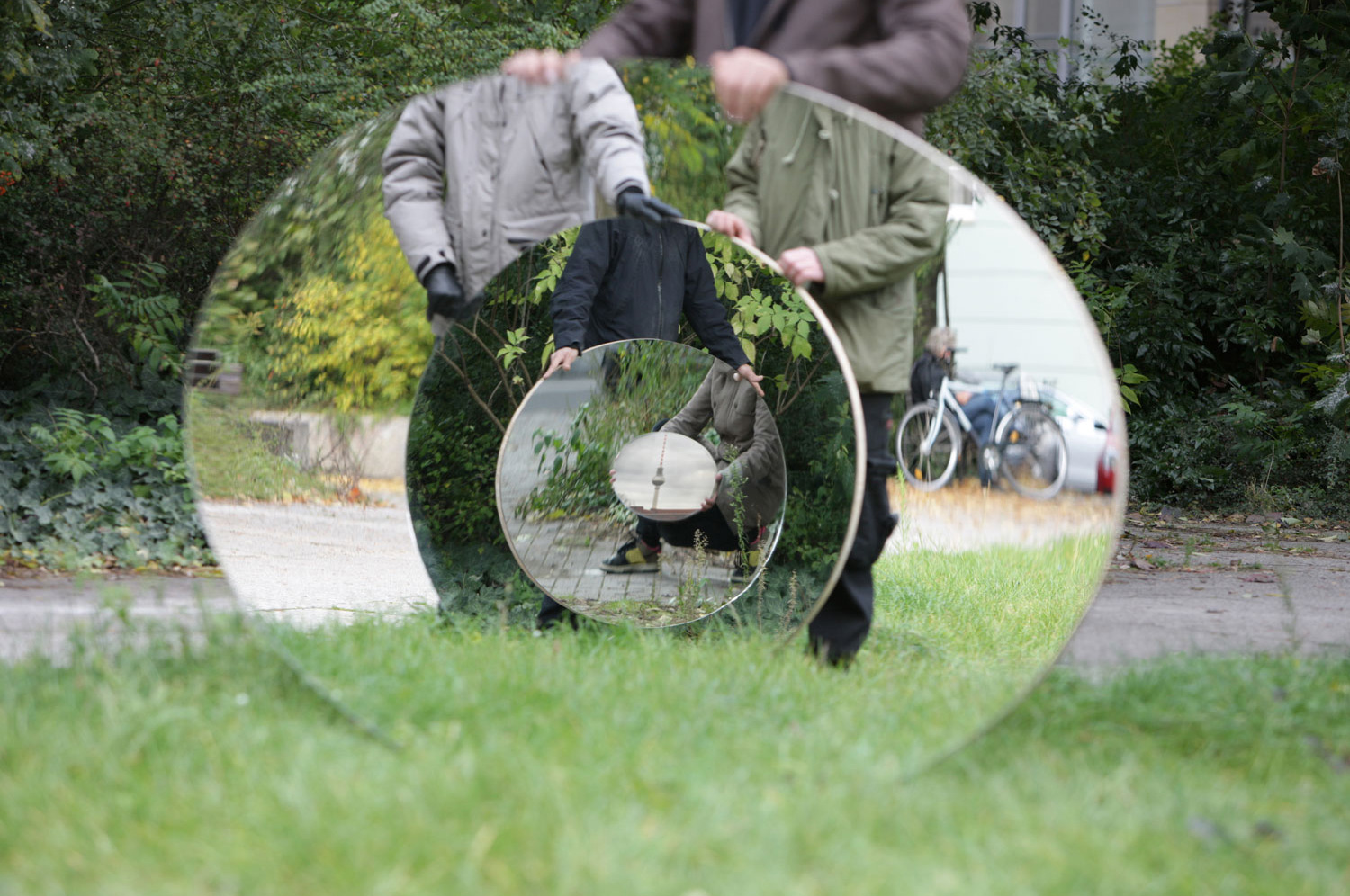
Manon Awst and Benjamin Walther


Manon Awst and Benjamin Walther began their collaboration in Berlin in 2006, with their work ranging from sculpture, performance, drawing and installation. Their backgrounds in architecture and theatre, allowing them to explore "into intimate relationships between human beings and their physical and socio-political environment", and with their "subtle yet critical approach... put society's governing values and accepted codes of behavior under scrutiny" (Awst & Walther, 2010).

"Awst & Walther's most recent work engages the architectural, temporal and metaphysical notion of a ‘threshold’. They investigate the ambiguous area between A and B (i.e: inside and outside, private and public, self and other) through a series of sculptures and interventions. This series incorporates specific industrial and ephemeral materials including gelatin, plaster and ice. The resulting objects and settings are unassuming and alluring, as they confront the viewer with an awareness of his or her own expectations and vulnerability." (Awst & Walther, 2010)


Awst, M. & Walther, B. (2010) Biography. [Online] http://www.awst-walther.com/ [09/05/2010]

CNN (2009) Ice Wall Honors Fall of Wall. [Online] 
German Embassy London (2009) Ice Wall in London Commemorates the Fall of the Berlin Wall. [Online] http://www.london.diplo.de/Vertretung/london/en/Mauerfall__archive/Projects/Ice__Wall/Ice__Wall__Bildergalerie.html [09/05/2010]

Rain, A. (2009) Commemorating the Fall of the Berlin Wall. [Online] http://www.nytimes.com/slideshow/2009/11/09/world/1109-BERLIN_7.html [09/05/2010]

Saturday, 8 May 2010

Sound: SolarBeat

SolarBeat

Twyman, L. [2010] Solar Beat 01. [Online] http://www.whitevinyldesign.com/solarbeat/ [07/05/2010]
The Sound Agency [2010] Audio. [online] http://www.thesoundagency.com/docs/Sound%20Affects.mp3 [27/02/2010]

Friday, 7 May 2010

Hung Up on "Hung" Parliament


"The German for 'hung parliament' is simply 'parliament', because the system of proportional representation the Federal Republic adopted in 1949 routinely produces parliaments with no overall majority... Yet somehow Germany today does not seem to resemble the ghastly chaos with which the Daily Mail and the Sun are now trying to scare their readers."

"Germany does show that you can run an effective economic policy with coalition governments; and Greece shows that you can run a lousy one with a clear single-party majority. It all depends who does it and how."

"There was a time, about 10 years ago, when I heard some Germans arguing that they needed Britain's first-past-the-post electoral system. Only thus could Germany get decisive economic reforms, to pull it out of its post-unification trough. But the last decade has proved those siren voices wrong. Germany has made tough economic adjustments, forcing down unit labour costs, and it has done so largely in co-operation with the unions. German-style "change through consensus" takes longer than the Margaret Thatcher-type, but is less socially divisive and ultimately more durable."

Ash, T.G. (2010) British Politicians will Need to Act More Like the Germans – Only Faster. [Online]
Sontheimer, M. (2010) Hung Parliament in the UK: A Very Un-British Election Result. [Online] http://www.spiegel.de/international/europe/0,1518,693603,00.html [07/05/2010]

Tuesday, 4 May 2010

Berlin

by Steve Crawshaw
The fall of the Berlin Wall in November 1989 was the culmination of months of protest across communist Europe and another triumph for the power and pressure of crowds


The collapse of the Berlin wall was the culmination of an incredible year. It was the most dramatic moment in an extraordinarily dramatic year. All across eastern Europe, one-party regimes collapsed in a heap. But nothing could trump the impact of the fall of the Berlin Wall on the evening of 9 November 1989. Television viewers around the world were transfixed as the loathed symbol of a divided continent broke open.

Following a confused, partly unintended announcement at an official press conference, East Berliners poured through the once-impenetrable barrier in to West Berlin; thousands more clambered on to the wall and celebrated there for days to come. Overnight, the barrier lost all its power.

This was a time of fairy-tale strangeness, a brave new world in the unburdened sense of the phrase. The fall of the wall was not, however, as unpredictable as politicians have often been eager to suggest. Indeed, it was unexpected only if one failed to see what the pressure of the crowds had already achieved, in the lead-up to that day.

Some changes were obvious and widely acknowledged. Through the summer of 1989, there was a vast outflow of East German refugees, especially through liberal Hungary, which proudly and publicly snipped a symbolic hole in its border fence in May, with unexpected consequences.

In the months to come, tens of thousands slipped across the Hungarian border to the west. East Germany’s lifeblood was haemorrhaging away. Those who remained and chanted “Wir bleiben hier!” (“We are staying here!”) provided no comfort to the regime, because their meaning was equally clear: “We are staying – because we want change.”

All of those pressures – from the leavers and the stayers alike – smoothed the way for what came next. However, probably the single most important moment came a month before the wall fell, on the evening of 9 October, in the city of Leipzig.

Throughout 1989, weekly Monday demonstrations – prayers for peace in the Nikolaikirche, followed by a demonstration – gradually gained strength, despite constant beatings and arrests. Eventually, the authorities decided enough was enough. They would teach Leipzig, and thus all of East Germany, a lesson.

A “reader’s letter” (read: an officially sanctioned announcement) in the Leipzig local paper announced that “these counter-revolutionary actions” would be dealt with, “if need be, with weapons in our hands”. In effect, the regime was publicly heralding its plans for a local reprise of the Tiananmen Square killings, which had taken place just four months earlier.

Nor was this mere bluster. The city of Leipzig was closed off. Weapons and ammunition were handed out. Hospitals were cleared. Before the demonstration began, I counted 16 trucks with armed workers’ militias in one side street alone. Inside the 13th-century Nikolaikirche, everybody knew what to expect once prayers were over. Through the tall windows, we could hear the echoing cries of the huge crowd outside, chanting, “No violence!” But it was clear to everybody: violence there would be tonight, and it might be lethal.

After the service, we moved outside. Presumably in common with many of those around me, I felt the tightening knot of fear as we waited for the shooting to begin.

A few minutes passed, without violence. And then a few minutes more. And then – utterly dramatic and conventionally un-newsworthy in equal measure – it became clear that there would be no shooting tonight. No shooting, not even arrests or beatings. As one demonstrator said after it was all over: “I felt as if I could fly. It was the most fantastic day that I have ever known. Now, we knew that there was no going back.”

Even outsiders could share in the exhilaration of that achievement.

Late that night, the Stasi secret police fetched me out of my room, searched my baggage and threw me out of the city (I had already phoned my report back to my newspaper in London from the central post office, and was thus content to be deported). The hotel receptionist asked why I was leaving in the middle of the night. I pointed to the waiting men in overcoats, and explained that my crime was to have witnessed and written about events that they would rather went undocumented. “It’s a disgrace!” she said, loudly enough for the Stasi men to hear. Such insolence would, until a few days earlier, have got her the sack or worse. Now the fear was broken. It would never return.

The regime’s threats of lethal action were intended to persuade the crowds to stay at home. Instead, more had come out that day than ever before. Despite all the guns and all its power, the regime was more afraid of the crowds than the crowds were afraid of the regime. This was, to quote Ryszard Kapuscinski’s description of the fall of the Shah of Iran a decade earlier, one of the last zigzags to the precipice.

In the next fortnight, the numbers of protesters doubled and doubled again, as the regime looked sulkily on.

Then – in an increasingly desperate attempt to slow the momentum – the government came up with a last, surreal concession. On 3 November, it was announced that all citizens could now leave for the west without special permission. Just two conditions were imposed. In a citizen-laundering exercise, they could not leave directly from East Germany to the west, but must pass through a third country on their way. Oh, and yes, everyone must give up their East German identity card when they leave, poor things.

Thus, the regime’s front door remained locked. The guns, watchtowers and minefields of the Berlin Wall were, after all, still in place. However, a side door – a simple detour of a few kilometres through Czechoslovakia and on to the west – was now officially open to all. It was a gloriously absurd contradiction.

The sacking of a third of East Germany’s ruling politburo, which happened the same day, would, in other contexts, have seemed important. By now, however, three weeks after Leipzig, the resignation of yet more men in ill-fitting suits seemed like yet another rearrangement of the deckchairs. (The loathed Communist leader Erich Honecker had already been dumped, just a week after the Leipzig showdown.)

More significant was that the Berlin Wall had suddenly become pointless – a redundant symbol. Thousands of East German refugees were crammed into the West German embassy in Prague; they received the news in dazed disbelief and headed off to the West German border.

The travel ban that underpinned East Germany’s very existence was now in free fall. The only real surprise was how utterly unprepared the politicians were for the wall’s fall when it finally came. Chancellor Helmut Kohl initially refused to believe his closest aide. “Ackermann,” he insisted, “are you sure?”

This was not a victory for Ronald Reagan (“Mr Gorbachev, tear down that wall!”), nor indeed a victory for the Soviet leader (a pragmatist who reluctantly bowed to the inevitable). Nor (another much-heard version) was it all down to a mix-up over which pieces of paper should or should not be read out at a press conference. It was a victory for the crowds of Leipzig and beyond.

The East German protesters did not stand in isolation. They owed much to the defiance of others who had come before. By autumn 1989, the Communist wheels were falling off all over the place. In partly free elections in Poland in June – the same weekend as the death of Ayatollah Khomeini, and the Tiananmen massacre in Beijing – the independent Solidarity movement defeated the Communists so overwhelmingly that the humiliated regime had no alternative but to bow to demands for a non-Communist prime minister. At the very latest from 4 June onward, the clock was ticking for one-party regimes across eastern Europe.

Elsewhere, too, extraordinary changes were afoot, demonstrating what Václav Havel called the power of the powerless. August 1989 was the 50th anniversary of the secret deal between Hitler and Stalin which allowed Moscow to gobble up the Baltic states. Two million people – a quarter of the entire population – formed a human chain that stretched for hundreds of miles through Estonia, Latvia and Lithuania. To the fury of Mikhail Gorbachev, they demanded a restoration of pre-war independence. (Gorbachev still pretended that the Balts had joined the Soviet Union voluntarily, which – especially given the mass deportations to Siberia after annexation in 1940 – was very sweet.)

For western politicians, the Baltic protests were either an irrelevance or an annoyance (“It’s worrying, because this makes things difficult for Gorbachev” was a frequent mantra). But the peaceful mass resistance of the Balts – despite and because of a subsequent armed crackdown – played a pivotal role in ending the Communist one-party system for all time.

Even today, many politicians still seem to believe that only their fellow politicians can initiate profound and lasting change. A seemingly plausible argument is made, too, that people should not make impossible demands. In 1989, the protesters of eastern Europe – in Leipzig, Gdansk, Prague, Vilnius and elsewhere – proved the sceptics wrong on both counts. Those lessons still deserve to be remembered.

Steve Crawshaw is UN advocacy director of Human Rights Watch. He was east Europe editor of the Independent from 1988 to 1992. He is the author of “Easier Fatherland: Germany and the 21st Century” (Continuum, £15.99) and co-author of “Small Acts of Resistance: How Courage, Tenacity and a Bit of Ingenuity Can Change the World”, to be published next year


Crawshaw, S. (2009) Berlin. [Online] http://www.newstatesman.com/europe/2009/03/berlin-wall-east-germany-1989 [04/05/2010]

Sunday, 2 May 2010

German-German Translation

In 1994, Steve Crawshaw reported that a university department in the east German city of Halle has set up a "German-German translation service" to bridge the linguistic gap between the former East and West Germans (Crawshaw, 1994). 20 years after the opening of the Berlin Wall, Brammertz illustrates what created the gap and how the argument has changed over time (Brammertz, 2009).

Brammertz , C. (2009) (trans. Okech, S.) Linguistic Change: 20 Years After the End of the German Democratic Republic: Has the Language Barrier Been Broken Down? [Online] http://www.goethe.de/ges/spa/siw/en4139259.htm [04/05/2010]
Crawshaw, S. (1994) Out of Germany: German Helpline Breaches the 'Wall in the Head'. [Online] http://www.independent.co.uk/news/world/europe/out-of-germany-german-helpline-breaches-the-wall-in-the-head-1421427.html [02/05/2010]
Stanley Vitte, S. (2009) (Trans. Flügel, E.) Linguistic Change: Dialects in Germany – Changing Variations on the Spoken Language. [Online] http://www.goethe.de/ges/spa/siw/en4230471.htm [04/05/2010]

Olafur Eliasson

From Innen Stadt Außen (Inner City Out)

"I don't think you need to be so result-oriented when you're trying to define the success of an art work. I think we can allow some unpredictability.... I am not worried whether people get it or not. I have great confidence in the visitors making some sense of it, something that will be relevant to them personally. And if some people go through it and it's just entertaining, then so what?" (Eliasson, in Schaer, 2010)

Eliasson, who has a studio lab in Berlin and his exhibition Innen Stadt Außen (Inner City Out) currently taking place at Martin-Gropius-Bau in Berlin. His focus is on space and people's connection to the space, and experiments the border between the artists and their audience (Eliasson, 2009).

Eliasson , O. (2009) Olafur Eliasson: Playing with Space and Light. [Online] http://www.ted.com/talks/lang/eng/olafur_eliasson_playing_with_space_and_light.html [02/05/2010]
Innen Stadt Außen: http://www.innenstadtaussen.de/exhibition.html [02/05/2010]
Schaer, C. (2010) Danish Artist Olafur Eliasson: 'The Reality We Live in Is Our Own Construction'. [Online] 

Friday, 30 April 2010

The Wall from Both Sides, Different Angles


"There are many people in the world who really don't understand, or say they don't, what is the great issue between the free world and the Communist world. Let them come to Berlin. There are some who say that Communism is the wave of the future. Let them come to Berlin. And there are even a few who say that it is true that Communism is an evil system, but it permits us to make economic progress. Lass' sie nach Berlin kommen. Let them come to Berlin.
Freedom has many difficulties and democracy is not perfect, but we have never had to put up a wall to keep our people in, to prevent them from leaving us."
- John F. Kennedy, in his 'Ich bin ein Berliner' speech, June 26, 1963.


"Comrade Ulbricht himself told me that the economy of the G.D.R. immediately began to improve after the establishment of border control. The demand for food products in East Berlin went down because West Berliners were no longer able to shop there...

Furthermore, the establishment of border control in Berlin had a very positive effect on the consciousness of the people. It strengthened them and reminded them that the task of building Socialism was a challenge of solid and lasting importance, dwarfing the temporary phenomenon of West German propaganda which had been used to tempt the East Germans over to the side of capitalism. The establishment of border control restored order and discipline in the East Germans' lives (and the Germans have always appreciated discipline)".
- Nikita S. Khrushchev, in his reminiscences, written in the early 60's.

"You can't live here and not be tied to the wall. It's not that I'm for it or against it. I'm totally confronted by it."
- Peter Unsicker, a West Berlin sculptor, Nov. 11, 1987.

"[The Wall] will still be here in 50, in a hundred years, so long as the reasons for its existence have not been eliminated. That much we must do to protect our republic against robbers, not to speak of those who are ready to disturb stability and peace in Europe."
- Erich Honecker, East German leader, January 1989 [10 months before the opening of the Wall].


The New York Times (1989) The World; Voices From Different Times, and Both Sides Of the Wall. [Online]  http://www.nytimes.com/1989/11/12/weekinreview/the-world-voices-from-different-times-and-both-sides-of-the-wall.html?pagewanted=1 [30/04/2010]

Thursday, 22 April 2010

(-) Ossi

STUTTGART


On 15th April, a labour court in Stuttgart ruled that former East Germans are not an ethnic group. German  newspapers talk about "the prevalence of negative stereotypes" (Smee, 2010) about people from the former GDR and cultural tentions. The case where a woman born in the former East Berlin sued a window manufacturer she applied for work in the southwestern city, for ethnic discrimination. Her CV was returned with "(-) Ossi"*, but the company claimed the minus sign meant lack of qualification. 

* "Ossi," based on the German word Ost, or East, often used negatively

The Stuttgart labor court rejected her claim and noted that East Germans were not an ethnic group, with the judge saying "more must be considered than just a person's regional origin... while at the same time conceding that the term "Ossi" could be taken as a negative label." (Smee, 2010)


The following editorials are from Smee's article.

Frankfurter Allgemeine Zeitung
"Only ignorant 'Wessis' (the nickname for those from western Germany) could label people from Mecklenburg, Thuringia and Saxony as belonging to the same ethnic group. Their only similarity is that they were all, to some extent, shaped by the socialist state during 40 years of the German Democratic Republic -- regardless if they personally supported the system or not. These shared experiences continue to affect those people today. It remains one of the biggest political mistakes that no one has tried to imagine the situation from the perspective of those in the former East Germany."  "We have as little influence over our origins as over our gender. For that reason it doesn't appear far-fetched to use anti-discriminatory legislation in such cases. Whatever one thinks of the General Equal Treatment Act, any employer who is stupid enough to reject an applicant on grounds other than their qualifications should not be surprised by a barrage of negative criticism."  "Meanwhile, there is something positive to be drawn from all this: Such cases serve to reinforce the inner unity of this country."

Süddeutsche Zeitung
"The Stuttgart labor court's decision firstly serves as good sideshow -- but it also focuses attention on legal issues. The detailed legal analysis is not quite as funny as a sideshow, but it is rewarding: It leads to the conclusion that the verdict is wrong."  "The Labor Court dismissed the case of the East Berlin-born job applicant who had been rejected by her employer on the grounds that she was an 'Ossi'. The court ruled that Ossis were not an ethnic group, based on the General Equal Treatment Act."  "That may well be true, but we also have the German constitution. Article 3, paragraph 3 of the constitution clearly states that no one should be discriminated against 'because of sex, race or language and' -- wait for it -- 'due to his homeland and origin'. Without a doubt, the label 'Ossi' refers to origin and homeland." 

Frankfurter Rundschau
"The term 'Ossi' may be offensive, but it is not covered by the General Equal Treatment Act. Of course it matters whether someone went to the Free German Youth (East Germany's official socialist youth movement) or was forbidden from their chosen professional path due to their allegedly mistaken political beliefs."  "For this generation at least, the term 'Ossi' remains crucial to many people's identity. In this particular case, the label 'Ossi' was not used neutrally, but negatively and thoughtlessly. Maybe the judge wanted to use this case to provoke awareness of a legally gray area. Hopefully the applicant will continue her fight." 

The Nordkurier, a regional paper from northeastern Germany
"The white, er, wise man, has rule: 'Ossis' aren't Indians. ... But plaintiff Gaberiele S. and her attorney have already done a lot by drawing considerable public attention to this issue. She should be praised for taking this to court rather than just accepting it."  "Too old, too fat, too costly, too sick, too female, too 'Ossi' -- in the daily fight for jobs many candidates face discriminatory judgments, either directly, or implied. Sometimes these are careless -- but rarely are they justifiable. It is fair enough, and even important, when the victims of such hurtful comments try to defend themselves and recover their self-esteem."

Ostthüringer Zeitung, a regional paper based in Gera, eastern Germany
"Thanks go to the judge who upheld that East Germans are not an ethinic group -- a fact that no one doubted in the first place. Anyone who grew up in East Germany, knows that people differed greatly across the former country, from Thuringia to Saxony to those dwelling in the major cities. It was German reunification that first embedded the clear categories of Easterners and Westerners. Those German generalizations always leave one group feeling discriminated against, rather than giving them a sense of 'Ossi' pride." 

Smee, J. (2919) 'Ossis Aren't Indians' [Online] http://www.spiegel.de/international/germany/0,1518,689403,00.html [22/04/2010]

DDP/The Local (2010) Court Rules Against 'Ossi' Discrimination Case. [Online] http://www.thelocal.de/society/20100415-26575.html?utm_source=email&utm_medium=email&utm_content=124 [22/04/2010]
Goebel, N. & Penfold, C. (ed.) (2010) Former East Germans are Not an Ethnic Group, Court Rules. [Online] http://www.dw-world.de/dw/article/0,,5471294,00.html [22/04/2010]

SMD/Spiegel (2010) Landmark 'Ossi' Discrimination Case Court to Decide if East Germans are Ethnic Group. [Online]

Designing Empty Cities

Where demolition is unavoidable in Aschersleben, there
are huge pieces of contemporary art, as big as houses


Müller, R. (2010) When Less Is More: Eastern German Project Provides Hope for Shrinking Cities. [Online]
http://www.spiegel.de/international/germany/0,1518,688152,00.html#ref=nlint [22/04/2010]

Sunday, 18 April 2010

The Invisible Wall by Stephan Kaluza


Although I didn't have €50 to spend on the book I found, The Invisible Wall by Stephan Kaluza, his website provides images as well as essays by Heinz-Norbert Jocks and David Galloway from the book.

Wilhelmstraße

There is also an interview online, with scenes of the photographer on location  (in German) by Institut für Kunstdokumentation.


Galloway, D. (2009) Walking the Line. [Online]
Institut für Kunstdokumentation  [2010] Stephan Kaluza - project Berlin Wall.  [Online] http://vimeo.com/6414799  [18/04/2010]
Jocks, H.-N. (2009) The Spirit of the Absent. [Online]

Wednesday, 7 April 2010

Berlin Stories


Berlin Stories is a series radio broadcast on NPR Worldwide, produced and directed by writers. The logo is designed by Christoph Niemann.

Berlin Stories [2010] http://berlinstories.org/ [07/04/2010] 
Niemann, C. (2008) http://christophniemann.com/ [07/04/2010] 

Metrofarm: The Wall


"It is delivered in a custom-made cardboard box and can be ordered directly from Metrofarm.
It's dimensions are:
Height 16cm, depth 11cm, width 10cm,
weight 550g" (Metrofarm, 2006)

Metrofarm (2006) The Wall. [Online] http://www.metrofarm.net/thewall/?image=3 [07/04/2010]

Megan O’Grady on 1989


O’Grady, M. (2009) Letter From Berlin: After The Wall. [Online] http://www.vogue.com/voguedaily/2009/11/letter-from-berlin/ [06/04/2010]

Tuesday, 6 April 2010

Washington Post Gallery

Photograph by Richard A. Lipski

A slideshow with narration by the Washington Post editor Marc Fisher, who in 1989 was the Post's Berlin correspondent. 

Washington Post (2009) Tearing Down the Wall in 1989. [online] http://www.washingtonpost.com/wp-dyn/content/gallery/2009/11/04/GA2009110403729.html [06/04/2010]

Wall and Fashion


Art is Everywhere (2009) Another Form of Canvas. [online] http://www.ashley-spencer.com/ArtIsEverywhere/?tag=berlin-wall-art [06/04/2010]
Comenetz, J. (2009) in Casciato, P. (ed.) "Berlin Wall Graffiti Returns as Leather Fashion" [online] http://www.reuters.com/article/idUSTRE5583YC20090609 [06/04/2010]
Mauerkleider [2010] East Side Gallery Goes Fashion - by Rodan. [online] http://www.mauerkleider.de/index.html [06/04/2010]
The Fashionables (2009) German Designer Commemorates The Fall Of The Berlin Wall. [online] http://www.thefashionables.com/2009/07/german-designer-commemorates-the-fall-of-the-berlin-wall/ [06/04/2010]

Heil Democracy!

Heil Democracy!

Grugel, M. L. (2009) Heil Democracy! [online] http://www.nosugar-studio.co.uk/ [06/04/2010]

Sunday, 4 April 2010

Absolut Wall


1. Purpose - selling swedish merchandise to a Berlin audience by familiarizing it to it's audience.

2. Serious audience- Definitely targets German and in particular a Berlin audience. cultural/educated/
metropolitan/mature. The age targeted could be a more young/middle-age crowd. The fact that it is
displayed in a museum allows the ad to reach more of the intellectual and historically-aware

3. Argument: connection to symbols Germans can relate to on a historical, informational, and emotional level. Relate the product, vodka, which is emotionless, with the emotions that were felt when the wall came down. Celebration and feelings of freedom were felt when the wall came down, and the ad attempts to recreate these feelings through the vodka. Jubilation. Also attempts to remove the negative stigma
typically associated with alcohol. Instead of depicting a rowdy, vulgar crowd it portrays the vodka more for socializing purposes than for the typical idea of "getting wasted."

3b. Pathos- drawing an emotional response through the portrayal of the Berlin Wall as well as a patriotic one through the German flag. (unification under one flag)
Ethos- placing the ad in a museum an attempt to relate the Swedish drink to the German audience through knowledge of German culture (flag, wall, language).

3c. triangular division of the ad with bipolar parts: first, the form of product and the wall
second, the name of product and synoymous meaning of absolut
third, the place Berlin

4. Bending and connecting two things that were not initially connected- Swedish vodka and German audience, oppression of the wall and freedom of choice. The wall no longer keeps things out.

5. Kairos- placing events in context, the knocking down of the Berlin Wall is recent, it's a current event, so it makes since to address it. Challenges cultural norms- puts alcohol into a cultivated place
like a museum, and gives it emotional and historical connection. A move towards unification, not only between East and West, but on a larger global context.

Cross-Cultural Blog (2007) The Rhetoric of Visual Ads: Absolut Berlin. [online]http://www.stanford.edu/group/ccr/blog/2007/12/the_rhetoric_of_visual_ads_abs.html [04/04/2010]

Mikhail Gorbachev with a Louis Vuitton


Mikhail Gorbachev drives pass the Berlin Wall, in a Louis Vuitton campaign. This photograph by Annie Leibovitz caused speculations, as the magazine headline reads "The Murder of Litvinenko: They Wanted to Give Up the Suspect for $7,000". Both Louis Vuitton and its agency Ogilvy & Mather denied the link to the case of Alexander V. Litvinenko, the former KGB spy who died after being poisoned with polonium 210 (Levin, 2007).

"Our company has absolutely no intention to pass any other messages than the one on ‘personal journeys", claimed Pietro Beccari, director of marketing at Louis Vuitton. Robert Passikoff noted "once you declare it was an overt and planned act, it has no meaning" (Levin, 2007).

Levin, D. (2007) Louis Vuitton Ad Shows Gorbachev Accompanied by Subversive Text. [online]
http://www.nytimes.com/2007/11/05/business/media/05vuitton.html [04/04/2010]

Aung San Suu Kyi, Lancia and Chrysler


This is a 30 second clip from a Fiat group online and TV campaign, associating Lancia Delta with World Summit of Nobel Peace Laureates, and calling for unconditional release for Burmese leader Aung San Suu Kyi [The Inspiration Room, 2010]. It was later adopted by Chrysler with similarly husky voice but less words, and a Chrysler.


The Lancia ad is also available in German, French and Italian

The Inspiration Room [2010] Fiat and Chrysler Back Aung San Suu Kyi. [online]  http://theinspirationroom.com/daily/2009/fiat-and-chrysler-back-aung-san-suu-kyi/ [04/04/2010]


Your Face for Freedom [2010] Freedom oOnly has One Face. [online] http://www.yourfaceforfreedom.org/ [04/04/2010]

Saturday, 3 April 2010

Berlin Wall in a Toilet

The Berlin Wall in a Las Vegas casino toilet

Greer, G. (2010) It was a Stunning Work of Art – So why is the Wall Hanging in a Las Vegas Loo? [online] 
http://www.guardian.co.uk/artanddesign/2010/feb/14/germaine-greer-berlin-wall-thierry-noir [03/04/2010]
Stein, J.D. (2007)Urinate on History in Vegas. [online] http://gridskipper.com/archives/entries/059/59384.php [03/04/2010]


Wikipedia [2010] List of Berlin Wall Segments. [online] http://en.wikipedia.org/wiki/List_of_Berlin_Wall_segments [03/04/2010]

“Before you even think you need it”


"Before you even think you need it" boasts a DHL advert with a man who has just unpacked a hammer. The Berlin Wall and the Brandenburg gate can be can be seen through his window. The ad was created by Gabor Spielmann and Bruno Almeidaat at Ogilvy Budapest, Hungary, and photographer Pal Nánási [The Inspiration Room, 2010].

The Inspiration Room [2010] DHL Hammer for Berlin Wall. [online] http://theinspirationroom.com/daily/2009/dhl-hammer-for-berlin-wall/ [03/04/2010]

Windows and Walls


This is a Microsoft advert for Windows, "designed to highlight that technology is supposed to help people break through barriers and overcome obstacles" (Flores, 2008). 


"The 20th anniversary of the fall of the Berlin Wall has inspired many advertising campaigns. Microsoft Windows has hit the nail with its “Break Down the Walls” campaign targeted at its own software sales staff. It concealed a letter of invitation to sales promotion inside concrete which had to be broken with hammer. Sales employees could also win a trip to Berlin by joining sales promotion. The idea was to inspire them to break down walls and build up sales." (Katti, 2009)

Flores, C. (2008) Windows: Life without Walls. [online]  http://windowsteamblog.com/blogs/windowsvista/archive/2008/09/18/windows-life-without-walls.aspx [03/04/2010]
Katti, M. (2009)Berlin Wall Fall Inspired Advertising Campaigns. [online] http://trendsupdates.com/berlin-wall-fall-inspired-advertising-campaigns/ [03/04/2010]

Beck's and the Berlin Wall


I'd previously found a short clip from "an integrated marketing and public relations campaign" (The Inspiration Room, 2009) by Beck's, for the anniversary of the opening of the Berlin Wall. Here are some posters and another by Tim Buesing (2009).

Dominated to Liberated

Oppression to Expression

Grief to Relief


Buesing studied in Berlin and the photographs in the clip below, 20 Years 20 Hours in Berlin, are from an exhibition commissioned by Beck's (Buesing, 2009).


Buesing, T. (2009) 20 Years – 20 Hours: Commemorating the Fall of the Berlin Wall. [online] http://between0and1.org/2009/10/26/20-years-20-hours/ [03/04/2010]
Buesing, T. (2009) Commemorating the Fall of the Berlin Wall Part 2. [online] http://between0and1.org/2009/10/29/fall-of-berlin-wall/ [03/04/2010]
The Inspiration Room (2009) Becks Berlin Wall in Australia. [online] http://theinspirationroom.com/daily/2009/becks-berlin-wall-in-australia/ [03/04/2010]

Thursday, 1 April 2010

Image Fulgurator by Julius von Bismarck


"People’s great trust in their photographic reproductions of reality was what motivated me to develop the *Image Fulgurator*. A camera can be used as a personal memory tool, since people do not doubt the veracity of their own photographs. Hence, photos can reproduce the reality of an individual environment or public space. At sacred or popular locations, or those having a political connotation, an intervention with the Fulgurator can be particularly effective. Especially objects with a special aura or great symbolic power are good targets for this kind of manipulation. In other words, with the Fulgurator it is possible to have a lasting effect on those kinds of individual moments and events that become accessible to the masses only because they are preserved photographically." (Von Bismarck, 2007/8)

Wowereit powered by "O2" Klaus Wowereit (mayor of Berlin)
 at the opening of the art fair "ART FORUM 2008"

Von Bismarck, J. (2007/8) Image Fulgurator. [online] http://www.juliusvonbismarck.com/ulgurator/fertig.html [01/04/2010]

Wednesday, 31 March 2010

Christoph Niemann and his Audience


"I fear that my most basic inspiration to draw and design is a genuine insecurity. Hence, there always has been a (more or less) defined character sitting in the back of my head giving me imaginary thumbs ups&downs. That character changes depending on the assignment: when I was sixteen I would usually think of one of the girls that I tried to impress with my drawings (I was usually spot on with guessing what they liked — except that they just liked the drawings but wouldn't make the leap to fall in love with me). By now I have fairly established set of avatars that are based on real people, that I run things by in my head. When I give a talk, I usually try to find out if there is someone in the audience that I know, and then turn that person into my mental target audience." [Niemann, in Frank, 2010]

Frank, Z. [2010] Christoph Niemann. [online] http://www.zefrank.com/audience/#christoph [31/03/2010]
Niemann, C. (2009) Over the Wall. [online] http://niemann.blogs.nytimes.com/2009/05/18/over-the-wall/ [31/03/2010]

Tuesday, 23 March 2010

Thatcher's View on Unification

Binyon, M. (2009) Thatcher Told Gorbachev Britain Did Not Want German Reunification. [online] http://www.timesonline.co.uk/tol/news/politics/article6829735.ece [23/03/2010]
Volkery, C. (2009) The Iron Lady's Views on German Reunification: 'The Germans Are Back!' [online] http://www.spiegel.de/international/europe/0,1518,648364,00.html [23/03/2010]

Wallstalgia

16 % of Germans polled by Emnid for Bild said rebuilding the Wall "would be the best thing that could happen" (AFP, 2010). Nearly one in four "sometimes think it would be better if the Berlin Wall were still there" claimed the AFP report, adding that there was very little difference between the former East (23%) and West (24%) Germans for the division to be recreated.


In 2009, Pew Research Center conducted a on the level of satisfaction survey across the former Eastern countries (Pew Research Center, 2009). Their research shows that in both former-East and -West Germany, people are less positive about the unification than they were 20 years ago. Overall, there is more positive opinion in the former East [fig.1].

[fig.1]Opinions of German Reunification
*The question wording was slightly different

There is a stark gap in how the unification has affected their life, where majority in East say their life is better off, majority of the people polled in the West feel that they were not affected [fig.2].

[fig.2] How Life has Changed as a Result of Unification

[fig.3] Satisfaction with Life

There is another gap in East-West perception over satisfaction with life [fig.3]. Between 1991 and 2009, there is 28% rise in satisfaction in East, a slight decrease in West. In comparison to other East European nations, the Germans favour democratic government over strong leader [fig.4].

[fig.4] Democratic Government vs. Strong Leader

How the German people perceive the issue of unification varies, traits being evident between the East-West groups.

AFP (2010) Survey Finds Support for Return of Berlin Wall. [online] http://www.france24.com/en/20100315-survey-finds-support-return-berlin-wall [23/03/2010]
Pew Research Center (2009) Highlights from 2009 Pulse of Europe Survey. [online] http://pewglobal.org/docs/?DocID=26 [23/03/2010]

Monday, 22 March 2010

Werner's Wall and His Audience

Werner Schloemerkemper, 75, starts to build a wall in Paul Cotter's short film The Berlin Wall, which also reflects Berliners' divided opinions of history. Berliners, including his neighbours who are unaware of his motivations, speculate and respond in various ways - some react positively and offer to help build the wall higher, whereas some of his neighbours in oppose the idea of a new wall which divides the community, projecting "their own biases and feelings onto his act" [Cotter, 2010]. "To Werner, the wall was a symbol of love, but to most people the wall was a symbol of hatred, of division, of separation, of dislike", but he never explains why.


"This opened up questions about the nature of public opinion. What it means, how groups of people so often develop opinions... people often project their own, already-formed opinions onto whatever they see in front of them" [Cotter, 2010]. Werner is uninterested in his neighbours opinions and remains an isolated architect, only true to his intentions. 

Cotter, P. [2010] The Berlin Wall Press Kit. [online] http://www.paulcotter.net/presskits/PressemappeENG.pdf [22/03/2010]
Cotter, P. (2010) The Berlin Wall. [online] http://www.paulcotter.net/theberlinwall/ [10/03/2010]