"From the time of our birth, humans have felt a primordial urge to explore -- to blaze new trails, map new lands, and answer profound questions about ourselves and our universe." (NASA, 2009)
"For centuries humans have seen imaginary animals, people, or mythological beings in the patterns and shapes of star groupings. Ancient stargazers gave names to these groupings, the constellations we know today" (National Geographic Society, 2009).
When people looked up into the night time sky, they did not only see the stars, but a connection between them. They drew lines from a star to another, so that each dot of light formed a bigger picture, and "these names give us a way to organize and locate the 6,000 stars and the galaxies" (National Geographic Society, 2009).
TED.com is a website where I often get inspired by. They bring in speakers to talk about creative ideas on technology, education or design, and most of them deliver their speech in a 20 minute slot. And before every clip, they show a TED ad-like clip where video clips of invited speakers move in a 3D way, which they gather and rotate into a globe, and fades away into the TED logo - symbolising collective intelligence forming a part of TED's mission:
"We believe passionately in the power of ideas to change attitudes, lives and ultimately, the world. So we're building here a clearinghouse that offers free knowledge and inspiration from the world's most inspired thinkers, and also a community of curious souls to engage with ideas and each other." [TED, 2009].
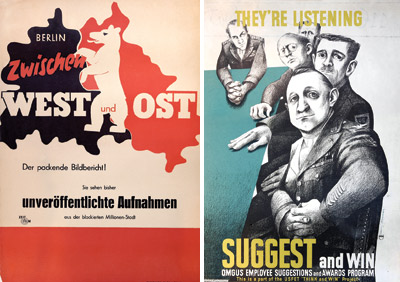
Posters produced by the Office of Military Government / U.S., the occupational authority in Germany after World War II. The office's documentary-film unit was the predecessor of the Marshall Plan motion-picture unit.
The European Recovery Program (or the Marshall Plan, named after Gen. George C. Marshall, secretary of state under President Harry S Truman) funded the war-torn Europe from 1948 until 1950, "when aid to Europe morphed into military support. Credited with speeding up the continent's economic recovery as well as restoring democracy to post-Nazi Germany, it extended the offer of aid even to the Soviet Union and East-bloc nations, which declined the help".
"The German economic miracle was due largely to American aid, and the decrepit nature of the East German economy was due to Russia's stripping of it... but we attributed that to the failure of communism, and the success of capitalism." (Berdahl in Bergman, 2005)