Saturday, 8 January 2011

web structures


I have been mapping websites, looking into structures and design, but I don't know how the Graft's site works, in relation to what I've learnt at uni this week. Or Get the Glass. The image below is the home page of Homeostatic.


Graft (2009) http://www.graftlab.com/ [08/01/2011]
California Milk Processor Board (2007) http://www.gettheglass.com/ [08/01/2011]
Homeostatic [2011] http://www.homeostatic.net/ [08/01/2011]

hosting transitional space

Art Cloud, at Schlossplatz, Berlin

Graft proposed to construct a temporary gallery in Berlin, where Palast der Repblik once stood, as a location which "breathes the identities of yesterday" today [Graft, 2011]. The "seemingly floating and resting for a moment" design fills the transition between "'what was' to 'what will be'". 

Graft [2011] Art Cloud: Here Today - Gone Tomorrow. [Online] http://www.graftlab.com/ [08/01/2011]

Imagine again


I have previously explored the HBO Imagine site, and have just come across their 14×14ft projection cube. Similarly to the website, audience were to choose from which side to view each scenes from. These were shot from 4 different angles, projecting diverse perceptions and experiences. The story came together after watching these scenes from all angles. Their message claimed, "sometimes a change in perspective changes everything".

The website had an interactive navigation, which allowed visitors to select the path in which they viewed each clips and images.

Thetrendwatch (2010) HBO Imagine. [Online] http://www.youtube.com/watch?v=S2m7JcD0dK0&feature=related [08/01/2011]
Virutic (2010) HBO Imagine Integrated Campaign / BBDO New York. [Online] http://vimeo.com/14029101 [08/01/2011]
FunnyAdsWorldCom (2009) HBO: Imagine. [Online] http://www.youtube.com/watch?v=Ko2tHPAPr74 [08/01/2011]

Sunday, 26 December 2010

Down and out in London

During the heavy snowfall in London, I visited Serpentine, Haunch of Venison, Tate Britain, National Portrait galleries and BFI Southbank Centre in London. Here are some ideas I picked up.

June 8, 1968, 2009

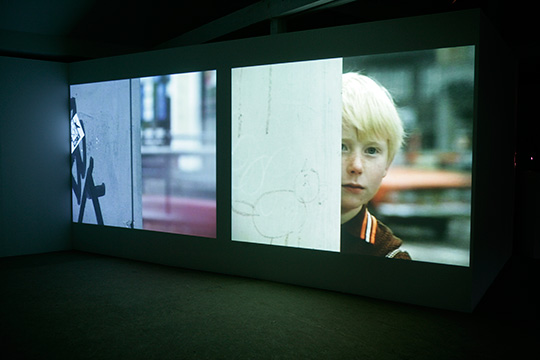
Visitors were guided through four rooms/spaces at Philippe Parreno: Films 1987-2010, which included film/animation installations by the artist.
"In Invisibleboy (2010), the viewer is delved deep into a world of both fantasy and reality where the boundaries between fiction and documentary began to blur. The movie features the story of an illegal Chinese immigrant boy who sees imaginary monsters that are scratched onto the film stock. June 8, 1968 (2009) portrays the train voyage that transported the corpse of assassinated senator Robert Kennedy from New York to Washington D.C. Kennedy’s invisible body and the Invisibleboy are characters that float between several layers of reality." [The European Graduate School, 2010] 
Serpentine Gallery also was showing Tom Hunter's A Palace for Us, where the artist interviewed residents of Woodberry Down Estate. The film has a documentary style, but the artist re-enacts scenes to narrate their history.

Nicolas Provost also works with moving image, and in his solo show at Haunch of Venison includes Stardust and Storyteller.  

And Winter's Bone at BFI Southbank. A daughter searches for her father to avoid the house, where she lives with her younger siblings, from being seized by the court. It's her experience, struggles and interactions with her neighbours and relatives the audience observe. 


I've been unable to shoot the ideas I've had, since my checked-in bag has not yet been delivered from Munich airport. My battery charger, a remore timer and my tripod for my camera are all in the bag, and my work continues to be disrupted days after airports managed to clear their runways.

The European Graduate School [2010] Philippe Parreno - Biography. [Online]
http://www.egs.edu/faculty/philippe-parreno/biography/ [26/12/2010]

Haunch of Venison [2010] Nicolas Provost: Stardust. [Online]
http://www.haunchofvenison.com/en/#page=london.current.nicolas_provost [26/12/2010]
National Portrait Gallery [2010] Taylor Wessing Photographic Portrait Prize. [Online]
http://www.npg.org.uk:8080/photoprize/site10/index.php [26/12/2010]
Provost, N. [2010] Work. [Online] http://www.nicolasprovost.com/#/workThumbs
[26/12/2010]
RoadsideFlix [2010] Winter's Bone - Official US Theatrical Trailer in HD. [Online]
http://www.youtube.com/watch?v=bE_X2pDRXyY [26/12/2010]
Serpentine Gallery  [2010] Exhibitions: Philippe Parreno: 25 November - 13 February. [Online]
Serpentine Gallery  [2010] Tom Hunter: A Palace For Us: 8 December - 20 January. [Online]
http://www.serpentinegallery.org/2009/01/the_skills_exchange_project.html [26/12/2010]
Tate Britain [2010] Eadweard Muybridge. [Online] 

Tuesday, 14 December 2010

Reflections on MSN4


My deadline has passed. I now have the time to reflect.

I have been generating ideas about still/moving images. I have thought about how I could develop the concept of memory and recollection on absence. One of the ideas I have used for MSN4 was to combine a video and a photograph in the same frame, to contrast motion and stillness - one represents present, and the other past. 

It also crosses the boundary of my photographic practices.


The idea to juxtapose present and past has been used by Amie Siegel in Berlin Remake. Sophie Calle combined interviews of people's memories in text and photographs of locations where monuments once occupied the space, displaying the absence.

I feel that my test images are too subtle and need stories, and more engaging elements. I have considered using sound and have been discussing this issue with people. I have intentions of creating an experience, rather than just an exhibit of my work, and looked at Jannis Kounellis' and Douglas Gordon's works, suggested by Shaun.

I want cues and excitement. 

My tests of the images, as well as projection, have worked out to an extent. I do feel that these need reinventing, to better project/reflect the concept of loss/past. I will investigate the relation of still and moving images, explore with time, and play/combine it with past and present. Neither slide show nor video.

I also want to further develop the projections, of smoke machine and frosted plastic sheets, with something vague and impermanent...


Bradley, F., Lingwood, J. & Gordon, D. [2010] Arts: Douglas Gordon, what have i done. [Online] http://arts.guardian.co.uk/pictures/0,,818576,00.html [14/12/2010]
Tate Online [2010] Jannis Kounellis. [Online] http://www.tate.org.uk/servlet/ArtistWorks?cgroupid=999999961&artistid=1438&page=1 [14/12/2010]
Tate Britain [2010] Douglas Gordon. [Online] http://www.tate.org.uk/britain/exhibitions/douglasgordon/default.shtm
[14/12/2010]

Thursday, 2 December 2010

Presentation

Masters Project Proposal


Masters Project Proposal

Learning Agreement


Leaning Agreement

still movie tests

This clip is a test of an idea I had about the present/ongoing and the past. I used a Nikon DSLR to shoot both still and video images, and combined the two in to one frame. I still need to work on the quality of the clip, but the idea is there, and I think it works.

Half/half

I also want to try dividing the screen horizontally, or for the frame to be vertical...


as well as adding an image which covers only a small section of the frame.


I have also created two clips from a same set of still photographs, to be played at different speeds. Shots with less frames/sec appears more like individual images, like a slide show, whereas when more shots are squeezed in, it flows more like a clip.


Other experimental clips I made: http://vimeo.com/user5371109

Wednesday, 1 December 2010

Artists on Berlin

Artists I have focused on for this unit are, Tacita Dean, Sophie Calle and Amie Siegel. They have engaged with Berlin and its post-Wall characteristics. Tacita Dean's Fehnsehturm and Palast are film clips of politically symbolic architectures, and Berliners' perceptions are still linked to the historical background before unification.

Fehnsehturm

Palast

Sophie Calle's The Detachment combines both text and visual images to demonstrate melancholic atmosphere. By interviewing passers-by, Calle highlights how changes that followed the German unification is felt by its citizens. 

The Detachment 

Amie Siegel has produced numerous short-films relating to the topic. Berlin Remake (below) juxtapose clips shot by the former GDR film firm with that of current (or post-unification) Berlin.

Berlin Remake

The artists have connected and contrasted the history of East Berlin/Germany with how it has transformed through the process of unification, and the works not only documents but rotate towards creative expression. 

Tuesday, 30 November 2010

projection test 2

I have tested projecting on to 3 sheets of frosted plastic, and then viewing them from both sides, and also on to smoke. The idea is to create an atmosphere of recollection.


 Opal 030 3mm, front and back


Opal/White 040 3mm, front and back


Silk 040 3mm, front and back

The test with smoke proved to be difficult. I've connected a smoke machine to a wooden box with an open front, which I can cover up with different material for different effects. I would then project an image on to it.

This was the set up: the smoke machine connected to the box on the right, and a projector connected to a laptop.


The first material that was roughly woven did not hold/control the smoke at all.


I'd then added another material, which had a closer weave. It let the smoke gradually through, and the images were better projected on to it, although, after a second or two there would be too much smoke in front of it (below).


The key is to have many smaller holes for the smoke to be let out, and somehow blow the smoke away so that it doesn't build up. The room filled up with smoke very quickly... there might be a problem with smoke detectors inside the exhibition space too (unless it had a heat detector alarm).

Friday, 26 November 2010

projection test

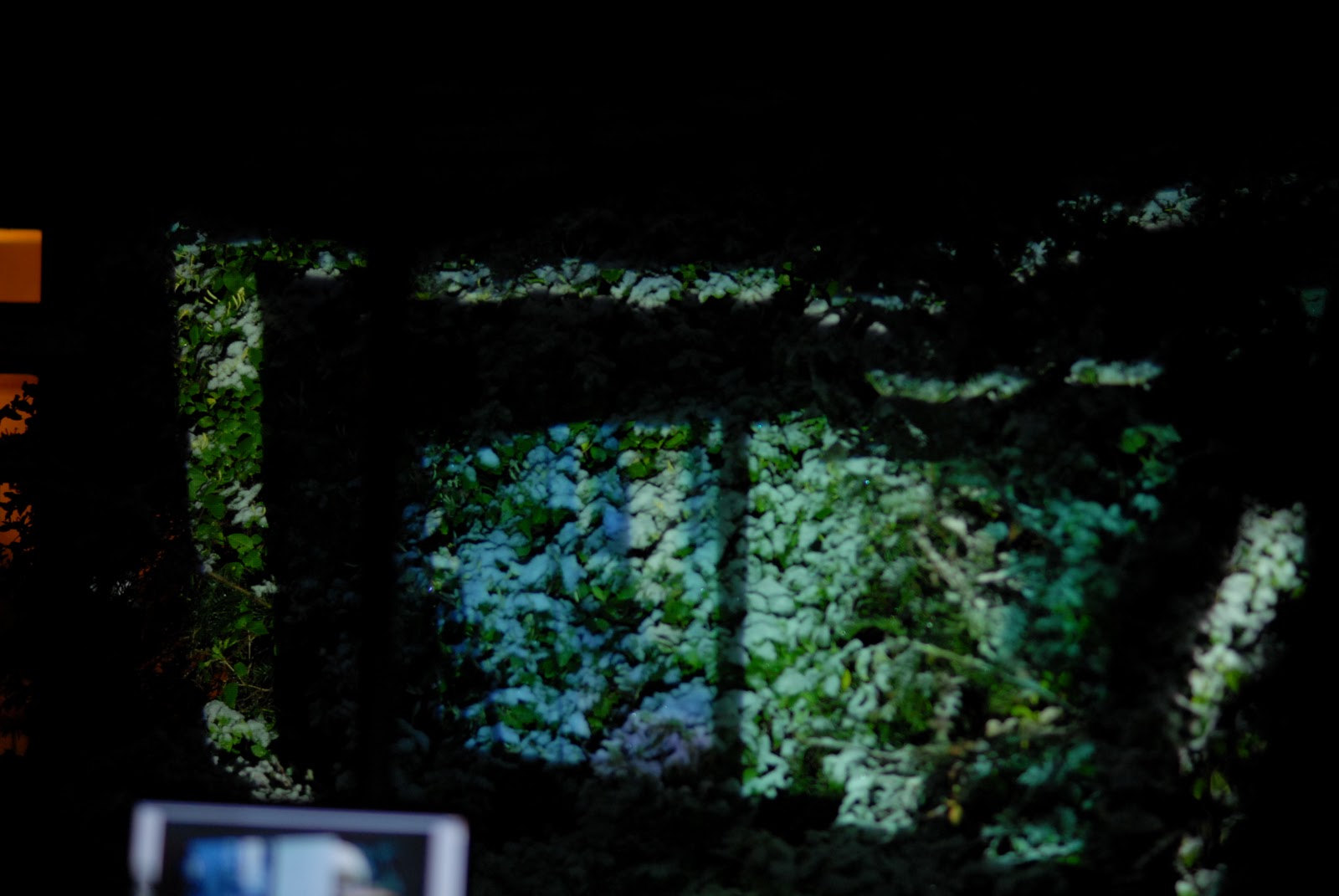
I'm unable to find a drill to make holes in the test plastic sheets. I have been projecting images onto snow, and snow-covered bushes... with little success. 


It is crucial for the surface to be smooth and that it faces the projector flat for an actual presentation of the image - which now seems too obvious - but there were interesting effects.

I've managed to create a possible screen to-be also. I've been thinking of various material to use as the screen, such as plastic, mist, smoke, to achieve the desired atmosphere.


I'll look into ways of controlling mist and smoke tomorrow. Then plastic sheets, once I drill holes in them.

test shots

These are the test shots. Most of the images have been captured in sequences, so I can also explore creating moving image-like sequences from still photographs. Three images below were shot in Leiston, Suffolk. Only the leaves, or shadow of them, appear to move, as it was a still day.


I wanted to create a photo-video merging images with these shots. With part of the image being still, and part moving.


Images shot from train, and in rainy/snowy Norwich.


Thursday, 18 November 2010

Life and Death in Venice


Life and Death in Venice (2010)

This is a work produced by Ming Wong, a 3-channel HD digital video installation, uses screens suspended in air, as well as a video screen mounted into a wall. The suspended screens give the impression of space irrelevant to the physical gallery space, and that of a distance and memory. The story is told through 2 main screens, with the video of the artist playing piano for sound track, on third.


Cornerhouse [2010] Unspooling - Artists & Cinema [Online] http://www.cornerhouse.org/art/info.aspx?ID=417&page=53000 [18/11/2010]
Wong, M. [2010] Life and Death in Venice /Leben und Tod in Venedig /Vita e Morte a Venezia. [Online] http://www.mingwong.org/index.php?/cv/life--death-in-venice-/ [18/11/2010]

Sunday, 7 November 2010

Marxism Today by Phil Collins


Maxism Today (Prologue) (2010)

Phil Collins interviewed former Marxism teachers of the GDR, for his short film Marxism Today (Prologue). In the second room of the exhibition, wooden school desks were set up with headphones, with a screen in front, to allow visitors to experience a Marxism class delivered by one of the teachers Collins interviewed. 


Cornerhouse [2010] Phil Collins: Maxism Today. [Online] http://www.cornerhouse.org/art/info.aspx?ID=418&page=0 [07/11/2010]
Reinhardt, N. & Sultan, C. (trans.) (2010) British Artist Documents Fate of East German Marxism-Leninism Instructors. [Online]
http://www.spiegel.de/international/zeitgeist/0,1518,702680,00.html [07/11/2010]

Fernsehturm by Tacita Dean

Fernsehturm detail (2001)

On Friday, I will be visiting Frith Street Gallery to view Tacita Dean's Fernsehturm (2001) and Palast (2004). I came across Dean's works through my research previously, but this is the first time for me to view her works in a gallery. Below is Dean's text on Fernsehturm, at Marian Goodman Gallery website:


"The Fernsehturm has become the beacon on my Berlin horizon. I look out for it wherever I am, in all weather, with its head so often lost in the low cloud or standing high above the city brilliantly catching the sun. I think it is beautiful; it excites me, yet so many people don't like it. Most Berliners from the former West have never been up it, yet large groups from the former East still book long in advance to have dinner in its revolving restaurant. The Fernsehturm has retained its political edge despite its consumption by the tourist world.

I went up it in 1986 on a college trip to Berlin. I remember the smell, the cloying cakes and the utilitarian atmosphere of this cafe above the clouds. But I loved it. I was told recently that in those days it took an hour to do a single rotation, and that that was exactly how long you were allowed to stay there for: one look at the full 360 degrees of the Berlin horizon and then out, never allowing for a second glance. There were not many public places to eat in the former GDR so a seat in the Fernsehturm restaurant was highly sought after. Consequently, it was one of the better jobs to work for the tower, so the staff were inevitably 'approved by the Party'. It now takes half an hour to do the full rotation. So with the progress of reunification, they have doubled the speed. And now you can stay as long as you like. But the staff, who are for the most part the same staff, still seem to work with the old system. Your order is taken and delivered with impeccable speed and efficiency. They move around the restaurant floor as if choreographed for the corps de ballet, never pausing to show disorientation or doubt as their world continually shifts and moves away from them.

Like the perpetual rotation of the spacecraft in Stanley Kubrick's '2001: A Space Odyssey', a conceit to maintain gravity on board ship, the Fernsehturm restaurant continues to turn almost imperceptibly like the movement of the planets in Space. It was visionary in its concept and a symbol of the future, and yet it is out of date. The Fernsehturm embodies the perfect anachronism. The revolving sphere in Space still remains our best image of the future, and yet it is firmly locked in the past: in a period of division and dissatisfaction on Earth that led to the belief that Space was an attainable and better place. As you sit up there at your table, opposite the person whom you are with, and with your back to the turn of the restaurant, you are no longer static in the present but moving with the rotation of the Earth backwards into the future" (Dean, 2001).


Dean, T. (2001) PART II: FERNSEHTURM, 2001: 16 mm colour anamorphic film with optical sound, 44 minutes: (BACKWARDS INTO THE FUTURE) [Online]  
http://www.mariangoodman.com/exhibitions/2001-05-04_tacita-dean/ [07/11/2010]

Frith Street Gallery (2008) Tacita Dean: Works. [Online] http://www.frithstreetgallery.com/works/view/fernsehturm_detail [07/11/2010]