Friday, 13 November 2009

Tuesday, 10 November 2009

TED Ad Clip

TED.com is a website where I often get inspired by. They bring in speakers to talk about creative ideas on technology, education or design, and most of them deliver their speech in a 20 minute slot. And before every clip, they show a TED ad-like clip where video clips of invited speakers move in a 3D way, which they gather and rotate into a globe, and fades away into the TED logo - symbolising collective intelligence forming a part of TED's mission:
"We believe passionately in the power of ideas to change attitudes, lives and ultimately, the world. So we're building here a clearinghouse that offers free knowledge and inspiration from the world's most inspired thinkers, and also a community of curious souls to engage with ideas and each other." [TED, 2009].


Take a look: Ken Robinson claims schools kill creativity.

TED [2009] About TED. [online] http://www.ted.com/pages/view/id/5

"Selling Democracy" in Europe

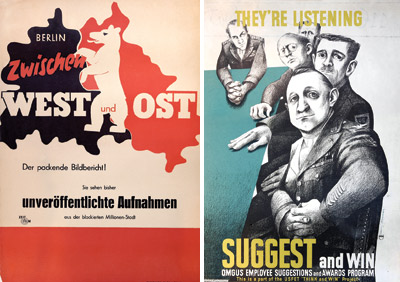
Posters produced by the Office of Military Government / U.S., the occupational authority in Germany after World War II. The office's documentary-film unit was the predecessor of the Marshall Plan motion-picture unit.

The European Recovery Program (or the Marshall Plan, named after Gen. George C. Marshall, secretary of state under President Harry S Truman) funded the war-torn Europe from 1948 until 1950, "when aid to Europe morphed into military support. Credited with speeding up the continent's economic recovery as well as restoring democracy to post-Nazi Germany, it extended the offer of aid even to the Soviet Union and East-bloc nations, which declined the help".

"The German economic miracle was due largely to American aid, and the decrepit nature of the East German economy was due to Russia's stripping of it... but we attributed that to the failure of communism, and the success of capitalism." (Berdahl in Bergman, 2005)

Bergman, B. (2005) A Man, A Plan, A Film Series. [online] http://berkeley.edu/news/berkeleyan/2005/10/26_Marshall.shtml

Photo Montage by Chris Steele-Perkins


The Magnum photographer Chris Steele-Perkins created a photo montage for an exhibition in Tokyo, which can be read individually and interacting of each other also (Steele-Perkins, 2007).
Steele-Perkins, C. (2007) What in Fact DO You Want to Say? [online] http://blog.magnumphotos.com/2007/02/what_exactly_do_you_want_to_say.html

All for One: A Bush Montage


How a collection of photographs are used to form a larger image. This montage image of George W. Bush is created by portraits of US soldiers. More can be seen at aor.macinbytes.com.

Paramount and Stars


Paramount logo with shooting (or falling?) stars.
http://www.youtube.com/watch?v=juGUxQ8FCv4

Berlin, Israeli-Palestinian and Mexico-USA walls

Negotiated Border by Yadiel J Rivera-Diaz highlights 3 border walls of Berlin, Israeli-Palestinian and Mexico-USA. Rivera-Diaz claims that border lines establishe "a distinction between two groups" which can be "political difference, unequal capital distribution, and ideology" and "regardless of their intention for separation, these borders have become places of interaction between the two sides".

Mexico-USA

Israel-Palestine


Berlin


Shaun Tan


Voice of America


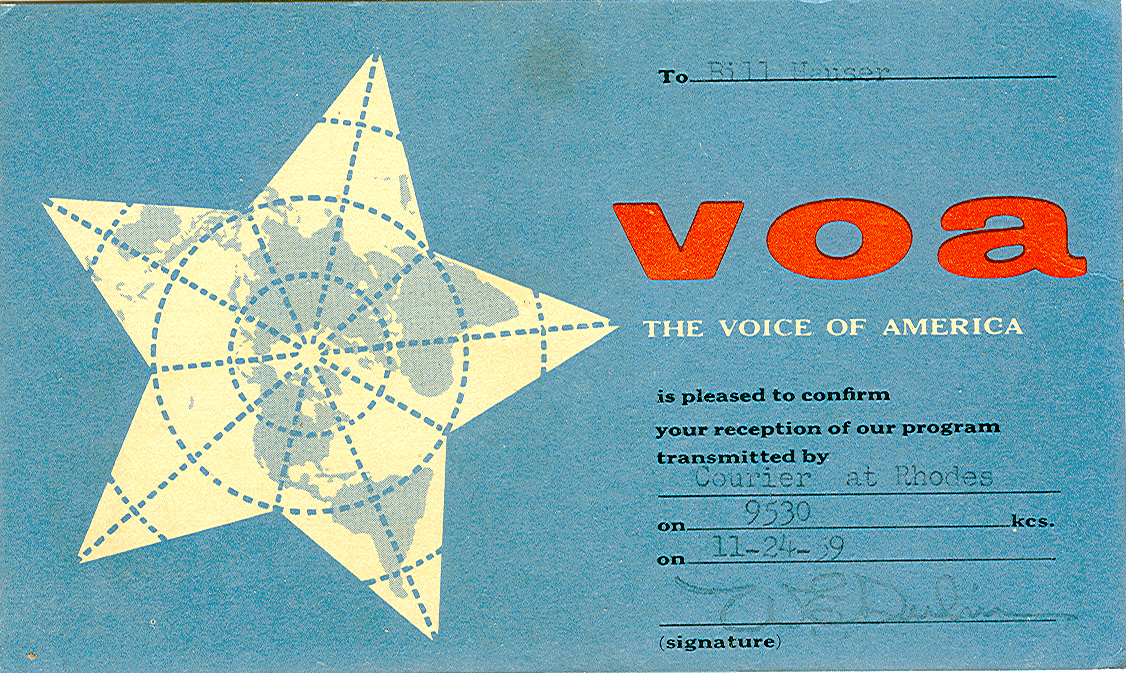
2 articles on the opening of the Wall by Voice of America (VOA). Funded by the American government, VOA first broadcasted has been broadcasting since 1942, throughout the Cold War.

Binder, D. (1990) Evolution in Europe; As Cold War Recedes, Radio Services Face Cuts. [online]
http://www.nytimes.com/1990/06/29/world/evolution-in-europe-as-cold-war-recedes-radio-services-face-cuts.html

De Nesnera, A. (2009) Fall of Berlin Wall Marks End of Cold War. [online] http://www.voanews.com/english/2009-11-02-voa25.cfm

VOA (2009) Fall of the Berlin Wall: 20 Years Later. [online]
http://www.voanews.com/english/BerlinWallAnniv.cfm

Pace, S. (2009) Berlin Wall Celebration Marked by Joy and Caution. [online] http://www.voanews.com/english/2009-11-09-voa28.cfm

Remaining divide


Ever since the legendary press conference on Nov. 9, 1989 when Günter Schabowski, a member of East Germany's Politbüro, surprised journalists with news that people could travel without restrictions, most Berliners wanted to rid their city of what Westerners had dubbed the "Wall of Shame." (Smee, 2009)
Many claim that the Wall which divided the city still remain in people's minds. Referendums in 2008 and 2009 showed a clear split between former East and West Berlin citizens - a divide which can often be seen elsewhere in Germany.

Boston, W. (2008) Tempelhof Airport Divides Berliners Along Cold-War Lines. [online] http://www.csmonitor.com/2008/0425/p04s01-woeu.html

JTW and sources (2009) Ethics-Religion Debate: Berlin Referendum Fails at the Polls. [online] http://www.spiegel.de/international/germany/0,1518,621281,00.html

Smee, J. (2009) Heated History: Berlin Still Divided on How to Commemorate Wall. [online] http://www.spiegel.de/international/germany/0,1518,611790,00.html

Von Hardenberg, D. (2009) Divide Remains as Berlin Celebrates. [online] http://english.aljazeera.net//focus/theberlinwall/2009/11/2009118849234700.html

John Craig Freeman

Imaging Belfast and Expanding Boundaries.

John Craing Freeman (2009) John Craing Freeman Weblog. [online] http://johncraigfreeman.wordpress.com
Senate Department for Urban Development

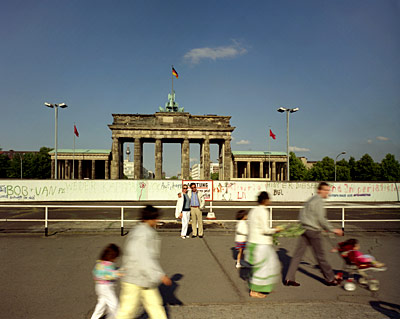
Walks through Berlin provides a thorough map of the Wall with monuments and events relating. Senate Chancellery hosts a similarly detailed site, The Berlin Wall.


Senate Department for Urban Development [2009] Walks through Berlin: Wall Tour - Changes to the Historical Site. [online] http://www.stadtentwicklung.berlin.de/bauen/wanderungen/en/strecke4.shtml

Virtuelle Mauer / ReConstructing the Wall

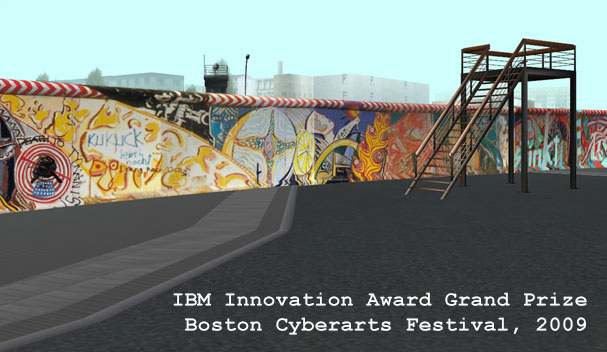
I was expecting a bit more. Beyond Manzanar recreates an interactive space of borders and camps.


Virtuelle Mauer / ReConstructing the Wall: http://www.virtuelle-mauer-berlin.de/english/events.htm
Tamiko Thiel - Online Portfolio: http://www.mission-base.com/tamiko/

Monday, 9 November 2009

Jennifer Daniel


Jennifer Daniel illustrates global issues and politics. There is no direct link between her work and the Berlin Wall, but illustrations such as Security State, 1000 Year Forecast and Immigrationare political and critical.
Daniel, J. [2009] HELLO! My name is Jennifer Daniel. You may call me Carrie A. Nation, Stephanie X, or Lacie Argyle. [online]


What Fell Apart, What Came Together

A day before the 20th anniversary of the opening of the Berlin Wall, or Mauerfall, The New York Times Op-ed editors asked 9 poets to look back at the event for new inspiration. In What Fell Apart, What Came Together poets from Germany, America, Russia and Eastern European countries show their work collectively on a broadscreen, showing various perspectives regarding the event.

Williams, C.K., Şenocak, Z., Šalamun, T, Pavlova, P., Lipska, E., Doty, M., Komunyakaa, Y., Howe, M. and Weigl, B. (2009) What Fell Apart, What Came Together. [online] http://www.nytimes.com/interactive/2009/11/08/opinion/08berlinpoems.html


Sunday, 8 November 2009

Over the Wall

"On the evening of November 9, 1989, I was watching TV. The Berlin Wall was coming down, and I was flabbergasted."

"From my 18-year-old perspective, the wall had always been there, and I had no reason to doubt that it would remain there forever. The news of the wall coming down was like somebody telling me that the Eurasian and North American tectonic plates had reversed course overnight, and that from now on you could stroll from Hamburg to Boston." (Niemann, 2009)
Christoph Niemann, an illustrator and author, observed the opening of the Berlin Wall and on TV and reflects on his visit to the divided city in 1988. He has since moved to Berlin with his family and illustrates the city 20 years on in Over the Wall. Images in his New York Times blog, Abstract City, is created from strips of orange and black coloured paper, woven into one another to form non-digital pixelated images.

In I LEGO N.Y., he replicates items from his memories of New York City, with Lego blocks. Bathroom Art, another pixelated work can be seen on Abstract City.

Niemann, C. (2009) Abstract City. [online] http://niemann.blogs.nytimes.com/
Niemann, C. (2008) Christoph Niemann. [online] http://christophniemann.com/index.html

Friday, 6 November 2009


This is a section of the Wall made of bouncy castle material, showing how the "wall in the mind" is not a solid object. Wall of shower idea relates to Julian Popp's bit.fall.

Thursday, 5 November 2009

Core Unit 05/11/09


Wednesday, 28 October 2009

SelfNeg 28/10/09


Friday, 23 October 2009

Number of Images Increases


The number of photographs that appears on the screen could increase towards the end of the clip, with more voices, and finally will show a constellation as a symbol of co-existance.

Thursday, 22 October 2009

Key Terms, Websites and Images

I have been photographing the streets, fields and forests where the Berlin Wall once stood and separated the city for twenty-eight years during the Cold War - often no more than a double cobblestone line, with occasional remnants of the Wall and border control facilities, forgotten behind adverts and trees. Through this personal photography project to revisit and to document the division, I have interviewed Berliners who have lived in the city during the time of the Wall, to record their experiences and perceptions of the Wall. Previously, I have worked as a photojournalist, and also as a political policy researcher, and these experiences have enabled me to work further on the political/social repotage of the Cold War divided city and its cultural traces. I have walked the entire length of the Wall by August 2009, and I now intend to work further with photographic images and recordings I have collected, in digital media, and broaden my creative practice in combination to technology and media.


Key terms relevant to my practice are: Berlin Wall, Cold War, German reunification, photography, documentation, narratives, experiences and perceptions.

Regarding my practice, I have accessed/researched literature produced on the Wall as well as post-reunified Germany. Historical events and documents surrounding the Wall are thoroughly archived online, by various media, academic and public institutions.

BBC website archives news footage from the post WWII Germany before the Wall was constructed in 1961, to the time of the Wall’s construction and the opening in 1989. iplayer also links BBC programs featuring the Wall or the Cold War.

SpiegelOnline is a website hosted by the German weekly magazine, Spiegel. It runs frequent feature stories regarding the Wall and numerous interviews of politicians and witnesses from former-East and -West German.

Magnum Photos is a collective of photographers which has a strong journalist focus on human rights issues. There are many socio-political photographic works of the Berlin Wall by Henri Cartier-Bresson, Rene Burri, Thomas Hoepker, Sebastião Salgado and others.

Brian Rose is a photographer who has documented the Berlin Wall as well as the Iron Curtain borders cutting accross the European continent. He has photographed the division during the Cold War and also after the changes of 1989 and the German reunification.

Jürgen Müller-Schneck has photographed the Wall from the streets and apartments of Berlin, and also from air in a helicopter.

Rory MacLean blogs for Goethe-Institute and is also the author of Stalin’s Nose, a travel writing through Eastern Europe following the events of 1989.

Christoph Niemann has lived in New York and he currently lives in Berlin. He publishes his illustrations, photographs and scanned drawings based on his ideas and experiences - including the opening of the Berlin Wall - through his New York Times blog.

Websites relevant to my these key terms, and copied images from the websites:

BBC [2009] The Berlin Wall: The Tale of a City Divided. [online] http://www.bbc.co.uk/archive/berlinwall/


MacLean, R. [2009] Meet the Germans. [online] http://blog.goethe.de/meet-the-germans/


Magnum Photos [2009] http://www.magnumphotos.com/


Müller-Schneck, J. [2009] Berliner Mauer: Web Photo Exhibition. [online] http://www.dieberlinermauer.de/


Niemann, C. (2009) Over the Wall. [online] http://niemann.blogs.nytimes.com/2009/05/18/over-the-wall/
 

Senate Chancellery [2009] The Berlin Wall. [online] http://www.berlin.de/mauer/index.en.html


Spiegel Online (2009) Photo Gallery: Remants of the Wall. [online] http://www.spiegel.de/fotostrecke/fotostrecke-44432.html


Rose, B. [2009] Wall. [online] http://www.brianrose.com/lostborder/wall.htm

Ideas to Project a trace


A flash would go off when a person stands in front of the wall, but the shadow of the person will stay and leave a trace.

Monday, 19 October 2009

A Short "ad" for BmB


Some sketches for an ad clip. It will be a combination of the recorded interviews and portraits of the Berliners I interviewed in March and April this year. How can I present the image of Berlin not as "one" but a city made up of individuals... dots? Stars, pixels, dots?
Ideas from my sketch book, 19/10/09

Were these called "stingers"?

Friday, 9 October 2009

Hyb concepts


Thursday, 8 October 2009

Ideas for a Clip


Turn portrait photographs of Berliners I interviewed into a clip. Their voices can appear/dissapear, as their images do simultaniously. With what image can I end?

Tuesday, 6 October 2009

Story Board for Poodle Baloon Light Bulb


We talked about the animation, and instead of my picture turning into someone else's, I had to transform someone else's picture into mine (other people had to do the same, turning other people's work into theirs). Unlike the sketch, the poodle baloon increased its weight, and I had to blow it up in order to get to my energy-saving bulb... I laughed it through, but I still don't know how instead of me zooming in, the dog gained weight.

An Energy-Saving Light Bulb Moment


I made this sketch for one of the MA group activities, which was to make a collaborative animation. We all drew a picture and had to transform our classmates picture into it. It would continue and would be looped up. I chose a light bulb because it seemed like a nice symbol for new ideas, and considering the time we live in, I better use an energy-saving one.

Wednesday, 5 August 2009

Working on Berliners' Interviews

How can I put together a piece with Berliners' interviews... to create an environment where there are many voices and opinions to reflect the diversity of the city? I have sketched an idea so that instead of listening to the entire interview collection, I could present the plurality...

It's hard to see, but this is an illustration to show that one voice would slowly fade away, to be replaced by another voice (which will fade away again) and so on. I have thought this idea to express different ideas (some based on East/West divide) co existing in one, perhaps in a hall. I planned it for BA dissertation page http://www.berlinmitberlin.de/ site, but it never materialised.

Tuesday, 4 August 2009

Developing Berlin mit Berlin


How can I illustrate Berlin with Berlin? I want to show the divide, but co-existing side by side.
Ideas from my sketch book, 04/08/09

Saturday, 1 August 2009

Berlin mit Berlin (Berlin with Berlin)


The Walls of Being is the title and the domain is BerlinmitBerlin, Berlin with Berlin, in German. The Walls of being is a reference to John Berger's The Ways of Seeing, and also reflects my view that the "Wall in the mind" is a character of the city, and neither positiver nor negative. Which is how I came to say "Berlin mit Berlin" - East with West, or West with East.
Ideas from my sketch book, 01/08/09