Friday, 27 May 2011
Planer LC15 ANN 1000
Specification: http://www.planar.com/products/docs/IBU/current_manual/amlcd/mn-planar-lc15-ann-1000.pdf [27/05/2011]
http://www.planar.com/products/docs/IBU/current_drawing/amlcd/076-0534-00B_MECH_OL_LC15.pdf [27/05/2011]
Saturday, 21 May 2011
Displaying images
How can I best display the images I create - is it with a projector, or a glass screen? After talking to Terry and Nick, I have been trying to determine how I should show my work. Without having a set environment for my work, it seemed impossible to design the accompanying soundscape.
I have in mind a plinth/column with glass, a vitrine, or something in between, to place a screen within. This seems more suitable than the large plastic-sheet projection idea I had previously, as I want bright images. My intention is also to show the screen as part of the exhibit, to give emphasis on the observational nature of my work, and a sense of archived documentation and reflection on history. The vitrine would be used if I am to combine a book in displaying the clips, and I'm also looking into a display column with glass windows.
Next week I will get measurements of the NUCA vitrine, and the screens (as well as weighing them, to evaluate how I could hoist them), and discussing it with Nick and Terry. I am intrigued about how we could design the sound scape for images behing a glass or plastic. I'll also check the control menu of the screens to see if there is a timer setting.
Tuesday, 17 May 2011
Bernauer Strasse
A clip to experiment with transitions and discordance. I'd like to present a sense of uncertainty - as many Berliners felt throughout the unification process - and to maintain a level of ambiguous air, also a reflection on diversity of perceptions and experiences since 1989.
Monday, 16 May 2011
whiteonwhite:algorithmicnoir & Winter Garden by Eve Sussman
I manage to visit the Eve Sussman exhibition at Haunch of Venison on the last day, almost by luck. It's very last-minute organisation as usual, and I have left my camera at work.
Winter Garden by Sussman and Simon Lee changes subtly from one video clip - some as still as a photograph - to another. Windows of pre-fab buildings in former-USSR cities are shown on 3 screens, morphing from one to the next, illustrating the dream that once was being "destroyed in a patchwork of humanity" [Haunch of Venison, 2011]. These images left me standing, waiting for more, just so that I can find out what happens next... or does it? Then I see a passerby. How to tell the future from the past, v.2, by Sussman and Angela Christlieb also uses 3 screens, shot during a 72-hour train journey. The window frames in the screen blurs the sence of time, and I'm left to wonder what documentation/observation defines.
How to tell the future from the past v.2, 2009
Whiteonwhite:algorithmicnoir is a film being edited live by a software, combining 2637 video clips with sound, creating "the narrative through unexpected juxtapositions" endless and never repeated (Haunch of Venison London, 2011).
shots from whiteonwhite:algorithmicthriller, 2011
Haunch of Venison [2011] Eve Sussman | Rufus Corporation whiteonwhite:algorithmicthriller 2011. [Online] http://www.haunchofvenison.com/en/#page=london.current.eve_sussman
[13/04/2011]
Haunch of Venison London (2011) Eve Sussman | Rufus Corporation whiteonwhite:algorithmicnoir. [Information sheet]. p.1.
Christlieb, A. [2011] How to tell the future from the Past, v.2. [Online]
http://www.angelachristlieb.com/htttfftp.html [15/04/2011]
Rufus Corporation [2011] How to tell the future from the past v.2. [Online]
http://www.rufuscorporation.com/projects.html#_self [15/04/2011]
Friday, 13 May 2011
Bernauer Strasse
A clip to experiment with transitions and discordance. I'd like to present a sense of uncertainty - as many Berliners felt throughout the unification process - and to maintain a level of ambiguous air, also a reflection on diversity of perceptions and experiences since 1989.
Saturday, 7 May 2011
books, memories and smell
Considering formats of presentation. Last week, I was surrounded by personal history files collected by the East German secret police Stasi. These files are now stored at the government archive in an East Berlin district, in a block occupied by Stasi as their HQ.
The Stasi building complex in Lichtenberg, Berlin
There is a distinctive smell of old paper as I enter one of the storage rooms, of the files that altered many lives, that brings thoughts about Berlin's history and how it deals with its past, of the people's experiences I have heard in my interviews.
Based on this experience, I plan to try out variations of exhibiting using old books and documents, screens, to link memories, emotions. One idea is to cut out a book to fit a screen into it, so that depending on the pages you turn, different parts of the screen becomes visible. Sound enhances the clips I've been testing, and I could possible use smell also, to engage with the audience better.
I think of photographing the shredded/torn pieces on my next visit. Günter Bormann, who interviewed at the BStU library, says people's interests towards the files are changing after 20 years of unification, and not fading away. Perhaps how people perceive history - and the process of German unification - is changing over time also.
Curry, A. (2008) Piecing Together the Dark Legacy of East Germany's Secret Police. [Online]I think of photographing the shredded/torn pieces on my next visit. Günter Bormann, who interviewed at the BStU library, says people's interests towards the files are changing after 20 years of unification, and not fading away. Perhaps how people perceive history - and the process of German unification - is changing over time also.
BStU [2011] Öffentliche Führungen. [Online]
http://www.bstu.bund.de/DE/Archive/OeffentlicheFuehrung/archivfuehrungen_inhalt.html
[07/05/2011]
http://www.bstu.bund.de/DE/Archive/OeffentlicheFuehrung/archivfuehrungen_inhalt.html
[07/05/2011]
Faber, M. (2010) Tree of Codes by Jonathan Safran Foer – review. [Online]
http://www.guardian.co.uk/books/2010/dec/18/tree-codes-safran-foer-review [07/05/2011]
Matas, M. (2011) Mike Matas: A next-generation digital book. [Online]
http://www.ted.com/talks/mike_matas.html [07/05/2011]
Sinclair, M. (2011) Tree of Codes: the making of a die-cut book [Online]
http://www.creativereview.co.uk/cr-blog/2011/april/tree-of-codes-making-of [07/05/2011]
Stafford, N. (2007) Anti-shredder aims to stick spy files back together. [Online]
Friday, 29 April 2011
More interviews in Berlin
I've been interviewing more people in Berlin, which have been successful. Out of many emails I send out requesting an interview, I get few replies, and even less that agree to be interviewed. Connections of people have helped me a lot, as a Berliner I speak to would introduce me to another. I've not had enough time to talk to everyone I had contacts for, but hopefully I will have opportunities later on.
My understanding about the divide and how Berliners experienced it (some still do today) expands every time. It's interesting to reflect on the fact I thought more about recording sound of the city when I first planned this visit, and how it has developed into a different experience from what I expected originally.
I have made up for some of the unrecorded interviews.
Sunday, 17 April 2011
Interviews in Berlin
I have been interviewing Berliners. Some successfully, some not. I have left the recorder on pause thinking it was recording on two occasions... painful lessons. I'll just have to work on getting more interviews.
On the positive side, the wind jammer I made from a tupperware and tights has been working well, and when I interviewed a singer who was performing on Oberbaumbrücke, a bridge that once was a checkpoint, it didn't pick up any noise from the wind.
Saturday, 16 April 2011
Tempelhof airport
This clip was made from shots at Tempelhof airport. Or what used to be. The result of a referendum in 2008 which asked Berliners on the future of the airport showed a divide in opinion between East and West, as well as a low turnout of 21.7%. One Shot, a short film by Dietrich Brüggemann, also uses the runway of Tempelhof, an airport once iconic symbol of Berlin Airlift, with dialogs on integration.
One Shot by Dietrich Brüggemann
Brüggemann, D. (2011) One Shot. [Online] http://achtungberlin.de/programm0/made-in-berlin-brandenburg0/kurzfilme/one-shot/ [16/04/2011]
France 24 (2008) Tempelhof airport supporters lose vote. [Online] http://www.thelocal.de/lifestyle/20080710-12983.html [16/04/2011]
Knight, B. (2008) A turd in Tempelhof. [Online] http://www.thelocal.de/lifestyle/20080710-12983.html [16/04/2011]
Monday, 11 April 2011
Checkpoint Charlie [test with sound]
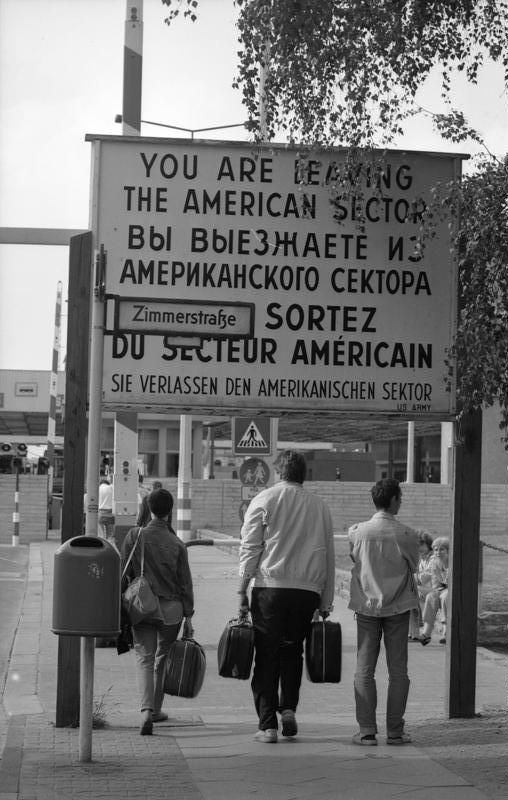
This one is another test with background sound, and uses shots taken from 2 angles looking East and West. The first is shot from the Western side, with the "you are leaving the American sector" sign, and second looks at the Western side, with a convenient representation of McDonald's in the background.
The noise is recorded on the same street, where tourists, coaches and cars, cyclists all fight over the space. It's also the first trial in seeing how I short clips should follow the preceding one. This one just snaps to another.
Deutsches Bundesarchiv (1988) File:Bundesarchiv B 145 Bild-F079005-0022, Berlin, Grenzübergang Checkpoint Charlie.jpg [11/04/2011]
Sunday, 10 April 2011
Checkpoint Charlie [test]
The first clip made from 4 still images, not 2. It's a little more confusing - and complex. I feel the changes are not simply from one to another, but mixture and accommodation of multiple perceptions. I'm trying to add an aesthetic depth to the clips also.
A food court with sushi, kebab and pizza has been replaced by McDonald's, which must have increased the value of Checkpoint Charlie as a tourist trap. The prop-guards will pose with you for €2 - or €1 if you're young and female. Some of them would cover their face with the American flag to prevent tourists capturing images without payment. This particular one had an aggressive attitude towards a family asking tourists for money, mocking them and calling them "gypsies". Perhaps he doesn't appreciate the capitalist competition.
Tourist Lovin' scenes at Checkpoint Charlie.
Traces of advertising in São Paulo
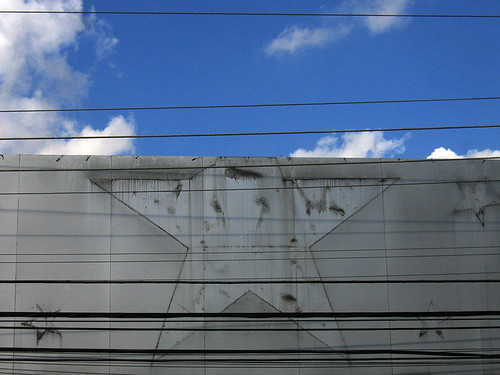
Adverts ban in São Paulo created signs with colours removed and walls with traces. These images share similar visual effect with Sophie Calle's The Detachment.
beckspacing. [Online] https://adayinthalifeof.wordpress.com/tag/sao-paulo-advertising-ban/ [10/04/2011]
De Marco, T. (2007-08) São Paulo No Logo. [Online] http://www.flickr.com/photos/tonydemarco/sets/72157600075508212/ [10/04/2011]Spurlock, M. (2011) The greatest TED Talk ever sold. [Online] http://www.ted.com/talks/morgan_spurlock_the_greatest_ted_talk_ever_sold.html [10/04/2011]
Thursday, 7 April 2011
The Otherside [Die Andere Seite 2007]
"Using first-person testimony from both sides of the divide, this animated documentary explores life with the Berlin Wall. Documenting the ideas, notions and preconceptions of Berliners about life on ‘the other side’, Die Andere Seite is a reflective visual essay on the interplay between myth and reality." (Land, 2007)
Berliners who experienced the divide are interviewed in Die Andere Seite. With segments of private memories, the work forms a broader collective feel/perceptions towards the Wall. With sound that accompany those experiences.
Land, E. (2007) Die Andere Seite 2007. [Online]http://www.ellieland.com/elliesite/?page_id=18 [07/04/2011]
Thursday, 17 March 2011
Saturday, 12 March 2011
design paths
Through consideration, I decide to create a story for the website. It is structured around segments /mages of memories, some distant and vague, some clear and more discriptive. It will not have a clear navigation, as I want to draw the audiences' attention to the fading, subjective and fluid nature of how events are remembered.
Some mysterious and ambiguous elements of James Hart Dyke's work on MI6, and personal and investigative endevour made by Timothy Garton Ash into his own file created by the East German secret police, have influenced my thoughts in composing the ideas and designs of this website.
"How can you ever really know what is fact, what fiction, and what still lies entirely hidden?" (Garton Ash, 1997, p.205)
The hotspots on each pages are not labeled and viewers are required to hover over the images to before they can turn the page of their experience. After travelling through the path without a clear signposts, they will reach a page (or be transfered to) a page which will have my short clip The New Republic. These uncertain stages are in reference to what people experienced in Germany (especially East Germany) after the Berlin Wall was breached and two Germanys unified in 1990.
"Yesterday your secret was hidden in a single dusty cardboard file. Today it lies open on a million breakfast-tables." (Garton Ash, 1997, p.194)
The project also follows a process of recording/observing Berlin, and making public the work I've produced - even though it does not have clear indications often seen in artists' portfolio sites. One idea is to lead visitors eventually to my vimio page.
Mount Street Gallery [2011] A Year with MI6: James Hart Dyke. [Online]
http://www.mountstreetgalleries.com/prints/?page_id=6&shopp_category=2 [12/03/2011]
Thursday, 3 March 2011
Clips from Berlin
I have not met a Berliner who speak positively of the current Checkpoint Charlie. The location is filled with tourists photographing guys posing as U.S. soldiers for 2€, with herds of coaches driving by the Checkpoint museum. I know there are things running deeper - the lives lost seeking freedom, or devastated by the Cold War policies - that are not glossy enough for the coaches to stop.
I'm first surprised with a McDonald's in front of the museum which was't there when I last visited, and I think to myself, it might as well.
This clip was made from shots at Griebnitzsee, on the border of Berlin and Brandenburg. The wall is on the former East German side, with West Berlin in the background. The wall used to have graffiti that changed every time I went, and it's now painted white. The riverside path that ran along the former border has since been cut up by houses built on the riverbank.
...and outside the former Permanent Representative [Ständige Vertretung] of West Germany, in former East Berlin. The facility had to be shut down in August 1989 as it couldn't cope with the number of East German citizens seeking visa to exit East Germany.
The first 2 clips are 20 seconds long, and the last 30.
Sunday, 20 February 2011
Capital cities
2 more test clips, of post-elections Berlin. The city has become the capital city of unified Germany, from being divided by the Wall, although various elections/referendum results show Berliners' diverse values.
Wednesday, 16 February 2011
'Operations can be surreal'
Ideas and concepts for website. I have been searching for a structure which is not as straight forward nor simply a portfolio site, with mysterious and uncertain narrative. The artist James Hart Dyke has worked with MI6, and due to confidential nature, he has made identities of agents vague and hidden.
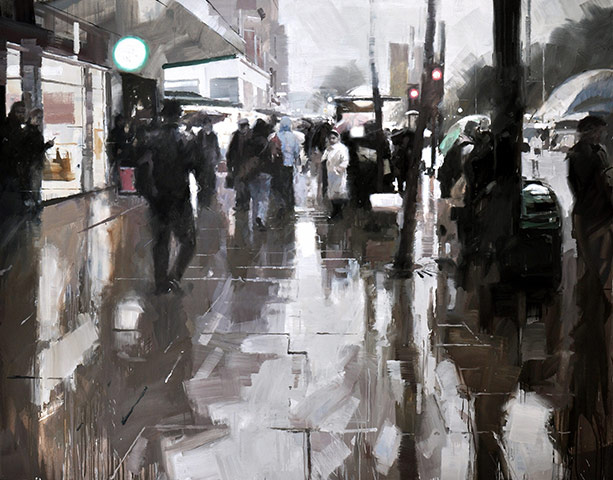
Espionage 2010, oil on canvas. An ordinary street scene. But is it ordinary, or is something out of the ordinary going on here? 'In the world of the spy, extraordinary events happen in the midst of the mundane,' says Hart Dyke. 'Once you're part of that world, you're never sure that things are as they seem. It can seem paranoid but it's paranoia with a point. Is this an ordinary day in a city or is it the scene of an SIS operation?'
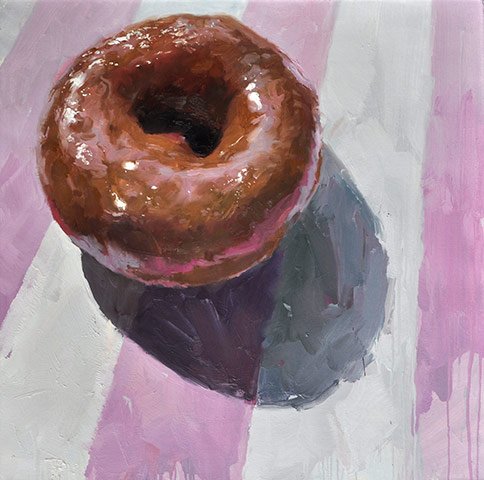
Doughnut on Stripes 2010, oil on canvas. The intelligence community sometimes refer to the GCHQ building as 'the doughnut'
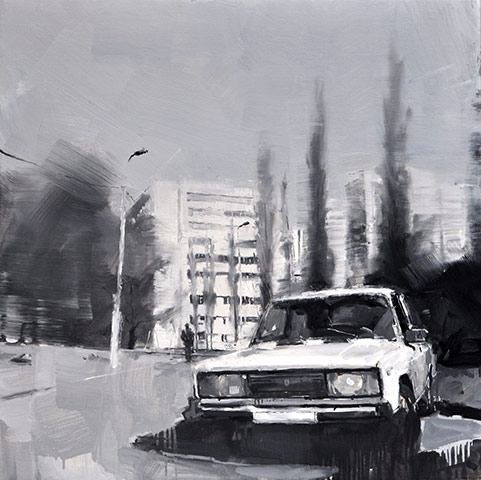
Housing Estate 2010, oil on canvas. A scene reminiscent of the cold war
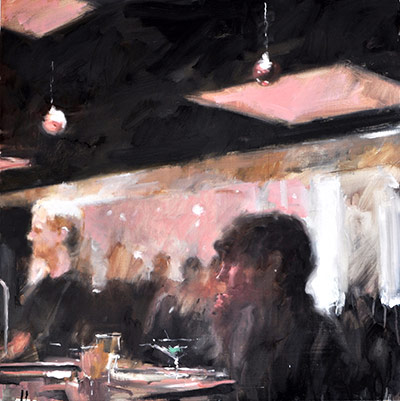
Ice Breaker 2011, oil on canvas. SIS officers need to be able to cultivate contacts. An officer contemplates how she might strike up a conversation with her target, who is having a drink at the bar
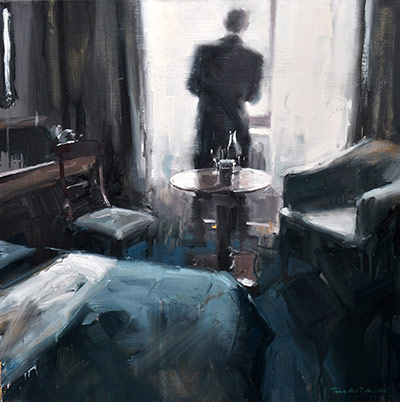
Waiting in the Hotel Room 2010, pencil, watercolour and charcoal on paper. Spies spend long hours working, waiting for contacts and waiting for calls. 'There's a lot of hanging around,' says Hart Dyke. 'You're in a completely ordinary place, waiting for something quite extraordinary to happen... and often waiting for a long time.'
"James Bond, as Ian Fleming originally conceived him, was based on reality. But any author needs to inject a level of glamour and excitement beyond reality in order to sell." (MI6, in Norton-Taylor, 2011)
Guardian.co.uk (2011) James Hart Dyke: A Year with MI6 - in pictures. [Online]
http://www.guardian.co.uk/artanddesign/gallery/2011/feb/14/james-hart-dyke-mi6-in-pictures?intcmp=239 [16/02/2011]
Norton-Taylor, R. (2011) Former spies' verdicts on James Hart Dyke's MI6 paintings. [Online]
http://www.guardian.co.uk/world/2011/feb/14/spies-hart-dyke-mi6-paintings [16/02/2011]
Friday, 11 February 2011
memory clips
I have been creating more clips, reflecting on loss and changes. The first clip pans from left to right, with a piano and a pianist. It focuses on the emotions of loss experienced by residents in the former East Germany, who ofter feel the unified Germany is not interested in hearing their views. The second clip portrays the changes they experience, from welcoming freedom and the democratic changes in East Germany, to uncomfortably altering their ways of life in the new republik.
Subscribe to:
Posts (Atom)