Showing posts with label monument. Show all posts

Friday, 13 April 2012

Collective memory and potential of monuments

The panel at a Frieze Talk, Mark Godfrey (Curator, Tate Modern) Edit András (Art historian and critic) Marko Luliç (Artist) Chair: Simon Rees (Curator, Contemporary Art Centre, Vilnius), addressed "the legacies and potential of monuments and public sculptures... and collective memory with which these objects interact" (Frieze Foundation, 2009).

Frieze Foundation (2009) CAC Vilnius presents: Memories, Monoliths, Monsters? [Online]
 http://www.friezefoundation.org/talks/detail/cac_vilnius_presents_memories_monoliths_monsters/ [13/04/2012]

Monday, 27 February 2012

Berlin elucidated


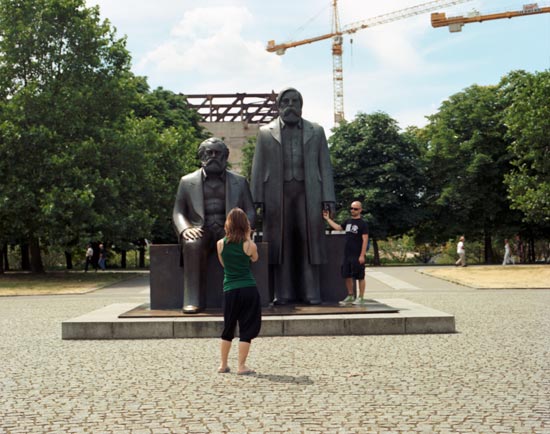
Photographer Warren Naidich notes that the opening of the Berlin Wall delivered immediate and long-term consequences: "this once important monument depicting two famous philosophical figures has become nothing more than a backdrop for staged photographs by tourists visiting the city elucidating the ideological changes that have resulted form the fall of Communism and the rise of Capitalism" [Neidich, 2012b]. 

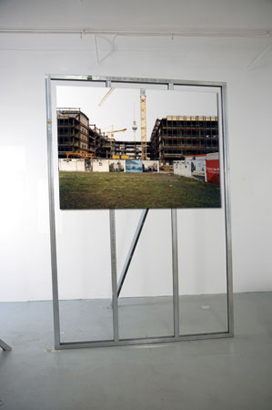
Neidich created a series Marx and Engels (2008-09) from photographs he took between 2008 and 2009. Installed in 1986, the Marx and Engels statue has moved about in Alexanderplatz, and can be seen in his series as a tourist backdrop with the disappearing Palast der Republik. He has also created an installation Undoing the Palast der Republik (2007) capturing the Palast being demolished. 


For the Black Square, Triangle, Circle Fragment 2 (2007), which he describes "a series of performative sculptures that reenact the memory of itself as a fragment of a once enacted performative space," Neidich states that "altogether the undoing of the Palast is metonymic for the process of undoing of Architecture as a cultural act. The Palast was not demolished but is being slowly and meticulously taken apart. The cultural undoing, assimilation and subsuming of the communist block by Capitalism after the fall of the Berlin is re-enacted in this work" [Neidich, 2012a].

Neidich, Warren [2012a] Black Square, Triangle, Circle Fragment 2 (2007) [Online]
 http://www.warrenneidich.com/black-square-triangle-circle-fragment-2-4/ [17/02/2012]
Neidich, Warren [2012b] Marx and Engels (2008-09) [Online]
 http://www.warrenneidich.com/marx-and-engels-2008-09/  [17/02/2012]
Neidich, Warren [2012c] Undoing the Palast der Republik (2007) [Online]
 http://www.warrenneidich.com/undoing-the-palast-der-republik/ [17/02/2012]

Saturday, 18 February 2012

Finding Lenin


Rick Minnich goes photographing statues of Lenin in his work The Book of Lenins (1993-96), which documents his journey to publish a book about Lenin monuments. Minnich digs up the 60 foot Lenin statue which stood in East Berlin until 1992 and was buried by the new German government (Minnich, 2011).

According to a Spiegel report, Berlin plans to dig up this statue for an exhibition at Spandau Citade, to be displayed among statues of various German era (Crossland, 2010).

Crossland, David (2010) 'Hello Lenin': Berlin to Resurrect its Disgraced Monuments [Online]
 http://www.spiegel.de/international/zeitgeist/0,1518,674218,00.html [16/02/2012]
Minnich, Rick (2011) The Book of Lenins - English version [Online]
 http://www.youtube.com/watch?v=hPoejKEuc_Y [16/02/2012]

Wednesday, 8 February 2012

A memorial in Tallinn

"Memory has to belong to people and not the government" (Norman, in Tulca Festival, 2011)
After-War by Kristina Norman is "a case study of the conflict" [Norman, 2012] surrounding the removal of a monument in Tallinn, in 2007. Although for the Russian residents the statue of a solder from 1947 symbolized victory over Nazism and positive identity, it signified the following Soviet occupation and political repression for many Estonians [Norman, 2012]. The Estonian government relocates the Bronze Soldier from central Tallinn to a military cemetery 2.5 km away, in a move according to Norman, to distance the Russian minority community from the majority Estonians, two "memory collectives" (Norman, in Tulca Festival, 2011).

On the Victory Day two years after these events, "I brought a full-size golden replica of the sculpture to its former location, which still remains a sacred place, although the government claims it is now profane. With this act I visualized my argument that although the upstaged problems surrounding the Bronze Soldier and the drama of its relocation are now neatly tucked away and removed from the public space, they nevertheless continue to exist and they should be dealt with" [Norman, 2012].

Norman, Kristina [2012] After-War. [Online]  http://www.cca.ee/?id=11280#Kristinatekst  [08/02/2012]
Tulca Festival (2011) Kristina Norman Tulca 2011. [Online] http://vimeo.com/30189884 [08/02/2012]

Higgie, Jennifer (2010) 10th Baltic Triennial. [Online]
 http://www.frieze.com/issue/article/10th_baltic_triennial/ [08/02/2012]