Showing posts with label divide. Show all posts

Sunday, 5 September 2010

Unifying Nations

South Korean President Lee Myung-bak proposed introduction of "reunification tax" on the country's independence day, although the republic and its separated northern counterpart is technically still at war: its relation based on a ceasefire signed in 1953, "with about 1 million soldiers facing off across the Cold War's last great divide" (Cole, 2010). With no clear indication that North and South Korea are close to reconciliation, and no peace treaty replacing the ceasefire, the president noted that "reunification will definitely come" and that "the time has come to start discussing realistic policies", to prepare for a process which some claim could cost over $1 trillion (Cole, 2010). The state-run Korea Institute of Public Finance, in its 2008 report, said the nation needed to set aside at least 12 percent of its gross domestic product annually, with a $931 billion economy, for the first 10 years of reunification (Lim & Kang, 2010).

Polls show above 60 percent of South Koreans wanting unification, sometime in the future, with concerns that 
North Korea, with less than 3% of the South's economy, based on annual gross national income of about $24 billion, in 2009 (Cole, 2010), or per capita income of the South at 18 times that of the North’s in 2009, according to the Bank of Korea in Seoul (Lim & Kang, 2010).

"It is imperative that the two sides choose coexistence instead of confrontation, progress instead of stagnation", although recent developments on the Korean Peninsula has been extremely hostile. North Korea warned that U.S.-South Korea military drill, which it described "all-out war maneuvers" may be met with "the severest punishment", according to the official news agency (Lim & Kang, 2010). In March, South Korea concluded that North was responsible for the sinking of the corvette Cheonan - a claim which was aggressively denied by the North Korean government - and cut off most trade ties with North Korea

The proposal for a reunification tax, first to be made by a South Korean leader, would add "a dose of reality rather than as a far- fetched goal" to the reunification debate, claimed a senior fellow at the Seoul-based Samsung Economic Research Institute, who also noted, "estimates vary on how much reunification will cost, but there is no question that it will cost a lot". Some estimate the cost to be "at between $322 billion to $2.1 trillion over 30 years (Lim & Kang, 2010).

---

A study reported in 2009 shows that some 1.3 trillion euros ($1.9 trillion) have been transferred from the west to rebuild the east (Graham, 2009). The IWH research institute claimed the net transfers from west to east had, "equivalent to over half Germany's total economic output" in the previous year, increased sharply in the past decade.
"The Cologne-based IW economic research institute said this week eastern output per capita would rise to around 80 percent of western levels from 70 percent now over the next decade. Eastern output was around 33 percent of the west in 1991." (Graham, 2009)
It is not simple, however, to compare the two situations, and the German experience is " is not an appropriate benchmark for Korea", claims Gregory (2010). Some of his argument is that:

1) the German constitution calls "for equal treatment in transfers among the states" and trade unions' demands for East-West wage equality "despite huge productivity differentials at the time of reunification" and "East Germans were required to be paid wages well in excess of their productivity", resulting in "persistent and exceptionally high unemployment in the East". He suggests that Koreans "avoid the mistake of requiring wage equality between North and South". He also claims that social welfare transfers in the South are a small percentage of total government, compare to Germany.

2) East Germany had a large industrial sector, compared to North Korea which has largely an agricultural economy. "Former Eastern state enterprises required large subsidies to keep in business", whereas "agriculture recovers quickly once freed of collective and state farms". 

3) Gregory suggests " the desperate welfare situation of the North could be immediately remedied... at relatively low cost" and the borders "to be opened gradually in light of the huge living standard differentials". 

Cole, B. (2010) South Korea President Calls for Reunification Tax. [Online] http://www.reuters.com/article/idUSTRE67E08K20100815 [05/09/2010]

Graham, D. (2009) (ed. Pizzey, C.) Study Shows High Cost of German Reunification: Report. [Online] http://www.reuters.com/article/idUSTRE5A613B20091107 [05/09/2010]

Gregory, P. (2010) The Low Cost of Korean Unification. [Online] http://whatpaulgregoryisthinkingabout.blogspot.com/2010/08/low-cost-of-korean-unification.html [05/09/2010]

Lim, B. & Kang, S. (2010) South Korea Calls for Unity Tax as North Slams Drills. [Online] http://www.bloomberg.com/news/2010-08-15/lee-says-south-korea-may-need-extra-tax-to-pay-for-eventual-reunification.html [05/09/2010]

-

Choe, S. (2010) South Korean Leader Proposes a Tax to Finance Reunification. [Online] http://www.nytimes.com/2010/08/16/world/asia/16korea.html [05/09/2010]

D.T. (2010) Invitation to a Reunion. [Online] http://www.economist.com/blogs/asiaview/2010/08/south_koreas_reunification_tax [05/09/2010]

Oliver, C. (2010) Seoul Proposes Korean Unification Tax. [Online] http://www.ft.com/cms/s/0/7c2afef8-a855-11df-86dd-00144feabdc0.html [05/09/2010]

Friday, 20 August 2010

Borderland interests


http://wapedia.mobi/en/Museums_of_the_inner_German_border

http://europeforvisitors.com/germany/gdr-tourism.htm
http://europeforvisitors.com/germany/potsdam/lindenstrasse-54-55-memorial.htm

Niedersachsen/Sachsen-Anhalt border

Streesow/Schnackenburg/Gartow
http://translate.google.co.uk/translate?hl=en&sl=de&tl=en&u=http://www.museum-schnackenburg.de/

Museum opening times
May-Oct
Mon to Fri 10-17
Sat 13-17
Sun and Holidays 10-17

Mar-Apr
Mon-Fri 10-16
Sat-Sun 13-16

Easter
Good Friday: 10-16
Holy Saturday 13-16
Easter Sunday 10-16
Easter Monday 10-16

Landwirtschaftliches Museum Böckwitz mit Grenzausstellung
http://www.museum-boeckwitz.de/

sunday:     1 P.M. - 5 P.M.
mon-sat, holiday: by Agreement
Phone: 03900880045
E-mail: info@museum-boeckwitz.de
€ 2

Museum Burg Brome (closed 2009-2011)
http://www.museen-gifhorn.de/burgbrome/burgbrome_start.html
Geöffnet: März – 2. Advent
Mi – Sa 15 – 17 Uhr
Sonn- u. Feiertage 12 – 18 Uhr
Eintritt € 1,–

Junkerende, 38465 Brome
Telefon (0 58 33) 18 20

Schleswig-Holstein/Mecklenburg-Vorpommern border
http://translate.google.co.uk/translate?js=y&prev=_t&hl=en&ie=UTF-8&layout=1&eotf=1&u=http://grenzausstellung.de/&sl=de&tl=en

Tues, Thurs, Fri and Sun: 14.00-17.00

Priesterkate Büchen - Gudower Straße 1 - 21514 Büchen
Telefon: 04155/6141 - Fax: 04155/3941

the museum in Helmstedt and a preserved section of the border at Hötensleben
http://www.grenzdenkmaeler.de/

Tue 15.00-17.00
Wed 10.00-12.00 and 15.00-17.00

Thu 15.00-18.30
Fri 15.00-17.00
Sat and Sun 10.00-17.00
Monday closed

the former checkpoint on the A2 autobahn near Marienborn
http://www.aidan.co.uk/article_gdr_border_tour.htm


Berlin

1990 – The Path to Unification: An exhibition of the German Historical Museum
6 July 2010 - 10 October 2010 http://www.dhm.de/ausstellungen/wiedervereinigung/index.html

Unter den Linden 2, 10117 Berlin
Open daily 10 a.m.–6 p.m.
Daily ticket for all exhibitions: 5 €

Leipzig/Halle

Naturkunde und Militärgeschichte der Dübener Heide gemeinnützige GmbH im Militaer-Museum Kossa
Dahlenberger Str. 1
04849 Kossa, bei Söllichau
22.50 €
http://www.bunker-kossa.de/
http://www.spiegel.de/international/germany/0,1518,687920-3,00.html

Sunday, 2 May 2010

German-German Translation

In 1994, Steve Crawshaw reported that a university department in the east German city of Halle has set up a "German-German translation service" to bridge the linguistic gap between the former East and West Germans (Crawshaw, 1994). 20 years after the opening of the Berlin Wall, Brammertz illustrates what created the gap and how the argument has changed over time (Brammertz, 2009).

Brammertz , C. (2009) (trans. Okech, S.) Linguistic Change: 20 Years After the End of the German Democratic Republic: Has the Language Barrier Been Broken Down? [Online] http://www.goethe.de/ges/spa/siw/en4139259.htm [04/05/2010]
Crawshaw, S. (1994) Out of Germany: German Helpline Breaches the 'Wall in the Head'. [Online] http://www.independent.co.uk/news/world/europe/out-of-germany-german-helpline-breaches-the-wall-in-the-head-1421427.html [02/05/2010]
Stanley Vitte, S. (2009) (Trans. Flügel, E.) Linguistic Change: Dialects in Germany – Changing Variations on the Spoken Language. [Online] http://www.goethe.de/ges/spa/siw/en4230471.htm [04/05/2010]

Tuesday, 8 December 2009

Reunited by a Bridge: Workington

A town which "can legitimately complain that it is now half the town it once was" (Kelly, 2009) is now reunited with a temporary bridge.


Kelly, Jon (2009) Rail station hope for the town cut in two. [online] http://news.bbc.co.uk/1/hi/uk/8377599.stm
Wainwright, Martin (2009) Footbridge reunites Workington after floods. [online] http://www.guardian.co.uk/uk/2009/dec/07/bridge-reunites-workington-cumbria-floods
Wainwright, Martin (2009) Workington divided by broken bridge: 'It's going to take years to correct'. [online] http://www.guardian.co.uk/uk/audio/2009/nov/26/workington-divided-floods-bridge

Monday, 7 December 2009

Another Wall of Division

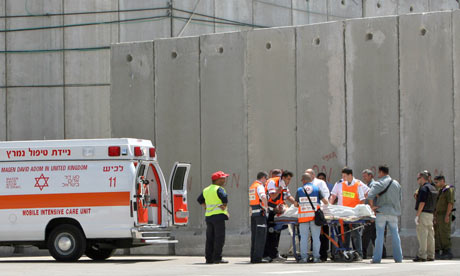
The wall between Israel and Palestine is still physical, and just like the Berlin Wall, it cuts people's lives into bits. This Guardian article is talking about how Palestinian patients are being pressured to become an Israeli collaborator in return for access to medical care.

"Israeli officials deny that entry to Israel for medical reasons is conditional on patients becoming informants but they say security is an issue." (McCarthy, 2009)
McCarthy, Rory. (2009) Israel accused of interrogating medical patients from Gaza. [online] http://www.guardian.co.uk/world/2009/dec/06/isarel-gaza-patients-accusation-interrogation 

Thursday, 3 December 2009

Two Berlins Kiss


This is an image created by Ina Mar, using prints and Photoshop, for the 20th anniversary of the opening of the Berlin Wall. It was designed from silhouettes of two people kissing and shapes of East and West Berlin, and the writing "Wir hasses Grenzen" - we hate borders, which refers to the Wall.


Ina Mar [2009] Fall of the Berlin Wall – 20th anniversary (1989-2009). online] http://blog.ina-mar.com/?p=196

Wednesday, 2 December 2009

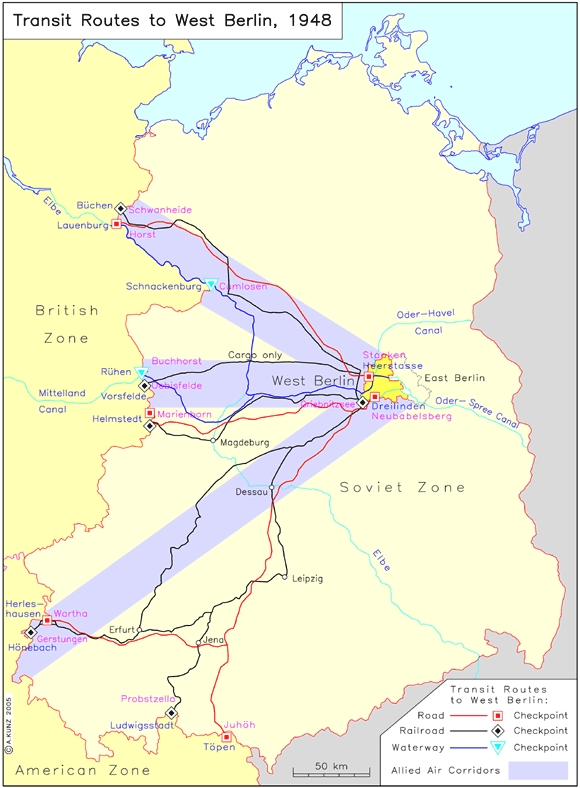
Maps of Berlin and Germanys


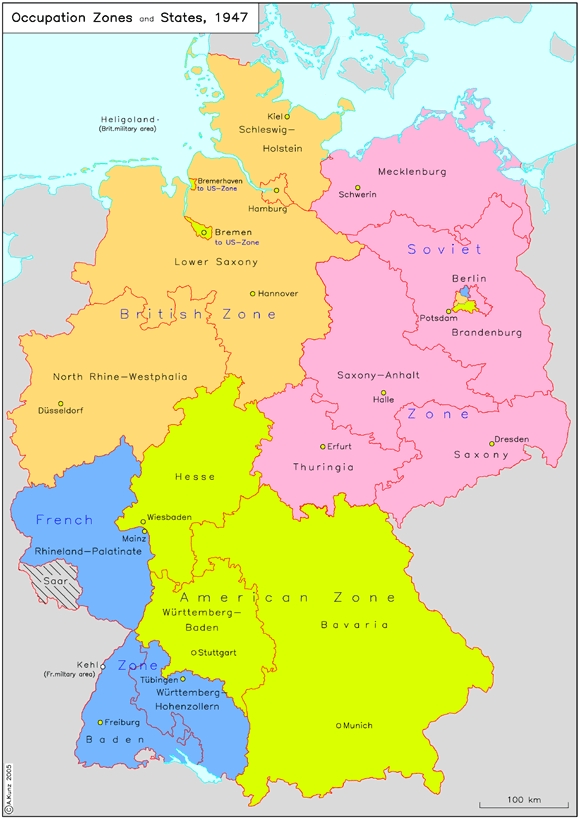
The map of Germany had been frequently updated since the end of the WWII, following military occupation and political changes. Various border changes can be seen at GHDI.

Saturday, 28 November 2009

Vardit Goldner Photographs Israel/Palestine


Vardit Goldner is a documentary photographer who focusses on social and human rights issues. The image above is taken in the occupied territory of Hebron, located in a Palestinian city (Goldner, 2009).
Goldner, V. (2009) My Art: Vardit Goldner. [online] http://www.saatchi-gallery.co.uk/stuart/ViewArtWorks/ast_id/82811

Torn and Hackescher Markt


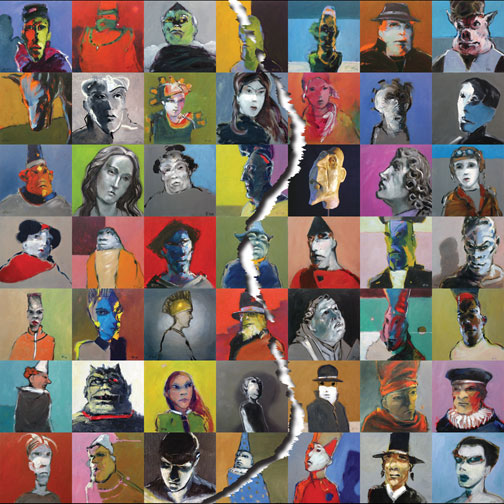
Hans Feyerabend's work Torn was displayed at Rise & Fall, an event commemorating the opening of the Wall [Feyerabend, 2009].

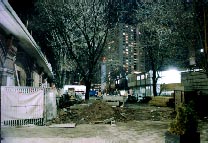
In 1997, the artist worked around the Hackescher Markt station in Berlin, in the central district of former East Berlin, recording images of buildings, signs and materials in the night.

Debris, Berlin 1997, Bahnhof Hackescher Markt
Feyerabend, H. [2009b] Photography Series Berlin - Bahnhof Hackescher Hof, Winter of 1997. [online] http://www.feyerabend.com/pages/photo.html

Friday, 20 November 2009

The Wall Between Art and Design


At the Core Unit session yesterday, the group of MA students were split into small groups to analyse a short film. This was the second Core Unit session where I noticed a boundary between Fine Arts students (from Fine Arts and Drawing courses) and "designers" (from DIgital Arts and Sound & Animation courses). Many "design students" are sometimes referred to as people who aren't exactly artists.

I've talked to my friends in Digital Arts and Animation & Sound Design courses, and they have noticed this too. I think we all see ourselves as artists, but one group seems to think the other isn't. Is there a divide of perceptions between the two groups? Is there another wall?

I remember a session where we discussed whether there were art and design differences in creativity. Most of us thought there were subtle differences... but it seemed as if design was not part of "art". In the discussion group we loosely agreed that  artists and designers are as creative as one another. Is it that important to differentiate? 

"Some designers consider themselves artists, but few artists consider themselves designers" and this is due to the "entirely different" relations they have within the creative culture, claims O'Nolan [2009]. 

O'Nolan, J. [2009] The Difference between Art and Design. [online]
 http://www.webdesignerdepot.com/2009/09/the-difference-between-art-and-design/


http://jehiah.cz/archive/design-is-not-art


http://www.we-make-money-not-art.com/


BBC (2009) In Pictures: Meeting at the Fence. [online] http://news.bbc.co.uk/1/hi/7908368.stm