Showing posts with label border. Show all posts

Monday, 23 April 2012

"Snackpoint Charlie" sees new cold war


There's a "new cold war" at Checkpoint Charlie, between commercial and historical interests, claims Connolly (2012). Although the site has been a tourist destination than a place of reflection for some years now, new developments seems to have an emotional impact on those involved.

Connolly, Kate (2012) Checkpoint Charlie's new cold war with the hot dog vendors. [Online]
 http://www.guardian.co.uk/world/2012/apr/22/checkpoint-charlie-hot-dog-vendors [23/04/2012]

Thursday, 1 March 2012

November, 1990

Excerpts from Brian Rose's journal, who captured images of East/West European borders. In 1990 he was on his way back to Berlin to photograph the aftermath and what once was the Wall.

Rose, Brian (1990) Journal Excerpts: November, 1990 [Online]
 http://www.brianrose.com/lostborder/journal.htm [26/02/2012]

Saturday, 25 February 2012

European borders


Border, an exhibition of works by Martin Sigmund, is on display until 28 March in Stuttgart. The photographs show a collection of deserted border checkpoints across Europe made redundant by the Schengen Agreement, and express a sense of the past and nostalgia.


I wondered if the description "D-DDR" on the label for the Dreilinden Checkpoint Bravo photo was intentional (as opposed to saying "BRD-DDR"). Although it made me think about the FRG-GDR relationship, the photographer later told me that he chose to use D and DDR based on car national identification stickers, which I think is appropriate as these checkpoints were inspecting cars crossing the border.

Photo Presse (2012) Martin Sigmund. Border [Online]
 http://www.photopresse.de/content/view/10162/52/ [15/02/2012]
Sigmund, Martin [2012] Border [Online]
http://www.martinsigmund.com/ [15/02/2012]
TREFFPUNKT Rotebühlplatz (2012) Martin Sigmund | Border [Online]
 http://www.treffpunkt-rotebuehlplatz.de/ausstellungen/ [15/02/2012]

Monday, 6 February 2012

Joshua Lutz and borderlands


Joshua Lutz's series The Border focuses on the lives by the US-Mexico border. Below are the photographs from his work Meadowlands.

"As fond as I am of documentary photography I think that we have come to a point in the history of photography where we need to think about photographs more in the way we do paintings and less in the traditional sense of a document. For that reason I generally don’t caption or title my work and I try not to say too much about the process of making my work. I like the ideas of possibilities and the more I talk about them the less experiences people can have with looking at them." (Lutz in Hulin, 2008)


"One of my first assignments was to travel the Texas-Mexico border. It came as a welcome relief from the Meadowlands project I had been struggling with. There was something really nice about the massiveness of this task, and the impossibility of coming to any conclusions on a place I knew so little about." [Lutz, 2012]

Hulin, Rache (2008) Shoot! Interview: Joshua Lutz and The Meadowlands. [Online] 
Lutz, Joshua [2012] The Border. [Online]

Tuesday, 25 October 2011

Politics at Checkpoint Charlie


Stand off at Checkpoint Charlie in 1961 only affirmed "the Four Power status of the city," notes Colitt (2011). Military officials and diplomats of the Allies were able to cross the Wall after the hostile confrontation at the border 50 years ago, while Berlin remained divided. It takes 28 years for the Wall to open up.

Colitt, Leslie (2011) Berlin crisis: the standoff at Checkpoint Charlie [Online]
 http://www.guardian.co.uk/world/2011/oct/24/berlin-crisis-standoff-checkpoint-charlie [24/10/2011]

Saturday, 1 October 2011

Cross-border Facebook friends


Peace on Facebook has created a graph based on the numbers of friend connections between people of different regions, religions and political affiliations. The image above shows connections made in regions Israel-Palestine, Albania-Serbia, India-Pakistan and Greece-Turkey (Peace on Facebook, 2011). 


Social Interactive with Facebook, UNESCO and the Stanford University Persuasive Technology Lab have created the visualisation above, using "networked technologies to transcend identity-based difference, and cultivate connectedness across conflict divides" [Social Interactive, 2011]. It is also "creating live-action video diaries" where "video stories will catalyze a powerful global outreach campaign to foster cross-conflict friendships in each region" [Social Interactive, 2011].

Peace on Facebook (2011) Friendships on Facebook [Online] http://peace.facebook.com/ [01/10/2011]
Social Interactive [2011] Friends witout Borders [Online] http://www.socialinteractiveinc.com/case.html
 [01/10/2011]

Sunday, 16 January 2011

web+concepts

Heath Bunting's web installation _readme links each word from a newspaper article to a .com website of the same name. In this project, where "everyday language becomes totally occupied by the owners of Internet domain names utilizing almost the entire vocabulary" , one of the characteristics of the web, "an endlessly linked information space" is highlighted [Medien Kunst Netz, 2011]. 

For the project BorderXing, Bunting travelled along inner European borders and created an online "documentation of walks that traverse national boundaries", with limited web page access, challenging "the supposed liberties that accompany the concept of the Internet as a borderless space" [Tate, 2011]. Bunting creates a situation where people "are being refused at the entrance and because they require a certain appreciation of how to preserve, develop and mutually share a precarious knowledge without compromising the project as a whole". In the project Schneider [2011] calls "an electronic antidote against any virtual or real border regime", audience visiting a website out of curiosity "find they have to prove their credentials".

Olia Lialina's My Boyfriend Came Back From the War splits the screen when a viewer clicks on a text or images, leading on to further dialogues and questions, and "into subdivisions of increasing complexity" (Paul, 2003) and provides the user to drive the narrative. 

Lialina, O. (1996) My Boyfriend Came Back From the War. [Online]
 http://www.teleportacia.org/war/war.html [16/01/2011]
Medien Kunst Netz [2011] Heath Bunting «_readme» [Online]
 http://www.medienkunstnetz.de/works/readme/ [16/01/2011]
Paul, C (2003) Digital Art. London: Thames & Hudson.
Tate [2011] BorderXing Guide  2002 - 2003: Heath Bunting. [Online]
 http://www.tate.org.uk/intermediaart/borderxing.shtm [16/01/2011]

Wednesday, 12 January 2011

Lichtgrenze / Border of Lights

Designed by WHITEvoid to mark the anniversaries of the Wall's opening. Each balloon contains an LED light. These balloons will be released after 28 minutes, 1 minute for each year that the Wall divided the city. The installation marks where the Wall once stood, and celebrates the joy of freedom by releasing the balloons.


Eva Meyer-Keller also used balloons in Volksballons und geklonte Krieger at Palast der Republik, an installation also connecting time and memory.

Eva Meyer-Keller: http://www.evamk.de/daten/volksde.php
WHITEvoid: http://www.whitevoid.com/
WHITEvoid's Photostream:  http://www.flickr.com/photos/whitevoid/

Thursday, 19 August 2010

Otjesd/Leaving


Otjesd/Leaving (2005)
15 min, color, sound

Otjesd (Отъезд) is a short film by Clemens von Wedemeyer, focusing on the immigration of Russians to Germany, an increasing phenomenon seen after the opening of the Berlin Wall and the changes in Eastern Europe. The 15 minute film is filmed in a single shot - and was shown as a continuum at the Kunstmuseum Stuttgart - capturing "an imaginary scene of people waiting for visas in front of the German consulate in Moscow", with the camera follows a young woman trying to enter the building [UbuWeb, 2010]. The Russian dialogues in the original film are "not dubbed or subtitled, creating for the viewer an atmosphere of confusion and disorientation" and "the scene was shot neither at a consulate nor in Moscow, but in a forest near Berlin" [UbuWeb, 2010]. 

UbuWeb [2010] Clemens von Wedemeyer. [Online]
http://www.ubu.com/film/wedemeyer_otjesd.html [19/08/2010]

Shortfilm.de [2010] Clemens von Wedemeyer. [Online]

Sunday, 8 August 2010

miniature checkpoint


Brandt, E. (2008) Reunification in Miniature. [Online]
http://geotypografika.com/2008/10/02/reunification-in-miniature/ [31/07/2010]

Wednesday, 28 July 2010

Fall of Berlin Wall was a hot moment for conservation - environment - 28 July 2010 - New Scientist


After the Berlin Wall fell in November 1989, it was only a matter of time before Germany would be reunified and its internal borders redrawn. Over the following 10 months, one man, Michael Succow seized the moment to set aside large chunks of land as nature reserves.
Propelled into the East German government in its dying days, the peatland ecologist managed to get 4.5 per cent of the state's land set aside as national parks and biosphere reserves. These were East Germany's first protected areas... Succow's historic intervention has now been shown to be part of a general trend: countries tend to set aside vast tracts of land for conservation in "hot moments", rather than building protected areas slowly over time.
...
These hot moments often coincided with periods of dramatic social or political change. For many African countries, this was in the 1960s and 1970s, at the end of the colonial era; in eastern Europe and the former Soviet Union, the peak of activity was in the early 1990s. "Both outgoing and incoming governments are prone to design new protected areas," [Volker] Radeloff told the meeting.
Succow, who had long opposed the East German regime, realised that he had the chance to change history only after he was appointed deputy to environment and water minister Hans Reichelt.
Reichelt, a convinced supporter of the regime, was devastated by its end, but seems to have seen in Succow a chance to correct its dismal environmental record. "He said: 'I have made many mistakes. You must make it better,'" recalls Succow, who was moved into offices in the ministry once occupied by the Stasi secret police and given freedom to employ like-minded colleagues. "In one week, I had a staff of highly motivated people."
On military land, security zones along the border with West Germany and hunting areas set aside for the amusement of the governing elite, Succow's team found that East Germany had jewels of undisturbed biodiversity. A huge chunk was set aside as one of the final acts of its government. And after reunification, other areas prioritised by Succow were also protected, bringing the total to 12 per cent of the land area of the former East Germany.
Radeloff warns that more work is needed to identify the precise combination of circumstances that create hot moments for conservation. He hopes other researchers will study the phenomenon, so that conservationists can effectively target the "when" as well as the "where" of protecting biodiversity. "We need to identify the right moment to strike," he says.
Aldhous, P. (2010) Fall of Berlin Wall was a Hot Moment for Conservation. [Online] http://www.newscientist.com/article/dn19233-fall-of-berlin-wall-was-a-hot-moment-for-conservation.html?DCMP=OTC-rss&nsref=online-news [28/07/2010]

Thursday, 27 May 2010

Propaganda across Intra-Korean Border


The Korean peninsula has been divided between South and North Koreas since the end of the Korean War in 1953, with Demilitarized Zone (DMZ) stretching 2km on each sides of the border: it is "the most heavily armed border in the world", and a popular tourist destination [Korea Tourism Organization, 2010].


Since the sinking of the South Korean navy corvette Cheonan, both sides have intensified propaganda operations across the border in attempts to reach citizens across the border, broadcasting through loud speakers and radio. Activists in South Korea have been floating helium balloons with leaflets, in an effort to deliver messages to citizens in North Korean (BBC, 2010), where the government threatening to close up its border (Branigan, 2010).

A BBC news clip from 2008

BBC (2010) Inter-Korean Crisis: Propaganda Fight. [Online]
http://news.bbc.co.uk/1/hi/world/asia_pacific/10161184.stm [27/05/2010]
BBC (2008) Propaganda balloons Enter N Korea. [Online]
http://news.bbc.co.uk/1/hi/world/asia-pacific/7719064.stm [27/05/2010]
Branigan, T. (2010) North Korea Threatens to Close Border with South as Relations Worsen. [Online] http://www.guardian.co.uk/world/2010/may/26/north-korea-border-south-relations-worsen [27/05/2010]
Korea Tourism Organization [2010] DMZ Tours. [Online]
http://www.visitkorea.or.kr/ena/SI/SI_EN_3_4_1.jsp [27/05/2010]
Thatcher, J. (2009) Border Tension: N. Korea Tries to Push Obama with S. Korea Threat. [Online] http://www.welt.de/english-news/article3118038/N-Korea-tries-to-push-Obama-with-S-Korea-threat.html [27/05/2010]

Getz, A. (2010) War Tour. [Online] http://www.newsweek.com/2010/04/15/war-tour.html [27/05/2010]
Troy, T.M.Jr. (2008) The Cultural Cold War: The CIA and the World of Arts and Letters. [Online] https://www.cia.gov/library/center-for-the-study-of-intelligence/csi-publications/csi-studies/studies/vol46no1/article08.html [27/05/2010]

Sunday, 7 March 2010

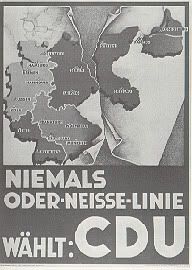
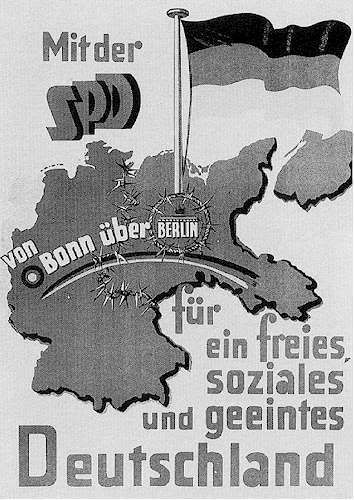
CDU and SPD Posters


Both the Cristian Democtrats and the Social Democrats claimed the territory beyond the Oder-Neisse Line, according to these election posters, now a recognised border between Germany and Poland.


Ederic O (2009) Re: Thatcher (and Mitterand, and Bush I) Opposed German Reunification. [online] http://forum.dune2k.com/index.php?PHPSESSID=no2nb6begjchnpj2pv3nguiul0&topic=21995.msg346918#msg346918 [05/-3/2010]

Saturday, 6 March 2010

Point Alpha: Between Germany and Germany


Point Alpha, on the border of Hessen and Thüringen, was a point on intra-German border. Now there is a memorial, and a piece of the Berlin Wall (Point Alpha Stiftung, 2009) at a location on Fulda Gap (Somaskanda, 2009).

Point Alpha Stiftung (2009) For Peace and Freedom in Europe. [online] http://www.pointalpha.com/home [05/03/2010]
Somaskanda, S. (2009) Cold War Tourism at Fulda Gap. [online] 
http://www.globalpost.com/dispatch/germany/090530/cold-war-tourism [05/03/2010]

Wednesday, 3 March 2010

Border Film Project


The Border Film Project handed disposal cameras to migrants and minutemen volunteers on the U.S.-Mexico border. The project has received 73 cameras: 38 from migrants and 35 from minutemen, and nearly 2000 photographs [Border Film Project, 2010]. There is a similar project taking place at the South Africa-Zimbabwe border also.

The Project is an art collaborative of undocumented migrant workers on one side of the border, and minutemen who are trying to stop the workers from entering the U.S. Visits to humanitarian aid groups and shelters on the Mexican side were approached to recruit migrant photographers. This process included showing the photographers what postboxes looked like in the U.S., so that they were able to send the disposal cameras back to the project.

Although the groups on each side of the U.S.-Mexico border have different interests/stakes, both sides have a common view, that they are documenting a situation which should not be happening.

Border Film Project [2010] Photos by Migrants & Minutemen on the U.S.-Mexico Border. [online] http://www.borderfilmproject.com/en/index.php [03/03/2010]
Adler, R., Criago, V. & Huneycutt, B. (2007) Border Film Project. New York, N.Y.: Abrams.

Mapping Ideas

If the Nazis had won the WWII, the map of Europe could have looked like the one above. Of course, this never happened and the map is a fiction. There are maps which don't simply show the geological facts, but help visualise cultures or a phenomenon also.

 
Mengisen, A. (2009) Maps: Fighting Disease and Skewing Borders. [online] http://freakonomics.blogs.nytimes.com/2009/11/09/maps-fighting-disease-and-skewing-borders/ [03/03/2-1-]
Strange Maps. [2010] http://strangemaps.wordpress.com/ [03/03/2010]

Enclaves, Exclaves

West Berlin was an enclave located in the middle of the GDR, detatched from West Germany. This geological characteristic of the city lead to historical events such as the Berlin Airlift and the construction the Wall. This dilemma resolved when Germany was unified in 1990 and Berlin became one city, but there are numerous enclaves and exclaves scattered across the world.


Robinson, R. (2010) Enclaves of the World. [online] http://enclaves.webs.com/ [03/03/2010]
Krogh, J.S. (2010) Enclaves, Exclaves and the Likes. [online] http://geosite.jankrogh.com/ [03/03/2010]

Sunday, 28 February 2010

The Green Iron Curtain

This is a cross border conservation which also aims to develop local communities socio-economically. 

European Green Belt (2006) The Green Belt Initiative. [online] 
http://europeangreenbelt.org/indoor.html
[28/20/2010]

Monday, 23 November 2009

Photographic Journey of 1989


Hungarian border guards dismantling barbed-wire fencing along the Austrian border [New York Times, 2009]. This is one part of the 1989 changes which opened up the Berlin Wall in November.

New York Times [2009] The Year the East Cried 'Freedom!' [online] http://www.nytimes.com/slideshow/2009/11/08/world/20091109-EAST_index.html

Illustrated Border Strip and Measurements


This is an illustration of the border strip, with measurements of the concrete slabs on the outer and rear Walls and signalling mechanism.
New York Times (2009) The Berlin Wall. [online]
http://www.nytimes.com/imagepages/2009/11/06/world/08berlinwallgrfxB-ready.html?ref=europe