Showing posts with label Stasi. Show all posts

Tuesday, 3 January 2012

Documentation and live imprisonment at Hohenschönhausen


Franziska Vu's exhibition Detained [Inhaftiert] combines photographs with interviews of Stasi prisoners, to create an exhibition to reflect on recent German history. Vu's collaborative "live-imprisonment" (DPA/The Local, 2009) project in 2009 at the Stati prison Berlin-Hohenschönhausen Stasi prison, with former prisoner Carl-Wolfgang Holzapfel planning to live in a cell for a week, ended with Holzapfel's psychological distress [Gedenkstätte Berlin-Hohenschönhausen, 2012].

DPA/The Local (2009) Emotional strain ends former Stasi prisoner's live re-enactment [Online]  http://www.thelocal.de/society/20091102-22971.html [03/01/2012]
Gedenkstätte Berlin-Hohenschönhausen [2012] 24/7 Stasi-Live-Haft [Online] http://www.stiftung-hsh.de/page.php?cat_id=CAT_1&con_id=CON_1516&page_id=867&subcat_id=CAT_1&recentcat=&back=
 [03/01/2012]
Kulturring in Berlin [2012] Inhaftiert/Detained. [Online]
 http://www.kulturring.org/konkret/inhaftiert/index.htm [03/01/2012]

B
Herschdorfer, Nathalie (2011) Afterwards: Contemporary Photography Confronting the Past. London: Thames & Hudson.
Rosenberg, Steve (2009) Reliving Stasi isolation - for art. [Online]
 http://news.bbc.co.uk/2/hi/europe/8333148.stm [03/01/2012]

Sunday, 1 January 2012

UK should hand over Stasi files: poll


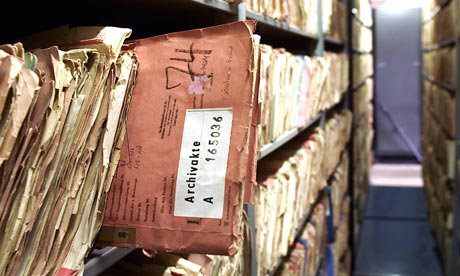
Three out of four participants of the Guardian poll said that the British government should hand over the files containing the names of Britons who spied for the Stasi to Germany. 1056 (75.8%) were in favour and 337 (24.2%) against. The poll is now closed.

The Rosenholz (Rosewood) microfilm images "contain 280,000 files giving basic information on employees of the foreign intelligence arm of the former GDR" and were obtained by the CIA shortly after the opening of the Wall. The "files relating to Stasi activity in the UK were given to MI5 by the Americans in the 1990s" and "they will be made available, unredacted, to scholars and historians" if the files are returned to Germany, disclosing British Stasi collaborators for the first time (Pidd, 2011).
"Asked by the Guardian why Britain refused to hand over the Rosenholz files, the Foreign Office, which handles press requests for MI5 and MI6, said: "We don't comment on intelligence matters." (Pidd, 2011)
Pidd, Helen (2011) Stasi files row as Britain refuses to return documents to Germany. [Online]

Friday, 30 December 2011

Should UK return Stasi files to Germany?


The Guardian is running an online poll on whether the British government should hand the East German secret police files over to Germany.

What do you think?

The Guardian (2011) Should the UK hand over Stasi files to Germany? [Online]
 http://www.guardian.co.uk/commentisfree/poll/2011/dec/29/uk-stasi-files-germany [30/12/2011]

Wednesday, 7 December 2011

Thomas Demand's National Gallery


Thomas Demand creates "a strudel of putting sculptures and photographs and concerns of painting into one" by constructing life-size scenes to photograph. He talks about his exhibition National Gallery which coincides with the anniversaries of the foundation of the Federal Republic of Germany and the opening the Wall, "two pivotal historical events in German history" (This is Tomorrow, 2009). Focusing on the collective memory of Germany, Demand describes his intention to capture "society falling apart and a new one forming" (Demand, in Bound, 2011) through a raided Stasi office. 

Office (1995)
"The tacit nature of this work's Germanness is striking. Imagine walking through an exhibition by Joseph Beuys devoted to the idea of the German nation without having to notice that this is the theme. Impossible. For Gerhard Richter, even more impossible. With Sigmar Polke, Hanne Darboven, Anselm Kiefer, Isa Genzken or Martin Kippenberger--for any of the photographers of the Becher school, too--a reflection on Germany and the traces of its history in the present could only be patent, unavoidable. Is this Demand's lesson: that Germany is now no different from anyplace else, that it is at last a normal, self-confident European nation like any other, unburdened of the memory of its historic tragedies, free of the guilt and resentment that have weighed so heavily on Demand's precursors? Has the effort of Vergangenheitsbewältigung (coming to terms with the past), a process as cumbersome as the word, been completed, or has it simply fizzled out?" (Schwabsky, 2009) 
"...What counts as destruction, and what counts as 'ours,' depends on your viewpoint. In 2002 the German Parliament voted to demolish the Palast der Republik, the grandiose seat of the former East German Parliament... It had been closed since 1990, and the idea was to replace it with a replica of the kaiser's castle that had once occupied the spot. The German Parliament sought to efface part of Berlin's living history in favor of sham historicism. Nothing that belonged to the GDR, according to powerful elements in Germany today, could possibly be 'ours.'" (Schwabsky, 2009) 
Bound, Robert (2011) News Report: Thomas Demand. [Online]
Schwabsky, Barry (2009) A Makeshift World: On Thomas Demand. [Online]
This is Tomorrow (2009) Thomas Demand: Nationalgalerie. [Online]
 [07/12/2011]

Illner, Peer [2011] Demand's Politics of Paper. [Online]
 http://introducingart.com/ISSUE%206/CONCEIVE/Peer%20Illner.html [06/12/2011]
MoMA [2011] Thomas Demand [Online]
 http://www.moma.org/visit/calendar/exhibitions/116 [06/12/2011]
Tate Channel (2008) Meet the Artist: Thomas Demand [Online]
 http://channel.tate.org.uk/media/26519199001 [06/12/2011]