Showing posts with label exhibition. Show all posts

Monday, 27 February 2012

Berlin elucidated


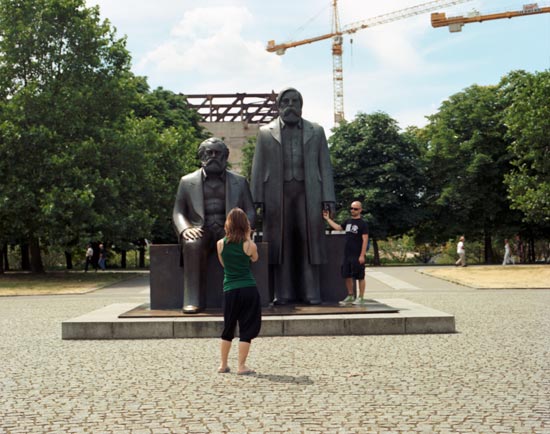
Photographer Warren Naidich notes that the opening of the Berlin Wall delivered immediate and long-term consequences: "this once important monument depicting two famous philosophical figures has become nothing more than a backdrop for staged photographs by tourists visiting the city elucidating the ideological changes that have resulted form the fall of Communism and the rise of Capitalism" [Neidich, 2012b]. 

Neidich created a series Marx and Engels (2008-09) from photographs he took between 2008 and 2009. Installed in 1986, the Marx and Engels statue has moved about in Alexanderplatz, and can be seen in his series as a tourist backdrop with the disappearing Palast der Republik. He has also created an installation Undoing the Palast der Republik (2007) capturing the Palast being demolished. 
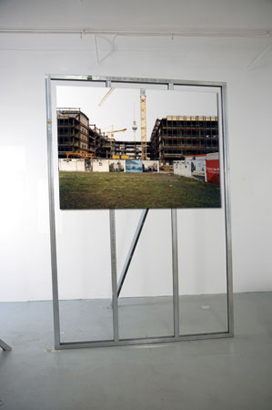

For the Black Square, Triangle, Circle Fragment 2 (2007), which he describes "a series of performative sculptures that reenact the memory of itself as a fragment of a once enacted performative space," Neidich states that "altogether the undoing of the Palast is metonymic for the process of undoing of Architecture as a cultural act. The Palast was not demolished but is being slowly and meticulously taken apart. The cultural undoing, assimilation and subsuming of the communist block by Capitalism after the fall of the Berlin is re-enacted in this work" [Neidich, 2012a].

Neidich, Warren [2012a] Black Square, Triangle, Circle Fragment 2 (2007) [Online]
 http://www.warrenneidich.com/black-square-triangle-circle-fragment-2-4/ [17/02/2012]
Neidich, Warren [2012b] Marx and Engels (2008-09) [Online]
 http://www.warrenneidich.com/marx-and-engels-2008-09/  [17/02/2012]
Neidich, Warren [2012c] Undoing the Palast der Republik (2007) [Online]
 http://www.warrenneidich.com/undoing-the-palast-der-republik/ [17/02/2012]

Saturday, 25 February 2012

European borders


Border, an exhibition of works by Martin Sigmund, is on display until 28 March in Stuttgart. The photographs show a collection of deserted border checkpoints across Europe made redundant by the Schengen Agreement, and express a sense of the past and nostalgia.


I wondered if the description "D-DDR" on the label for the Dreilinden Checkpoint Bravo photo was intentional (as opposed to saying "BRD-DDR"). Although it made me think about the FRG-GDR relationship, the photographer later told me that he chose to use D and DDR based on car national identification stickers, which I think is appropriate as these checkpoints were inspecting cars crossing the border.

Photo Presse (2012) Martin Sigmund. Border [Online]
 http://www.photopresse.de/content/view/10162/52/ [15/02/2012]
Sigmund, Martin [2012] Border [Online]
http://www.martinsigmund.com/ [15/02/2012]
TREFFPUNKT Rotebühlplatz (2012) Martin Sigmund | Border [Online]
 http://www.treffpunkt-rotebuehlplatz.de/ausstellungen/ [15/02/2012]

Monday, 20 February 2012

DOUBT


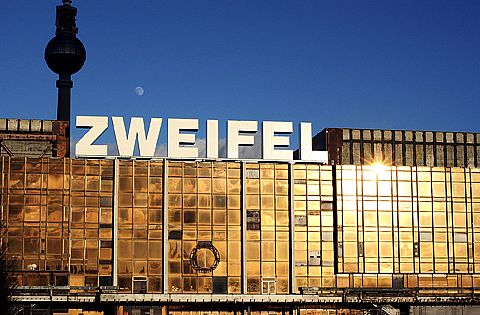
Palast der Republik was abandoned for 15 years after the fall of the GDR. Monitoring debates about the future of the building, Lars Ø Ramberg developed the idea where doubt has become a proof of democracy, and to symbolize this phenomenon in 2005 he created Palast des Zweifels – the Palace of Doubt [Larsramberg.de, 2012]. Ramberg had been collecting newspaper articles with the word "Zweifel" (doubt) in the headline, and printed  Zweifel Allgemeine with the headlines of these articles [Node Berlin, 2012].


Larsramberg.de [2012] Palast des Zweifels [Online]
http://www.larsramberg.de/1/viewentry/3890 [17/02/2012]
Node Berlin [2012] Zweifel Allgemeine [Online]
 http://nodeberlin.com/archive/zweifel-allgemeine [17/02/2012]

Saturday, 11 February 2012

Art, architecture and memories


The Architektonika exhibition illustrate the ways in which artists since the 1960s have reflected "at the cross-roads between art and architecture," with focuses the architectural design of buildings and urban spaces as well as the social and economic implications [Hamburger Bahnhof, 2012]. The artists include Sophie Calle, Nina Fischer & Maroan el Sani, Thomas Florschuetz, Dieter Roth & Björn Roth, Peter Fischli & David Weiss, Thomas Struth and Jeff Wall, whose "works unlock the door on imaginary spaces, stir memories of well-known buildings or revive various visions of the future that may now seem dated" [Hamburger Bahnhof, 2012].

Hamburger Bahnhof [2012] Architektonika [Online] http://www.hamburgerbahnhof.de/exhibition.php?id=34328&lang=en [09/02/2012]

Thursday, 9 February 2012

Global contemporary art, since 1989

1989 was an eventful year, with the military crackdown on the pro-democracy protest in Tiananmen Square, the uprising in South Africa prior to the reforms that ended apartheid, the opening of the Berlin Wall following mass protest rallies and emigration in the GDR. 

The Global Contemporary exhibition also highlights shifts in contemporary art in 1989, noting: Xiao Lu who fired a gunshot at her installation Dialogue at the exhibition China/Avant-Garde in Beijing, and providing "voice to a form of contemporary art that was not rooted in western Modernism"; Centre Pompidou in Paris opened the exhibition Magiciens de la Terre, where "for the first time works by artists from countries such as Haiti, India, Madagascar, Australia and South Africa were displayed alongside their counterparts" and including series of works that previously "would have been labeled 'World Art' and confined to ethnographic museums"; and in London, the Other Story focusing on the Afro-Indian artists' contribution to British modern art, curated by Pakistani artist Rasheed Areen, whose Third Text Journal "had already begun rewriting art history from a 'Third World' perspective" in 1987 (ZKM, 2011).

ZKM (2011) Face the Facts: 1989 & the Arts [Online]
 http://www.global-contemporary.de/en/room-of-histories/172-face-the-facts-1989-and-the-arts [09/02/2012]

Wednesday, 8 February 2012

Architecture and contemporary photography


Envisioning Buildings exhibition, with eight thematic chapters on Restoration, Reanimation, Dwelling, Utopian Visions, Refraction, Deconstruction, Critique, and Systems Analysis [MAK, 2012], reviews discourses and "major conceptual, theoretical, and visual concerns of photography as a specific contemporary art medium" [e-flux, 2012]. The exhibition presents works of camera-based artists who, since the 1980s, "have changed discourses about the production and reception of photography" [e-flux, 2012] along with debates throughout January and April. 


Deutsches Bundesarchiv (2009) File:Bundesarchiv Bild 183-1986-0417-414, Berlin, XI. SED-Parteitag, Eröffnung.jpg [Online] http://en.wikipedia.org/wiki/File:Bundesarchiv_Bild_183-1986-0417-414,_Berlin,_XI._SED-Parteitag,_Er%C3%B6ffnung.jpg [08/02/2012]
Deutsches Bundesarchiv (2008) File:Bundesarchiv Bild 183-R0821-400, Berlin, Palast der Republik.jpg. [Online]
http://en.wikipedia.org/wiki/File:Bundesarchiv_Bild_183-R0821-400%2C_Berlin%2C_Palast_der_Republik.jpg [08/02/2012]

e-flux [2012] Envisioning Buildings: reflecting architecture in contemporary art photography. [Online] 
http://www.e-flux.com/announcements/envisioning-buildings-reflecting-architecture-in-contemporary-art-photography/ [08/02/2012]
MAK [2012] Envisioning Buildings: Reflecting Architecture in Contemporary Art Photography. [Online] http://www.mak.at/e/jetzt/f_jetzt.htm [08/02/2012]

Sunday, 5 February 2012

Lenin tour 2009


"l show Lenin to my contemporaries. And the 21st century to Lenin. Who will explain it to him?" (Herz, 2009: 78)
The city council in Dresden decided to remove its Lenin statue, a in a move to move away from the GDR past. In 2004, Rudolf Herz from a stonemason borrowed the decommissioned torso of Lenin and drove around Europe with two other anonymous statues. In the evening the truck would stop in cities asking artists, sociologists and economists to give their views on Lenin in the twenty-first century. The tour was filmed and photographed.
"I am searching for images, I am exploring the life in our globalised, capitalist world, am enquiring after memories and current views of utopia... Our journey takes us through contemporary everyday life, high-tech zones, and desolate industrial areas in the East and the West. A change of locale engenders a change of references and perspectives, Prage is not Zurich, Dresden is not Rome."  (Herz, in Museum Ludwig, 2012)

Herz, Rudolf (2009) Lenin w Trasie / Rudolf Herz. Lenin on Tour. [Online]
 http://www.erasedwalls.eu/erasedwalls.pdf [04/02/2012]
Museum Ludwig (2012) Rudolf Herz. Lenin on tour. [Online]
 http://www.museenkoeln.de/museum-ludwig/default.asp?s=2665 [04/02/2012]

Artimageslibrary (2010) Rudolph Herz Dachau Museumsbil
 http://www.flickr.com/photos/artimageslibrary/4954051621/ [04/02/2012]

Friday, 30 December 2011

Postcards from lost countries


This clip shows an interactive project due to launch on 10 Jan 2012, made from a collection of 25 postcards sent from 11 East European countries between 1975 and 1991 (Gebrüder Beetz Filmproduktion, 2011). 

Gebrüder Beetz Filmproduktion (2011) Farewell Comrades! (Interactive) [Online]
Artline Films & Gebrüder Beetz Filmproduktion [2011] Farewell Comrades. [Online]

Wednesday, 28 December 2011

Fragments of Holocaust


"I think that we can only see the Holocaust in fragments, and these fragments are individual lives and individual deaths, and this is the only measure of things." (Bałka in Davies-Crook, 2011)
Mirosław Bałka's exhibition Fragment is about the collective experiences of the Holocaust with focuses on video works. He claims that the only way to understand life is through "the consciousness of the fragments" and not in "big numbers – the ones discussed by historians" (Bałka in Davies-Crook, 2011).

Davies-Crook, Susanna (2011) Disassembling Bambi. [Online]
 http://www.exberliner.com/articles/interview%3AMiros%C5%82aw-Ba%C5%82ka [27/12/2011]
Vernissage TV (2011) Miroslaw Balka: Fragment at Akademie der Kunste Berlin. [Online]
 http://www.youtube.com/watch?v=Pm455zOuVHY [28/12/2011]


Tate Channel (2009) The Unilever Series: Miroslaw Balka. [Online]
 http://channel.tate.org.uk/media/47872674001 [28/12/2011]
White Cube (2011) Miroslaw Balka at Akademie der Kunste, Berlin. [Online]
 http://whitecube.com/news/miroslaw_balka_at_akademie_der_kunste_berlin/ [28/12/2011]

Thursday, 22 December 2011

Locked-up memories

Søren Lose's exhibition Relicts, on GDR-era Berlin and collective memories, was closed. 


Excerpt from the Brandts website.

The city of Berlin has been exposed to an unusually high number of historical events and periods which have been decisive for world history. This is what Relicts is all about: Berlin as the setting for the East-West conflict of the cold war years, of Communism and Capitalism; of past and present; regime versus the individual and the concept of Utopia – the notion of an ideal world.The exhibition features works, such as Curtain, 2011, which refers to an interior decoration from the East-German Unity Party’s assembly hall in Palast der Republik in the former GDR. The work is reminiscent of a stage curtain with strong authentic institutional aesthetics but at the same time also anonymous and neutral. Wall, 2011, consisting of reconstructed fragments of the Berlin Wall, embodies the post-war period and the segregation of East and West. After a narrow claustrophobic passage comes the work Flag, 2011, referring to a wall decoration in the aforementioned assembly hall, where one can see black and white photos. They form collages from an era, a particular period, a particular place. The earlier work Monument for Amnesia, 2009, mimics the helter-skelter like fashion of beams found in a construction site. Furthermore, the monumental Ghost, 2011, a reconstruction of a now demolished Lenin monument from 1970, is presented. Lose's fragmented version does not appear glorifying but rather abstract and dystopian. Finally, a number of objects, texts, photos are exhibited in display cases. The reinterpretation of Lose’s sculptures functions as a focal point for the exhibition; the sculptures act as relicts, as historical and situational signifiers for the GDR’s cultural and political ideologies.
Relicts combines several mythological narratives and significant historical buildings to unveil the fictitious,constructed and complex layers of meaning within history.

Brandts [2011] Søren Lose: Relics. [Online]
 http://www.brandts.dk/en/current-exhibitions?option=com_exhibitions&view=article&id=89 [18/12/2011]
e-flux [2011] Søren Lose's Relics. [Online]
 http://www.e-flux.com/announcements/soren-loses-relicts/ [18/12/2011]

Tuesday, 20 December 2011

"Being there but not there": In a Lonely Place


Gregory Crewdson's photographs are "projections of a story" he might have heard, "trying to search beneath the surface of things for an unexpected sense of mystery or something that's secret" [Crewdson in the Loyal Library, 2011]. They capture "the moment of transition between before and after" where he uses twilight for its evocative effects (Crewdson in Helmore, 2006).

Crewdson creates his scenes similarly to a film production using sets. In his interview projected in his exhibition In a Lonely Time, he also speaks about photography of truth and photography of fiction, and how the he merges the two approaches together to create tensions between detachment and intimacy, of "being there but not there" [Crewdson in the Loyal Library, 2011].

Amie Siegel also works on the relationship of documentary and fiction, which I will explore and experiment for my Berliners' project to raise questions about the coexistence of objective and subjective histories. 


Apperture Foundation [2011] Gregory Crewdson. [Online]
 http://www.aperture.org/crewdson/ [19/12/2011]
Fletcher, Kenneth R. (2008) Gregory Crewdson's Epic Effects. [Online]
 http://www.smithsonianmag.com/arts-culture/gregory-crewdson.html# [19/12/2011]
Helmore, Edward (2006) The witching hour. [Online]
 http://www.guardian.co.uk/artanddesign/2006/oct/04/photography [19/12/2011]
Royal Library, The [2011] Gregory Crewdson: In a Lonely Place. [Online]
 http://www.kb.dk/en/dia/udstillinger/crewdson.html [19/12/2011]

Monday, 31 October 2011

BBC Radio Norfolk interview


On 30th August I was interviewed by Matthew Gudgin on BBC Norfolk about the Berlin Wall - built 50 years ago that month - and my MA exhibition on Berliners' post-Wall perceptions.

My NUCA exhibition profile's been moved to another page.

Friday, 14 October 2011

Wall perspectives

Exhibition at Museum Villa Schöningen.

Golden Section Graphics News (2011) Mauerperspektiven [Online]
 http://goldensectiongraphics.blogspot.com/2011/09/mauerperspektiven.html [14/10/2011]

Bundeszentrale für politische Bildung [2011] Jugend Opposition in der DDR [Online]
 http://www.jugendopposition.de/index.php?id=1 [14/10/2011]

Saturday, 1 October 2011

Art Worlds After 1989


The Global Contemporary. Art Worlds After 1989 on globalization and geopolitical shift.

Jermolaewa, Anna (2008) Kremlindoppelganger, Fotoserie, je 50 x 35 cm, gerahmt, 2008 [Online]
 http://www.jermolaewa.com/works/kremlin_doppel.html [01/10/2011]
Zentrum für Kunst und Medientechnologie Karlsruhe [2011] The Global Contemporary. Art after 1989
 [Online] http://www.global-contemporary.de/en/[01/10/2011]

Friday, 23 September 2011

Playing among the Ruins

"While the Wall stood, the people longed for liberation and Berlin came to symbolize their fight for freedom. This enthusiasm still remains and the free spaces dotted throughout the city are what make the present Berlin such a ‘special place’. The micro-utopias presented ‘here’, these special places that we are permitted today, are expressed through videos, paintings, performances, etc., by 18 artists and projects that have gathered together from around the world to base themselves in Berlin. The history of society that replaces ideology, the reconstruction of stories, the relationship between spaces and identity brought about by intervention with the city, are questioned through performances, art, information, bodies, and urban spaces, demonstrating a spectacular creativity with a new phase of sensibility." [MOT, 2011]


Nevin Aladağ
John Bock
Phil Collins
Omer Fast
Fuji Re-United (Simon Fujiwara & Kan Fujiwara)
Isa Genzken
Katharina Grosse
Alicja Kwade
Simon Dybbroe Møller
Kirstine Roepstorff
Anri Sala
Matthias Wermke & Mischa Leinkauf
Ming Wong
Haegue Yang


Saâdane Afif
Jay Chung & Q Takeki Maeda
Christian Jankowski
Institute for Spatial Experiments
 (founded by Olafur Eliasson)

MOT [2011] Berlin 2000-2011: Playing among the Ruins. [Online]
 http://www.mot-art-museum.jp/eng/2011/berlin/ [22/09/2011]

Saturday, 21 May 2011

Displaying images

How can I best display the images I create - is it with a projector, or a glass screen? After talking to Terry and Nick, I have been trying to determine how I should show my work. Without having a set environment for my work, it seemed impossible to design the accompanying soundscape.

I have in mind a plinth/column with glass, a vitrine, or something in between, to place a screen within. This seems more suitable than the large plastic-sheet projection idea I had previously,  as I want bright images. My intention is also to show the screen as part of the exhibit, to give emphasis on the observational nature of my work, and a sense of archived documentation and reflection on history. The vitrine would be used if I am to combine a book in displaying the clips, and I'm also looking into a display column with glass windows.

Next week I will get measurements of the NUCA vitrine, and the screens (as well as weighing them, to evaluate how I could hoist them), and discussing it with Nick and Terry. I am intrigued about how we could design the sound scape for images behing a glass or plastic. I'll also check the control menu of the screens to see if there is a timer setting.

Monday, 16 May 2011

whiteonwhite:algorithmicnoir & Winter Garden by Eve Sussman


I manage to visit the Eve Sussman exhibition at Haunch of Venison on the last day, almost by luck. It's very last-minute organisation as usual, and I have left my camera at work.

Winter Garden by Sussman and Simon Lee changes subtly from one video clip - some as still as a photograph - to another. Windows of pre-fab buildings in former-USSR cities are shown on 3 screens, morphing from one to the next, illustrating the dream that once was being "destroyed in a patchwork of humanity" [Haunch of Venison, 2011]. These images left me standing, waiting for more, just so that I can find out what happens next... or does it? Then I see a passerby. How to tell the future from the past, v.2, by Sussman and Angela Christlieb also uses 3 screens, shot during a 72-hour train journey. The window frames in the screen blurs the sence of time, and I'm left to wonder what documentation/observation defines.

How to tell the future from the past v.2, 2009

Whiteonwhite:algorithmicnoir is a film being edited live by a software, combining 2637 video clips with sound, creating "the narrative through unexpected juxtapositions" endless and never repeated (Haunch of Venison London, 2011).


shots from whiteonwhite:algorithmicthriller, 2011

Haunch of Venison [2011] Eve Sussman | Rufus Corporation whiteonwhite:algorithmicthriller  2011. [Online] http://www.haunchofvenison.com/en/#page=london.current.eve_sussman
 [13/04/2011]
Haunch of Venison London (2011) Eve Sussman | Rufus Corporation  whiteonwhite:algorithmicnoir. [Information sheet]. p.1.

Christlieb, A. [2011] How to tell the future from the Past, v.2. [Online]
 http://www.angelachristlieb.com/htttfftp.html [15/04/2011]
Rufus Corporation [2011] How to tell the future from the past v.2. [Online]
 http://www.rufuscorporation.com/projects.html#_self [15/04/2011]

Friday, 21 January 2011

Street names in Berlin

Vincent Trasov focused on history and changes by highlighting the phenomenon of the numerous street name changes, squares and underground stations in Berlin. "A direct expression of the rapid development of a once divided city into a vibrant metropolis" was installed nearby the former Berlin Wall.
"STRASSENBILD names the more than 60 streets, underground stations and squares which have been renamed in East Berlin. In the painting there is no direct connection between the old and the new name. They are placed at random. The work is a metaphor for the dissolve of a political system and the collapse of ideologies." [Trasov, 2011]
Trasov, V. [2011] Word Paintings. [Online]
 http://vincenttrasov.ca/index.cfm?pg=menu&filter=word%20paintings [21/01/2011]

Sunday, 26 December 2010

Down and out in London

During the heavy snowfall in London, I visited Serpentine, Haunch of Venison, Tate Britain, National Portrait galleries and BFI Southbank Centre in London. Here are some ideas I picked up.

June 8, 1968, 2009

Visitors were guided through four rooms/spaces at Philippe Parreno: Films 1987-2010, which included film/animation installations by the artist.
"In Invisibleboy (2010), the viewer is delved deep into a world of both fantasy and reality where the boundaries between fiction and documentary began to blur. The movie features the story of an illegal Chinese immigrant boy who sees imaginary monsters that are scratched onto the film stock. June 8, 1968 (2009) portrays the train voyage that transported the corpse of assassinated senator Robert Kennedy from New York to Washington D.C. Kennedy’s invisible body and the Invisibleboy are characters that float between several layers of reality." [The European Graduate School, 2010] 
Serpentine Gallery also was showing Tom Hunter's A Palace for Us, where the artist interviewed residents of Woodberry Down Estate. The film has a documentary style, but the artist re-enacts scenes to narrate their history.

Nicolas Provost also works with moving image, and in his solo show at Haunch of Venison includes Stardust and Storyteller.  

And Winter's Bone at BFI Southbank. A daughter searches for her father to avoid the house, where she lives with her younger siblings, from being seized by the court. It's her experience, struggles and interactions with her neighbours and relatives the audience observe. 


I've been unable to shoot the ideas I've had, since my checked-in bag has not yet been delivered from Munich airport. My battery charger, a remore timer and my tripod for my camera are all in the bag, and my work continues to be disrupted days after airports managed to clear their runways.

The European Graduate School [2010] Philippe Parreno - Biography. [Online]
http://www.egs.edu/faculty/philippe-parreno/biography/ [26/12/2010]

Haunch of Venison [2010] Nicolas Provost: Stardust. [Online]
http://www.haunchofvenison.com/en/#page=london.current.nicolas_provost [26/12/2010]
National Portrait Gallery [2010] Taylor Wessing Photographic Portrait Prize. [Online]
http://www.npg.org.uk:8080/photoprize/site10/index.php [26/12/2010]
Provost, N. [2010] Work. [Online] http://www.nicolasprovost.com/#/workThumbs
[26/12/2010]
RoadsideFlix [2010] Winter's Bone - Official US Theatrical Trailer in HD. [Online]
http://www.youtube.com/watch?v=bE_X2pDRXyY [26/12/2010]
Serpentine Gallery  [2010] Exhibitions: Philippe Parreno: 25 November - 13 February. [Online]
Serpentine Gallery  [2010] Tom Hunter: A Palace For Us: 8 December - 20 January. [Online]
http://www.serpentinegallery.org/2009/01/the_skills_exchange_project.html [26/12/2010]
Tate Britain [2010] Eadweard Muybridge. [Online] 

Thursday, 18 November 2010

Life and Death in Venice


Life and Death in Venice (2010)

This is a work produced by Ming Wong, a 3-channel HD digital video installation, uses screens suspended in air, as well as a video screen mounted into a wall. The suspended screens give the impression of space irrelevant to the physical gallery space, and that of a distance and memory. The story is told through 2 main screens, with the video of the artist playing piano for sound track, on third.


Cornerhouse [2010] Unspooling - Artists & Cinema [Online] http://www.cornerhouse.org/art/info.aspx?ID=417&page=53000 [18/11/2010]
Wong, M. [2010] Life and Death in Venice /Leben und Tod in Venedig /Vita e Morte a Venezia. [Online] http://www.mingwong.org/index.php?/cv/life--death-in-venice-/ [18/11/2010]