Saturday, 22 May 2010

Room with a Historical View

Mauerspringer (Wall Jumper) by Gabriel Heimler

Gabriel Heimler was one of the artists involved in "the first joint art project between the two Germanys" after the opening of the Berlin Wall. The collaborative project by two artist associations, the VBK from the East and the BBK from the West, was titled the East Side Gallery, and was completed in 1990 with the participation of 102 artists [Arte Luise Kunsthotel, 2010a]. Heimler's work has now also "taken up residence"  in Room 421 at Arte Luise Kunsthotel and also "has been adapted to its current time and place": Mauerspringer leaped from West to East in 1989 in a symbolic gesture of bringing freedom, he jumps "from history into the reality of the present" [Arte Luise Kunsthotel, 2010a].

"All rooms in the hotel have been individually decorated by a renowned artist, whose concept incorporates the entire room. Every room is an original, and the only thing that they all have in common is high artistic quality". [Arte Luise Kunsthotel, 2010b]

Berlin History by Moritz Götze

Another room at the hotel features a collection of ironic images of Berlin by Moritz Götze. "By the window: an enamel skyline created by the artist with all the key orientation points, including the top floor of the hotel with a view of the Spree, the Reichstag building and the Chancellery. Next to the window is a shelf with selected Berlin literature and a telescope for remotely discovering the history-laden surroundings" [Arte Luise Kunsthotel, 2010c].

Arte Luise Kunsthotel [2010a] 421 Double Room with Shower. [Online] http://www.luise-berlin.com/en/rooms/421.htm [22/05/2010]
Arte Luise Kunsthotel [2010b] Arte Luise Kunsthotel. [Online] http://www.luise-berlin.com/en/index.htm [22/05/2010]
Arte Luise Kunsthotel [2010c] 432 Double Room with Shower. [Online] http://www.luise-berlin.com/en/rooms/432.htm [22/05/2010]

Sophie Calle Exhibitions


"To record this process, I visited places from which symbols of GDR history have been effaced. I asked passers-by and residents to describe the objects that once filled these empty spaces. I photographed their absence and replaced the missing monuments with their memories." [Calle, in German Bundestag, 2010]

The artist Sophie Calle documents how Berlin faces its history and its correlation of memory and personal identity. The installation "Die Entfernung - The Detachment" makes audiences aware of "the complex way in which we perceive reality - and to the equally complex way in which history and the present are interwoven" and "is one of the most revealing artworks on the history of inter-German relations and its contemporary afterimage" [German Bundestag, 2010]

 
Guides for the exhibitions Die Entfernung - The Detachment
and Talking to Strangers [PDF]

In Talking to Strangers, a documentary and performing arts by Calle, combines photography, film and text, balancing "conceptual rigour and the elements of chance brought about by including both herself and her subjects directly in the artistic process. This spirit of inclusivity is more likely to illicit feelings of intimate understanding than intellectual dispassion; Calle’s is a conceptual art born of the world, not the classroom or studio (Pellerin, 2009). The guide for Talking to Strangers suggests actions for the audience to take at the exhibition and elsewhere, alongside a dialogue by two artists, to enhance the experience at the gallery and to understand Calle's work further [Whitechapel Gallery, 2010]. 


German Bundestag [2010] Sophie Calle: Die Entfernung - The Detachment. [Online] http://www.bundestag.de/htdocs_e/artandhistory/art/artists/calle/index.html     [22/05/2010]
Pellerin, A. (2009) Sophie Calle: Talking to Stragers. [Online] http://www.dazeddigital.com/ArtsAndCulture/article/5539/1/Sophie_Calle_Talking_to_Strangers [22/05/2010]
Whitechapel Gallery [2010] Conversations and Actions. [Online] http://www.whitechapelgallery.org/downloads/calle.pdf [22/05/2010]

Vukadin, A. (2009) Sophie Calle: Talking to Strangers. [Online] http://whitehotmagazine.com/articles/2009-sophie-calle-whitechapel-gallery/1976 [22/05/2010]

Friday, 21 May 2010

Meat Love by Jan Švankmajer


Meat Love (Zamilované Maso) is a short film directed by Jan Švankmajer, a Czech animator, and released in 1989. Although governments in Eastern European states were collapsing in 1989, Czechoslovakia was still one nation then (Cowley, 2009). The Berlin Wall was opened in in this year also, and the plot of the film made me think of the German unification. 

Cowley, J. (2009) 1989 The Year of the Crowd. [Online] http://www.newstatesman.com/international-politics/2009/03/world-crowd-end-wall-1989 [21/05/2010]
Meatpaper [2010] Jan Svankmajer’s “Meat Love” Animation from 1989. [Online] 
http://www.meatpaper.com/meatart/svankmajer/index.html [21/05/2010]
Michnik, A. & Havel, V. (2008) After the Velvet, an Existential Revolution? [Online]
http://www.salon.eu.sk/article.php?article=801&searchPhrase=velvet%20revolution&lang=EN [21/05/2010]

Monday, 17 May 2010

Eva Meyer-Keller

NNF10
"Death is certain started from a wish to do something really simple and easily accessible. I got interested in fairy tales, because they leave a lot of space for projection and the 'action' to project seems essential to perceive them." (Meyer-Keller, 2003)
Eva Meyer-Keller performs internationally as well as organising festivals and events. She collaborats with other artists and groups also. I have interviewed her between her performances of Death is Certain at Norwich and Norfolk Festival, on her work including Volksballons und geklonte Krieger/People's balloons And cloned warriors at Palast der Republik in Berlin, and how she connects with her audience.

Eva Meyer-Keller preparing Death is Certain

Meyer-Keller, E. (2003) From the Klapstuk festival program, October 2003: From an interview with Sally de Kunst. [Online] http://www.evamk.de/daten/d_sally.html [14/05/2010]

Goethe-Institut [2010] Eva Meyer-Keller. [Online] http://www.goethe.de/kue/tut/cho/cho/mr/mey/enindex.htm [14/05/2010]
Tollmann, V. (Trans. Mahoney, N.) (2009) Eva Meyer-Keller: Building after Catastrophes/Handmade. [Online] http://www.goethe.de/ges/umw/prj/kuk/fot/eva/enindex.htm [14/05/2010]
Vivid (2005) Artfest 06. [Online] http://www.vivid.org.uk/projects.php?work=34 [14/05/2010]


Sunday, 16 May 2010

Marina Abramović

"The work is done for the audience. Without audience the world doesn't exist: it doesn't make any meaning."
(Abramović, in MoMA, 2010a) 


"In an endeavor to transmit the presence of the artist and make her historical performances accessible to a larger audience, the exhibition includes the first live re-performances of Abramović’s works by other people ever to be undertaken in a museum setting. In addition, a new, original work performed by Abramović will mark the longest duration of time that she has performed a single solo piece... All performances, one of which involves viewer participation, will take place throughout the entire duration of the exhibition, starting before the Museum opens each day and continuing until after it closes, to allow visitors to experience the timelessness of the works." (MoMA, 2010b) 

Live between 14 March-31 May, 2010

Abramović claims that performance is a "unique form of art and is very temporary", and that "there's nothing to sell in performance: it's just memory". She also notes that she does not expect anything from the audience and "then it's up to the audience how they take it" (Abramović, in MoMA, 2010a). 

As well as broadcasting Abramović's performance on its website, MoMA has also created a photostream of participants' portraits online.

Day 53, Portrait 12; Day 53, Portrait 11; Day 53, Portrait 10 by Marco Anelli

Anelli, M. (2010) MoMA The Museum of Modern Art's Photostream. [Online] http://www.flickr.com/photos/themuseumofmodernart/ [15/05/2010]
MoMA (2010b) Marina Abramović: The Artist Is Present. [Online] http://moma.org/visit/calendar/exhibitions/965 [15/05/2010]
MoMA (2010a) What is performance art? [Online] http://www.moma.org/interactives/exhibitions/2010/marinaabramovic/conversation.html [15/05/2010]

Saturday, 15 May 2010

Cultures in Conflict: Visual Arts in Eastern Germany since 1990 [PDF]


Deshmukh, M.F. (ed.) (1998) Cultures in Conflict: Visual Arts in Eastern Germany since 1990. [Online] http://www.aicgs.org/documents/gdrart.pdf [15/05/2010]

Reality Bites: Making Avant-Garde Art in Post-Wall Germany [PDF]


Mildred Lane Kemper Art Museum [2010] Reality Bites: Making Avant-Garde Art in Post-Wall Germany. [Online] http://kemperartmuseum.wustl.edu/files/rbeducationguide.pdf [15/05/2010]

Why the Berlin Wall Fell

From Truman to Reagan, the benefits of moral clarity.


THE WALL STREET JOURNAL
In the debate over who deserves credit for causing the Berlin Wall to collapse on the night of November 9, 1989, many names come to mind, both great and small.

There was Günter Schabowski, the muddled East German politburo spokesman, who in a live press conference that evening accidentally announced that the country's travel restrictions were to be lifted "immediately." There was Mikhail Gorbachev, who made it clear that the Soviet Union would not violently suppress people power in its satellite states, as it had decades earlier in Czechoslovakia and Hungary. There were the heroes of Poland's Solidarity movement, not least Pope John Paul II, who did so much to expose the moral bankruptcy of communism.

And there was Ronald Reagan, who believed the job of Western statesmanship was to muster the moral, political, economic and military wherewithal not simply to contain the Soviet bloc, but to bury it. "What I am describing now is a plan and a hope for the long term—the march of freedom and democracy which will leave Marxism-Leninism on the ash-heap of history," he said in 1982, to the astonishment and derision of his critics. Now, there was the audacity of hope.

All of these figures played their part, as did a previous generation of leaders who insisted that the West had a moral duty to defend the little enclave of freedom in Berlin.

Fulfilling that duty came at a price—71 British and American servicemen lost their lives during the Berlin Airlift—that more "pragmatic" politicians might have gladly forgone for the promise of better relations with the Soviets. Not a few NATO generals thought the defense of Berlin needlessly exposed their forces in a militarily indefensible position while giving the Russians an opportunity to blackmail the West as they advanced on strategically more vital ground, particularly Cuba.

Yet if the West's stand in Berlin demonstrates anything, it is that moral commitments have a way of reaping strategic dividends over time. By ordering the airlift in 1948, Harry Truman saved a starving city and defied Soviet bullying. As importantly, he showed that the U.S. would not abandon Europe to its furies, as it had after World War I, thus helping to pave the way for the creation of NATO in April 1949.

By holding firm for 40 years, Truman and his successors transformed what was supposed to be the Atlantic alliance's weakest point into its strongest. To know what the West stood for during most of those years, one merely had to go to Berlin, see the Wall, consider its purpose, and observe the contrasts between the vibrant prosperity on one side of the city and the oppressive monotony on the other.

Those contrasts were even more apparent to the Germans trapped on the wrong side of the Wall. Barbed wire, closed military zones and the machinery of communist propaganda could keep the prosperity of the West out of sight of most people living east of the Iron Curtain. But that wasn't true for the people of East Berlin, many of whom merely had to look out their windows to understand how empty and cynical were the promises of socialism compared to the reality of a free-market system.

Yet it bears recalling that even these obvious political facts were obscure to many people who lived in freedom and should have known better. "Despite what many Americans think, most Soviets do not yearn for capitalism or Western-style democracy," said CBS's Dan Rather just two years before the Wall fell. And when Reagan delivered his historic speech in Berlin calling on Mr. Gorbachev to "tear down this wall," he did so after being warned by some of his senior advisers that the language was "unpresidential," and after thousands of protesters had marched through West Berlin in opposition.

It is a tribute to Reagan's moral and strategic determination, as it was to everyone else who played their part in bringing down the Wall, that they could see through the sophistries of Soviet propagandists, their Western fellow travelers, and the legions of moral equivocators and diplomatic finessers and simply look at the Wall.

"To see what is in front of one's nose needs a constant struggle," George Orwell once said. That is what the heroes of 1989 did with unblinking honesty and courage for years on end until, at last, the Wall came tumbling down.

The Wall Street Journal (2009) Why the Berlin Wall Fell. [Online] http://online.wsj.com/article/SB10001424052748704013004574515850127019522.html [15/05/2010] 

Survey finds support for return of Berlin Wall

AFP
BERLIN — Nearly one in four Germans "sometimes think it would be better if the Berlin Wall were still there," according to a new poll published on Monday.

The Emnid poll of 1,001 people for mass circulation daily Bild also showed that 16 percent of people thought a rebuilding of the once-hated barrier "would be the best thing that could happen."

The survey found little difference of opinion between those that used to live on either side of the Wall, with 23 percent of east Germans and 24 percent of west Germans saying they could be in favour of another Wall.

The 155-kilometre (96-mile) barrier, erected overnight by communist authorities on August 13, 1961, split the city of Berlin in two and came to symbolise Cold War division.

In a bloodless revolution on November 9, 1989, the Wall, officially called an "anti-fascist barrier" by the communists, was yanked down and hundreds of thousands of East Germans streamed across to the West.

The 20th anniversary of this momentous day was marked recently with an emotional ceremony at Berlin's Brandenburg Gate, attended by dozens of world leaders, topped off by a surprise video message by US President Barack Obama.

AFP (2010) Survey Finds Support for Return of Berlin Wall. [Online] http://www.google.com/hostednews/afp/article/ALeqM5gRSmyZgbVwp9q-wu8_nSOVgSKErw [15/05/2010]

Widow of East German leader insists life was better behind the Wall

THE IRISH TIMES
AFTER 20 years of capitalism, former citizens of the East German Democratic Republic (GDR) have begun to realise they had it better behind the Berlin Wall.

That is the conviction of Margot Honecker, widow of former GDR leader Erich Honecker, expressed at a private party to celebrate the 60th birthday of the vanished socialist state. While the rest of Germany gears up for the 20th anniversary of the fall of the Berlin Wall next month, the 82-year-old widow of the man who co-ordinated its construction is rueful, but unrepentant.

“Okay, so we didn’t manage it , but still, 40 years isn’t so bad. It certainly left an impression,” said Ms Honecker in a video on YouTube filmed in Chile, her home since 1992.

A year earlier she left Germany with her husband before his death from cancer in 1994. “There is no news programme, no film that doesn’t try to discredit the GDR, but they haven’t succeeded,” she said under the old GDR flag, after singing a verse of The Internationale. “Fifty per cent of East Germans say ‘we have a worse life under capitalism, we had a good life in the GDR’. People are thinking more and more about what they had in the German Democratic Republic.”

Among young people, in particular, she said there was a “huge interest”. “The left wing is there, getting ever more votes and support as the larger parties are punished for their anti-social politics,” she said, noting the 12 per cent of the poll in September’s general election for the Left Party, a successor to the ruling SED.

“Things in Germany are going downhill for the working class, so things are looking good for the left,” she said. “I’m optimistic, always was and always will be.”

Ms Honecker, who served as education minister in the GDR, was accused, but never charged, of involvement in organising forced adoptions of children of dissidents to loyal party members.

Attitudes to the vanished East Germany vary widely in surveys, depending largely on the question asked. Some 80 per cent of Germans quizzed by Stern magazine this week say they are happy that the Berlin Wall fell.

About one in seven former East Germans quizzed said they would like to see the wall back. In a survey in June for the Emnid polling institute, some 49 per cent of 600 former easterners quizzed said the GDR had more positive than negative sides.

Meanwhile, a former prisoner of the Stasi secret police has locked himself in his former cell – and is streaming the images on the internet – to recall GDR oppression.

Carl-Wolfgang Holzapfel donned his old blue uniform yesterday and entered the cell at Berlin’s Hohenschönhausen prison, where he served nine months in 1965. “We have to remember the leaden years before, the courage of people who were hounded by the authorities, and the revisionist politics of the Left Party.” His website is www.stasi-live-haft.de

DEREK Scally, D. (2009) Widow of East German Leader Insists Life was Better Behind the Wall. [Online] http://www.irishtimes.com/newspaper/world/2009/1031/1224257766778.html [15/05/2010]

Steffenhagen, J. (2009) Die Mauer im Kopf von Margot Honecker. [Online] http://www.welt.de/fernsehen/article5024563/Die-Mauer-im-Kopf-von-Margot-Honecker.html [02/05/2010]

Plans for monument to German unity cause some division

THE NEW YORK TIMES
BERLIN — Plans for a monument to celebrate German unity and freedom are causing a stir 18 years after the Wall fell, with some accusing Berlin of building too many memorials and others saying the whole project is pointless.

The lower house of Parliament, the Bundestag, is to discuss the proposed monument on Friday - the 18th anniversary of the 1989 opening of the Berlin Wall, which brought an end to Communist East Germany and opened the door to German reunification less than a year later.

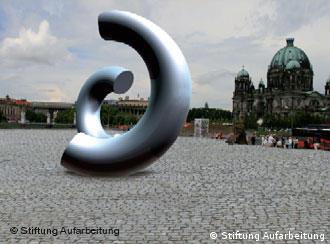
The winning design for the "Memorial to the Freedom and Unity of Germany" was by Bernadette Boebel, a 25-year-old student. It consists of two steel semi-circles 10 meters apart which appear as a full circle when viewed from a certain perspective.

Norbert Lammert, president of the Bundestag, said at the award ceremony for Boebel's design that a monument to post-Cold War German freedom and unity was "long overdue" in a city full of memorials recalling the Nazi and communist dictatorships.

But not everyone shares his enthusiasm.

Nikolaus Bernau, a prominent architectural expert, says a steel monument can never hope to evoke abstract concepts like freedom and unity, let alone the euphoria of the 12 months leading up to reunification in 1990.

"Based on all the experience people have with building and preserving monuments, this concept is at best naive," Bernau wrote in the Berliner Zeitung newspaper.

He said 1989 would be better remembered in celebrations, exhibitions, museums, films and other works of art.

Luc Jochimsen, cultural spokeswoman for the Left party, said the monument focuses on unification and ignores more important aspects of the 1989 revolution.

"We think Berlin is the wrong place. We think its focus should be on Leipzig, not Berlin, and on Oct. 9 (1989), not Nov. 9," she said, referring to demonstrations in the eastern city of Leipzig that marked the beginning of the end of Communist rule.

Others say Berlin already has more than enough monuments.

Within a stone's throw of the Brandenburg Gate in central Berlin are the new Holocaust Memorial, a permanent exhibition honouring Germans killed trying to cross the Wall and a monument commemorating the Soviet army's liberation of Berlin.

A new center remembering Germans and others expelled from eastern Europe after World War II is also planned.

One reason why a memorial marking German unity is under discussion may be that most traces of the Wall that separated east and west Berlin for nearly three decades are gone.

Many Germans still have mixed feelings about reunification, making the debate over the new monument even more complicated.

Klaus-Peter Schoeppner of the Emnid polling institute says the majority of Germans still think of the former Communist east as a "second class Germany."

A recent survey showed that one out of five Germans would like to have the Berlin Wall back.

© Stiftung Aufarbeitung

KJ (2008) German Reunification Memorial Initiators Awarded National Prize. [Online] http://www.dw-world.de/dw/article/0,,3417566,00.html [15/05/2010]

The New York Times (2007) Plans for Monument to German Unity Cause Some Division. [Online] http://www.nytimes.com/2007/11/09/world/europe/09iht-09wall.8269616.html?_r=1 [14/05/2010]

Tuesday, 11 May 2010

Forgetting Why the Wall Fell

Benjamin R. Barber
In the orgy of Reagan revisionism and capitalist triumphalism that followed the fall of the Berlin Wall twenty years ago, we have largely forgotten how and why the Cold War came to an end. It would be almost impossible to discern its real origins from today's Disney style celebration of the "Mauerfall" that began on Thursday evening with musical celebrities (e.g., Bono and Beyonce) and the European MTV awards in front of the Brandenburg Gate and ends this evening in the same place with a gala featuring political celebrities (e.g., Hillary Clinton) and sundry Nobel Prize winners (e.g., Gorbachev), a performance of Beethoven's Ode to Joy (the Ninth Symphony) and a symbolic wall happening. A thousand large painted domino blocks stretching from Pottsdammerplatz to the Reichstag (that have actually divided the two Berlins again this week since cars can't get through!) will topple domino style -- sort of the way the Eastern bloc countries and then the Soviet Union did after November 9, 1989.

Nowadays it is easier to accede to the received wisdom that the events that brought down the wall were the outcome of President Reagan out-producing the Russians in the arms race and then shouting "Tear down this wall!" Or the result of Gorbachev's Perestroika and Glasnost policies in the Soviet Union that brought both him and his empire to grief.

Truth is, however, that the wall came down because of a decade or more of grass roots democratic organization in Poland (Solidarity), Czechoslovakia (Vaclav Havel and the Velvet Revolution) and, of particular consequence for Berlin, by Neues Forum, that informal bottom-up syndicate of students, workers and intellectuals whose meetings and broadsheets and courageous demonstrations in Leibzig, Dresden and Berlin softened up the East German regime and put enough holes in the German Democratic Republic's ideological architecture to make the collapse of its physical architecture inevitable.

But Neues Forum and its locally based associations and publications were quickly swallowed up once the wall was down by the West's quick and aggressive takeover of East Germany (remember the Treuerhand Trust that converted the "people's property" to private property?) and by the triumphalist notion that it was not so much democracy but capitalism that had won the Cold War.

The New European Man who emerged after the wall was not the new European citizen but the new European consumer. Shopping, not voting defined the new paradigm. To this day, Europeans talk with regret about a "democratic deficit" that has permitted the new Europe to flourish in ways determined by the Euro rather than the European.

Yet the standard paradigm continues to believe in liberation from the outside -- to imagine that some combination of Reagan's hard power politics and West German soft power television along with consumerism's endless seductions pulled, pushed and shoved the East into surrender and then freedom. Presto! Down came the wall.

Only that's not how it happened then, and it isn't how it happens now -- not in the German Democratic Republic and not in Iraq or Afghanistan either. Might as well bring the troops home, they will no more "liberate" Afghanistan than Ronald Reagan and Margaret Thatcher liberated East Germany.

We still pursue the illusion that democracy can be imposed from without, that a people can be leveraged into liberty by suasion and force, that people can be seduced to embrace democracy. As it was in 1776 in the British colonies, and in 1989 in Berlin, democracy grows from the inside out, bottom up.

No people can become free unless they mount their own struggle for freedom. Liberty cannot be gifted from the outside, and certainly cannot be engendered by force or occupation or the threat of invasion.

East Germany -- and with it Eastern Europe and Russia too -- overcame tyranny from the inside out. West Berliners helped pull down the wall but East Berlin citizens unmoored it from its foundations.

The same will have to happen if Iraq and Afghanistan and Iran are to establish their own liberty. So we might as well bring the troops home. Because until a people commits fully to achieving its own freedom, foreign boots on the ground will only push them further into servitude.

Barber, B. R. (2009) Dispatch from Berlin: Forgetting Why the Wall Fell. [Online] http://www.huffingtonpost.com/benjamin-r-barber/dispatch-from-berlin-forg_b_350671.html [11/05/2010]

Sunday, 9 May 2010

Amie Siegel


Berlin Remake (2005) is a 14 minutes long 2-channel video installation by Amie Siegel. The artist projects scenes shot by East German State Film Studio alongside "'remade' version" of the present, creating space "where chronological time becomes simultaneous and where physical and cinematic landscapes coincide in an uncanny juxtaposition of past and present, making history (like the GDR) simultaneously present and absent, dramatic and banal, ruptured and reconnected" [Siegel, 2010a].

“Approaching a film, or a film scene, like a text or musical score, as performance. To approach a cultural output— images from a national film studio—as an index of time & place. Re-making cinematic spaces, shot architectures and angles, the movements of extras. Remaking but leaving things out. The shot pulls focus through emptiness. So the performance becomes a performance of the camera, a performance of estrangement. A performance of absence. A haunting, a doubling, a replica. The historical event that usually goes unseen suddenly so close at hand. A conjunction of virtuality & presence, correspondence & contradiction. A feeling of unease.” [Siegel, 2010a]


DDR/DDR (2008) is a HD, 135 minutes film with colour/sound, also by Amie Siegel, "Dream-like and propositional, works in this series mirror shared concerns of voyeurism, psychoanalysis, memory, surveillance and modernist architecture. These films engage in a self-reflexive inquiry into non-fiction film practices, including objectivity, authority and performance" [Siegel, 2010b]. It reveals "the lingering ghosts of the past to be still very much in the minds of both the older and younger generations living in the now unified nation" with interviews of former GDR citizens and survailance and training films from the Stasi archives [Harvard Film Archive, 2010].

"[DDR/DDR] is a mosaic of interviews and incidents that gradually connect, allowing issues of history, state control, personal identity, and memory to emerge. A man walking across streets and fields as if on a tightrope is a recurring motif—an apt metaphor for the East-West divide... The ruminating psychological and intellectual content of Siegel's works posits that everything is subject to shifting interpretation." [Kaufman, in Siegel, 2010b]

Harvard Film Archive [2010] Three Films by Amie Siegel. [Online] http://hcl.harvard.edu/hfa/films/2010janmar/siegel.html [09/05/2010]
Siegel, A. [2010a] Berlin Remake. [Online] http://amiesiegel.net/project/berlin_remake [09/05/2010]
Siegel, A. [2010b] DDR/DDR. [Online] http://amiesiegel.net/project/ddr_ddr [09/05/2010]

D'Ambrose, R. [2010] DDR/DDR. [Online] http://www.slantmagazine.com/film/review/ddrddr/4799 [09/05/2010]
Siegel, A. [2010] Deathstar / Todesstern. [Online] http://amiesiegel.net/project/deathstar_todesstern [09/05/2010]

Manon Awst and Benjamin Walther


Manon Awst and Benjamin Walther began their collaboration in Berlin in 2006, with their work ranging from sculpture, performance, drawing and installation. Their backgrounds in architecture and theatre, allowing them to explore "into intimate relationships between human beings and their physical and socio-political environment", and with their "subtle yet critical approach... put society's governing values and accepted codes of behavior under scrutiny" (Awst & Walther, 2010).

"Awst & Walther's most recent work engages the architectural, temporal and metaphysical notion of a ‘threshold’. They investigate the ambiguous area between A and B (i.e: inside and outside, private and public, self and other) through a series of sculptures and interventions. This series incorporates specific industrial and ephemeral materials including gelatin, plaster and ice. The resulting objects and settings are unassuming and alluring, as they confront the viewer with an awareness of his or her own expectations and vulnerability." (Awst & Walther, 2010)


Awst, M. & Walther, B. (2010) Biography. [Online] http://www.awst-walther.com/ [09/05/2010]

CNN (2009) Ice Wall Honors Fall of Wall. [Online] 
German Embassy London (2009) Ice Wall in London Commemorates the Fall of the Berlin Wall. [Online] http://www.london.diplo.de/Vertretung/london/en/Mauerfall__archive/Projects/Ice__Wall/Ice__Wall__Bildergalerie.html [09/05/2010]

Rain, A. (2009) Commemorating the Fall of the Berlin Wall. [Online] http://www.nytimes.com/slideshow/2009/11/09/world/1109-BERLIN_7.html [09/05/2010]

Saturday, 8 May 2010

Sound: SolarBeat

SolarBeat

Twyman, L. [2010] Solar Beat 01. [Online] http://www.whitevinyldesign.com/solarbeat/ [07/05/2010]
The Sound Agency [2010] Audio. [online] http://www.thesoundagency.com/docs/Sound%20Affects.mp3 [27/02/2010]

Friday, 7 May 2010

Hung Up on "Hung" Parliament


"The German for 'hung parliament' is simply 'parliament', because the system of proportional representation the Federal Republic adopted in 1949 routinely produces parliaments with no overall majority... Yet somehow Germany today does not seem to resemble the ghastly chaos with which the Daily Mail and the Sun are now trying to scare their readers."

"Germany does show that you can run an effective economic policy with coalition governments; and Greece shows that you can run a lousy one with a clear single-party majority. It all depends who does it and how."

"There was a time, about 10 years ago, when I heard some Germans arguing that they needed Britain's first-past-the-post electoral system. Only thus could Germany get decisive economic reforms, to pull it out of its post-unification trough. But the last decade has proved those siren voices wrong. Germany has made tough economic adjustments, forcing down unit labour costs, and it has done so largely in co-operation with the unions. German-style "change through consensus" takes longer than the Margaret Thatcher-type, but is less socially divisive and ultimately more durable."

Ash, T.G. (2010) British Politicians will Need to Act More Like the Germans – Only Faster. [Online]
Sontheimer, M. (2010) Hung Parliament in the UK: A Very Un-British Election Result. [Online] http://www.spiegel.de/international/europe/0,1518,693603,00.html [07/05/2010]

Tuesday, 4 May 2010

Berlin

by Steve Crawshaw
The fall of the Berlin Wall in November 1989 was the culmination of months of protest across communist Europe and another triumph for the power and pressure of crowds


The collapse of the Berlin wall was the culmination of an incredible year. It was the most dramatic moment in an extraordinarily dramatic year. All across eastern Europe, one-party regimes collapsed in a heap. But nothing could trump the impact of the fall of the Berlin Wall on the evening of 9 November 1989. Television viewers around the world were transfixed as the loathed symbol of a divided continent broke open.

Following a confused, partly unintended announcement at an official press conference, East Berliners poured through the once-impenetrable barrier in to West Berlin; thousands more clambered on to the wall and celebrated there for days to come. Overnight, the barrier lost all its power.

This was a time of fairy-tale strangeness, a brave new world in the unburdened sense of the phrase. The fall of the wall was not, however, as unpredictable as politicians have often been eager to suggest. Indeed, it was unexpected only if one failed to see what the pressure of the crowds had already achieved, in the lead-up to that day.

Some changes were obvious and widely acknowledged. Through the summer of 1989, there was a vast outflow of East German refugees, especially through liberal Hungary, which proudly and publicly snipped a symbolic hole in its border fence in May, with unexpected consequences.

In the months to come, tens of thousands slipped across the Hungarian border to the west. East Germany’s lifeblood was haemorrhaging away. Those who remained and chanted “Wir bleiben hier!” (“We are staying here!”) provided no comfort to the regime, because their meaning was equally clear: “We are staying – because we want change.”

All of those pressures – from the leavers and the stayers alike – smoothed the way for what came next. However, probably the single most important moment came a month before the wall fell, on the evening of 9 October, in the city of Leipzig.

Throughout 1989, weekly Monday demonstrations – prayers for peace in the Nikolaikirche, followed by a demonstration – gradually gained strength, despite constant beatings and arrests. Eventually, the authorities decided enough was enough. They would teach Leipzig, and thus all of East Germany, a lesson.

A “reader’s letter” (read: an officially sanctioned announcement) in the Leipzig local paper announced that “these counter-revolutionary actions” would be dealt with, “if need be, with weapons in our hands”. In effect, the regime was publicly heralding its plans for a local reprise of the Tiananmen Square killings, which had taken place just four months earlier.

Nor was this mere bluster. The city of Leipzig was closed off. Weapons and ammunition were handed out. Hospitals were cleared. Before the demonstration began, I counted 16 trucks with armed workers’ militias in one side street alone. Inside the 13th-century Nikolaikirche, everybody knew what to expect once prayers were over. Through the tall windows, we could hear the echoing cries of the huge crowd outside, chanting, “No violence!” But it was clear to everybody: violence there would be tonight, and it might be lethal.

After the service, we moved outside. Presumably in common with many of those around me, I felt the tightening knot of fear as we waited for the shooting to begin.

A few minutes passed, without violence. And then a few minutes more. And then – utterly dramatic and conventionally un-newsworthy in equal measure – it became clear that there would be no shooting tonight. No shooting, not even arrests or beatings. As one demonstrator said after it was all over: “I felt as if I could fly. It was the most fantastic day that I have ever known. Now, we knew that there was no going back.”

Even outsiders could share in the exhilaration of that achievement.

Late that night, the Stasi secret police fetched me out of my room, searched my baggage and threw me out of the city (I had already phoned my report back to my newspaper in London from the central post office, and was thus content to be deported). The hotel receptionist asked why I was leaving in the middle of the night. I pointed to the waiting men in overcoats, and explained that my crime was to have witnessed and written about events that they would rather went undocumented. “It’s a disgrace!” she said, loudly enough for the Stasi men to hear. Such insolence would, until a few days earlier, have got her the sack or worse. Now the fear was broken. It would never return.

The regime’s threats of lethal action were intended to persuade the crowds to stay at home. Instead, more had come out that day than ever before. Despite all the guns and all its power, the regime was more afraid of the crowds than the crowds were afraid of the regime. This was, to quote Ryszard Kapuscinski’s description of the fall of the Shah of Iran a decade earlier, one of the last zigzags to the precipice.

In the next fortnight, the numbers of protesters doubled and doubled again, as the regime looked sulkily on.

Then – in an increasingly desperate attempt to slow the momentum – the government came up with a last, surreal concession. On 3 November, it was announced that all citizens could now leave for the west without special permission. Just two conditions were imposed. In a citizen-laundering exercise, they could not leave directly from East Germany to the west, but must pass through a third country on their way. Oh, and yes, everyone must give up their East German identity card when they leave, poor things.

Thus, the regime’s front door remained locked. The guns, watchtowers and minefields of the Berlin Wall were, after all, still in place. However, a side door – a simple detour of a few kilometres through Czechoslovakia and on to the west – was now officially open to all. It was a gloriously absurd contradiction.

The sacking of a third of East Germany’s ruling politburo, which happened the same day, would, in other contexts, have seemed important. By now, however, three weeks after Leipzig, the resignation of yet more men in ill-fitting suits seemed like yet another rearrangement of the deckchairs. (The loathed Communist leader Erich Honecker had already been dumped, just a week after the Leipzig showdown.)

More significant was that the Berlin Wall had suddenly become pointless – a redundant symbol. Thousands of East German refugees were crammed into the West German embassy in Prague; they received the news in dazed disbelief and headed off to the West German border.

The travel ban that underpinned East Germany’s very existence was now in free fall. The only real surprise was how utterly unprepared the politicians were for the wall’s fall when it finally came. Chancellor Helmut Kohl initially refused to believe his closest aide. “Ackermann,” he insisted, “are you sure?”

This was not a victory for Ronald Reagan (“Mr Gorbachev, tear down that wall!”), nor indeed a victory for the Soviet leader (a pragmatist who reluctantly bowed to the inevitable). Nor (another much-heard version) was it all down to a mix-up over which pieces of paper should or should not be read out at a press conference. It was a victory for the crowds of Leipzig and beyond.

The East German protesters did not stand in isolation. They owed much to the defiance of others who had come before. By autumn 1989, the Communist wheels were falling off all over the place. In partly free elections in Poland in June – the same weekend as the death of Ayatollah Khomeini, and the Tiananmen massacre in Beijing – the independent Solidarity movement defeated the Communists so overwhelmingly that the humiliated regime had no alternative but to bow to demands for a non-Communist prime minister. At the very latest from 4 June onward, the clock was ticking for one-party regimes across eastern Europe.

Elsewhere, too, extraordinary changes were afoot, demonstrating what Václav Havel called the power of the powerless. August 1989 was the 50th anniversary of the secret deal between Hitler and Stalin which allowed Moscow to gobble up the Baltic states. Two million people – a quarter of the entire population – formed a human chain that stretched for hundreds of miles through Estonia, Latvia and Lithuania. To the fury of Mikhail Gorbachev, they demanded a restoration of pre-war independence. (Gorbachev still pretended that the Balts had joined the Soviet Union voluntarily, which – especially given the mass deportations to Siberia after annexation in 1940 – was very sweet.)

For western politicians, the Baltic protests were either an irrelevance or an annoyance (“It’s worrying, because this makes things difficult for Gorbachev” was a frequent mantra). But the peaceful mass resistance of the Balts – despite and because of a subsequent armed crackdown – played a pivotal role in ending the Communist one-party system for all time.

Even today, many politicians still seem to believe that only their fellow politicians can initiate profound and lasting change. A seemingly plausible argument is made, too, that people should not make impossible demands. In 1989, the protesters of eastern Europe – in Leipzig, Gdansk, Prague, Vilnius and elsewhere – proved the sceptics wrong on both counts. Those lessons still deserve to be remembered.

Steve Crawshaw is UN advocacy director of Human Rights Watch. He was east Europe editor of the Independent from 1988 to 1992. He is the author of “Easier Fatherland: Germany and the 21st Century” (Continuum, £15.99) and co-author of “Small Acts of Resistance: How Courage, Tenacity and a Bit of Ingenuity Can Change the World”, to be published next year


Crawshaw, S. (2009) Berlin. [Online] http://www.newstatesman.com/europe/2009/03/berlin-wall-east-germany-1989 [04/05/2010]

Sunday, 2 May 2010

German-German Translation

In 1994, Steve Crawshaw reported that a university department in the east German city of Halle has set up a "German-German translation service" to bridge the linguistic gap between the former East and West Germans (Crawshaw, 1994). 20 years after the opening of the Berlin Wall, Brammertz illustrates what created the gap and how the argument has changed over time (Brammertz, 2009).

Brammertz , C. (2009) (trans. Okech, S.) Linguistic Change: 20 Years After the End of the German Democratic Republic: Has the Language Barrier Been Broken Down? [Online] http://www.goethe.de/ges/spa/siw/en4139259.htm [04/05/2010]
Crawshaw, S. (1994) Out of Germany: German Helpline Breaches the 'Wall in the Head'. [Online] http://www.independent.co.uk/news/world/europe/out-of-germany-german-helpline-breaches-the-wall-in-the-head-1421427.html [02/05/2010]
Stanley Vitte, S. (2009) (Trans. Flügel, E.) Linguistic Change: Dialects in Germany – Changing Variations on the Spoken Language. [Online] http://www.goethe.de/ges/spa/siw/en4230471.htm [04/05/2010]

Olafur Eliasson

From Innen Stadt Außen (Inner City Out)

"I don't think you need to be so result-oriented when you're trying to define the success of an art work. I think we can allow some unpredictability.... I am not worried whether people get it or not. I have great confidence in the visitors making some sense of it, something that will be relevant to them personally. And if some people go through it and it's just entertaining, then so what?" (Eliasson, in Schaer, 2010)

Eliasson, who has a studio lab in Berlin and his exhibition Innen Stadt Außen (Inner City Out) currently taking place at Martin-Gropius-Bau in Berlin. His focus is on space and people's connection to the space, and experiments the border between the artists and their audience (Eliasson, 2009).

Eliasson , O. (2009) Olafur Eliasson: Playing with Space and Light. [Online] http://www.ted.com/talks/lang/eng/olafur_eliasson_playing_with_space_and_light.html [02/05/2010]
Innen Stadt Außen: http://www.innenstadtaussen.de/exhibition.html [02/05/2010]
Schaer, C. (2010) Danish Artist Olafur Eliasson: 'The Reality We Live in Is Our Own Construction'. [Online]