Tuesday, 25 May 2010

"Longest Stretch of Berlin Wall outside Berlin"


"The longest stretch of the Berlin Wall in the world, outside of Berlin" (a voice, in Brian1979d, 2009) was constructed in Los Angeles for the 20th anniversary of the opening of the Wall. The event was organised by the Wende Museum to honour "the cultural and historical implications of the fall of the Wall" including Thierry Noir, who was one of the first artists to paint on the Berlin Wall in 1984, and Shepard Fairey, whose "HOPE" portrait of Barack Obama became an "iconic image and helped inspire an unprecedented political movement" [The Wende Museum, 2010].

Shepard Fairey for The Wall Project
"The two sides of the Berlin Wall segment that stands outside the Wende Museum in Culver City speak volumes. The side that once faced West Berlin is painted with colorfully interlocking cartoon faces by Thierry Noir, a French artist, but the other side, which the East would have seen, is dull gray concrete. It's a tidy encapsulation of the polarities of the wall." (Cheng, 2007) 
Speaking of the exhibition "Facing the Wall: Living With the Berlin Wall" which had been curated in the previous years, the founder of the museum Justinian Jampol claims "We begin to come to terms with our own past by seeing what was going on on the other side as well" and that "there's no way you can come away without with a certain amount of self-reflection" where (Cheng, 2007).

Berlin Wall 20th Anniversary Celebrations. [Online]
http://www.germany.info/Vertretung/usa/en/__pr/GKs/LOSA/2009/11/02WallEvents.html [25/05/2010]
Brian1979d (2009) Berlin Wall Installation Ceremony in Los Angeles. [Online]
http://www.youtube.com/watch?v=GhL16zI14eo [25/05/2010]
Cheng, S. (2007) On View: In the Wake of the Wall. [Online]
http://articles.latimes.com/2007/oct/07/entertainment/ca-wende7 [25/05/2010]
German Missions in the United States (2009) A Day that Changed the World: Be a Part of the Fall of the Wall. [Online]
http://www.germany.info/Vertretung/usa/en/09__Press__InFocus__Interviews/03__Infocus/04__Without__Walls/__Main__S.html [25/05/2010]
Wende Museum, The [2010] The Wall Project. [Online]
http://www.wendemuseum.org/downloads/WallProject_JAN14_2010.pdf [25/05/2010]

digital displays

Freestanding Portrait Display

 82" LCD Landscape Advertising Display - PF82H1

AllSee Technologies. (2010) 82" LCD Landscape Advertising Display - PF82H1. [Online]
http://www.allsee-tech.com/TFT-LCD/digital-advertising-display-82inch.html [25/05/2010]
AllSee Technologies. (2010) Freestanding Portrait Display. [Online]
http://www.allsee-tech.com/poster/digital-poster-l-series.html [25/05/2010]

Sam Taylor-Wood, Travesty of a Mockery and Third Party


Travesty of a Mockery (1995), is a 10 minute film by Sam Taylor-Wood - who frequently uses film and photography to illustrate psychological/emotional states - portraying a man and a woman having an argument, "enacted simultaneously on two separate projected screens... each participant is isolated within his and her own screen, the borders from one to the other being crossed by thrown objects such as a glass of milk or a frying pan and, occasionally, by one of the participants, who, unable to contain their rage, launches an attack across the divide. A soundtrack of tuning into a series of different radio stations accompanies the film, seeming to articulate the switching emotional tenor of the scenario as it moves through confusion, anger, sadness and resignation" [White Cube, 2010]. 

Travesty of a Mockery
"This is one of several works in which Taylor-Wood locates her subjects in emotionally heightened or distressing situations, and then monitors their responses." [White Cube, 2010]
Third Party

The 10-minute film sequence, Third Party, is shot with 7 cameras simultaneously, is accompanied by an sound installation, and "the simultaneous presentation in the installation space asks the visitor to individually synthesize the scenario" [Württembergischer Kunstverein, in Medien Kunst Netz/Media Art Net, 2010].

Medien Kunst Netz/Media Art Net [2010] Sam Taylor-Wood, «Third Party», 1999. [Online] http://www.mediaartnet.org/works/third-party/ [24/05/2010]
White Cube [2010] Sam Taylor-Wood: Travesty of a Mockery. [Online] 
http://www.whitecube.com/exhibitions/travestyofamockery/ [24/05/2010]
WVIZPBS (2008) Brief Applause: Artist Sam Taylor-Wood. [Online]
http://www.youtube.com/watch?v=gzuWjwcqTcs [24/05/2010]

The Solomon R. Guggenheim Foundation (2010) Sam Taylor-Wood [Online]
http://www.guggenheim.org/new-york/collections/collection-online/show-full/bio/?artist_name=Sam%20Taylor-Wood&page=1&f=Name&cr=4 [24/05/2010]
White Cube [2010] Sam Taylor-Wood. [Online]
http://www.whitecube.com/artists/taylorwood/video/37/ [24/05/2010]

2 Berlin Wall Digital Maps

Map by Senate Chancellery

Map by LiveMap

Senate Chancellery [2010] The Wall inside the City. [Online]
http://www.berlin.de/mauer/verlauf/index/index.en.php [24/05/2010]
LiveMap GmbH [2010] Verlauf der Berliner Mauer. [Online] http://www.die-berliner-mauer.de/index.php?option=com_google_maps_vision&category=52&Itemid=119&lang=en
[24/05/2010]

Monday, 24 May 2010

Sam Taylor-Wood and Decaying Still Life


Still Life

A Little Death

Two still life imageries by Sam Taylor-Wood, both capturing decaying processes. 

Taylor-Wood, S. [2010] Still Life (2001). [Online] http://www.ubu.com/film/tw_still.html
[24/05/2010]
Taylor-Wood, S. [2010] A Little Death. [Online] http://www.ubu.com/film/tw_death.html
[24/05/2010]

Sunday, 23 May 2010

Berliner Republik Bar

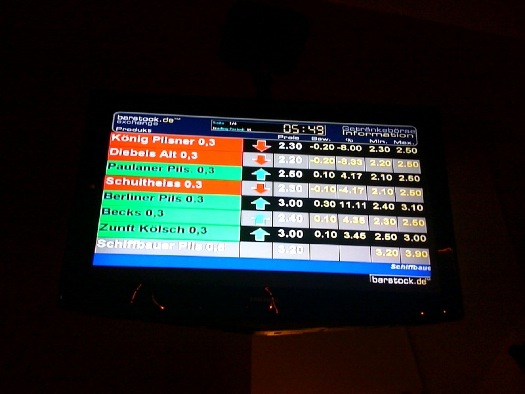
"18 different draught beers are on offer on our 'beer market', and, after 6pm. the price depends on how popular the beer is at the moment." (Die Berliner Republik, 2010)

Trades screen at Berliner Republik

At the Berliner Republik bar, the price of beers change depending on supply and demand at the bar (Connolly, 2010). The beer price is also shown online. 

Carroll, T. (2009) Berlin Day 2, Part 1: Sun, Oct 25, 2009 at 10:46 AM. [Online]
http://www.foodgps.com/tomm-carroll’s-european-beer-dispatches/ [23/05/2010]
Connolly, K. (2010) Berliners Dream of Return to Deutschmark. [Online]
http://www.guardian.co.uk/world/2010/may/23/euro-crisis-dispatch-berlin-mark [23/05/2010]
Die Berliner Republik (2010) http://www.die-berliner-republik.de/en/ [23/05/2010]

Photosynth and Jean-Gabriel Périot

I've looked into Photosynth last year, as it allows ways of digitally mapping photographs online (BmB, 2009). There are similarities between Photosynth and Nijuman no Borei by Jean-Gabriel Périot, which I find them interesting ways to rearrange photographic images to create something new.

Nijuman no Borei

Photosynth

BmB (2009) Photosynth. [Online]
http://berlinmitberlin.blogspot.com/2009/12/photosynth.html [23/05/2010]
Périot, J.-G. (2007) Nijuman no Borei (200000 phantôms). [Online] http://www.jgperiot.net/FILMS/NIJUMAN%20NO%20BOREI/nijuman.htm
[23/05/2010]
Photosynth [2010] Bernauer Strasse. [Online] http://photosynth.net/view.aspx?cid=ba599ffa-4d1d-4909-b04c-3e1f20b938f0 [23/05/2010]

Under Twilight by Jean-Gabriel Périot

A scene from Under Twilight

Short archival clips are mirrored and overlapped, as they are projected onto one screen.

Périot, J.-G. (2006) Under Twilight. [Online] http://www.jgperiot.net/FILMS/UNDER%20TWILIGHT/UnderTwilight.htm
[23/05/2010]

HSBC Adverts

"HSBC has been communicating its understanding of its customers and the world they live in by recognising their different values. From courage to status and trust, HSBC strives to celebrate the diversity of these values." (HSBC, 2010)

freedom; status symbol; polluter

fate; fear; fairy tale

As HSBC claims to be "the world's local bank" (HSBC, 2010) their adverts promo their message that they understand the diversity of values. The adverts fames two of three photographic images with divverent, sometimes conflicting values, to show how people perceive differently. At the end of their two short clips, Integrity and Responsibility, a mosaic map of the world appears from a collection of portraits - which is similar to a Berlin mit Berlin ident I produced for Hybridised Practices unit last year. 


HSBC (2010) Advertising. [Online] http://www.hsbc.com/1/2/about/advertising#
[23/05/2010]

Nijuman no Borei by Jean-Gabriel Périot


Jean-Gabriel Périot produces a 10-minutes long photo-essay Nijuman no Borei from images shot in Hiroshima, around the site of the A-Bomb Dome (Périot, 2007). The memorial in 1996 was inscribed as a World Heritage [UNESCO, 2010].

Périot, J.-G. (2007) Nijuman no Borei (200000 phantôms). [Online] http://www.jgperiot.net/FILMS/NIJUMAN%20NO%20BOREI/nijuman.htm
[23/05/2010]
UNESCO [2010] Hiroshima Peace Memorial (Genbaku Dome). [Online] http://whc.unesco.org/en/list/775 [23/05/2010]

Open-Air Exhibition

Kulturprojekte Berlin
Open-air exhibition at Alexanderplatz

The exhibition tells the story of the Peaceful Revolution and its main participants. In fascinating pictures it shows how complex this process developed and that its outcome was neither inevitable nor self-evident. The exhibition is open twenty-four-seven; free entry.

A project by Robert-Havemann-Gesellschaft e.V. in collaboration with Kulturprojekte Berlin GmbH; sponsored by Stiftung Deutsche Klassenlotterie Berlin and the Federal Government's representatives for culture and media. [Kulturprojekte Berlin, 2010]

Kulturprojekte Berlin. [2010] 2010 – 20 Years Since the Fall of the Berlin Wall: Peaceful Revolution 1989/90 – Open-Air Exhibition. [Online]  http://www.kulturprojekte-berlin.de/en/projects/20-years-since-the-wall-came-down/20-years-since-the-fall-of-the-berlin-wall/ [23/05/2010]

The Art of the Two Germanys during the Cold War / Deutsche Kunst im Kalten Krieg

Kulturprojekte Berlin
This exhibition will present the art of former East and West Germany in the United States for the first time. It is financially supported by Germany’s foundation for culture and by the German lottery. Starting in January 2009, it will be the first special exhibition to be presented in the newly built Broad Contemporary Art Museum, and is being organized by the Los Angeles County Museum of Art and Kulturprojekte Berlin GmbH.


On 23rd May 2009 the exhibition will open in the “Germanisches Nationalmuseum” in Nuremburg to mark the 60th anniversary of the foundation of the Federal Republic of Germany; it will be on display in Berlin from 3rd October 2009. There, it will be at the centre of events celebrating the 20th anniversary of the fall of the Berlin wall, when the Cold War came to an end.

The exhibition shows how much the two art histories were fused with one another despite their extreme ideological differences. Memorial competitions took place in the early fifties and late eighties to mark the beginning and end of the Cold War. In 1953 there were competitions for the “unknown political prisoners” in the West (Bernhard Heiliger took part amongst others), and for the victims of Buchenwald concentration camp in the East (Fritz Cemer). At the end of the Cold War, the Federal Republic of Germany and the German Democratic Republic were united in artistic projects that looked to discover an identification of their respective state’s creation: Werner Tübke with his panorama of the Peasant War in Bad Frankenhausen, and Johannes Grützke with his depiction of the “Peoples’ Representative in the 1848 revolution” in the Paulskirche in Frankfurt am Main.

The confrontation between opposing images of humanity at the start of the fifties has turned into a coexistence of self-critical discussion about the historical legends of the two Germanys.

Kulturprojekte Berlin [2010] The Art of the Two Germanys during the Cold War / Deutsche Kunst im Kalten Krieg. 


BmB (2009) Art of Two Germanys Exhibition. [Online]

"The Most Difficult Time" since Germany's Reunification

Photograph by Carsten Koall

Europeans face "the most difficult time in the EU since the collapse of communism and Germany's reunification, with the huge difference that the situation is now depressed and pessimistic in contrast to the air of possibility and optimism when the Berlin Wall fell", claims Traynor (2010).

Ian Traynor is the Guardian's European editor.

Traynor, I. (2010) David Cameron and Angela Merkel: A Candid Relationship. [Online] http://www.guardian.co.uk/uk/2010/may/21/david-cameromn-angela-merkel [23/05/2010]

Koall, C. [2010] http://www.carsten-koall.com/ [23/05/2010]

Polish Airlines Hijacking


Barbara Galonska was a passenger on board Polish Airlines flight 165 heading for East Berlin. The flight was hijacked by Hans Detlef Tiede who demanded it to land in West Berlin. Galonska chose to return to the GDR, rather than to defect (Scheuermann, 2010). A US court was set up in the Tempelhof airport departure lounge to prosecute (Deutsche Welle, 2008).

Judge Stern (right)

Deutsche Welle (2008) US Judge: Berlin Plane Hijack Trial Had Parallels to Guantanamo.
[Online] http://www.dw-world.de/dw/article/0,,3587971,00.html [23/05/2010]
Scheuermann, C. (2010) Hijacked to Capitalism: Unwitting East German Defectors Revisit Decision to Stay or Go. [Online]
http://www.spiegel.de/international/germany/0,1518,695710,00.html#ref=nlint
[23/05/2010]

Taiwanadvice.com [2010] US v. Tiede Summary: United States Court for Berlin, March 14, 1979. [Online] http://www.taiwanadvice.com/westberlint.htm [23/05/2010]

The Art Of Conversation: London—Berlin


1 chain of exchanging ideas. 
10 London design studios.
10 Berlin design studios. 
20 original works.
[The Art of Conversation, 2010]

The Art of Conversation (2010) The Art Of Conversation: London—Berlin. Trailer / Half way teaser. [Online] http://vimeo.com/9699994 [22/05/2010]
The Art of Conversation [2010] The Art Of Conversation: London—Berlin. [Online]http://www.theartofconversation.org/face.html [22/05/2010]
Dazed Digital (2010) Art of Conversation. [Online]
http://www.dazeddigital.com/ArtsAndCulture/article/7555/1/Art_of_Conversation [22/05/2010]

Berliner Morgenpost Animation


Berliner Morgenpost [2010] 20 Jahre Mauerfall in Berlin. [Online] http://appl.morgenpost.de/bm_flash/21_Mauerfall/index2.html [22/05/2010]

Saturday, 22 May 2010

Room with a Historical View

Mauerspringer (Wall Jumper) by Gabriel Heimler

Gabriel Heimler was one of the artists involved in "the first joint art project between the two Germanys" after the opening of the Berlin Wall. The collaborative project by two artist associations, the VBK from the East and the BBK from the West, was titled the East Side Gallery, and was completed in 1990 with the participation of 102 artists [Arte Luise Kunsthotel, 2010a]. Heimler's work has now also "taken up residence"  in Room 421 at Arte Luise Kunsthotel and also "has been adapted to its current time and place": Mauerspringer leaped from West to East in 1989 in a symbolic gesture of bringing freedom, he jumps "from history into the reality of the present" [Arte Luise Kunsthotel, 2010a].

"All rooms in the hotel have been individually decorated by a renowned artist, whose concept incorporates the entire room. Every room is an original, and the only thing that they all have in common is high artistic quality". [Arte Luise Kunsthotel, 2010b]

Berlin History by Moritz Götze

Another room at the hotel features a collection of ironic images of Berlin by Moritz Götze. "By the window: an enamel skyline created by the artist with all the key orientation points, including the top floor of the hotel with a view of the Spree, the Reichstag building and the Chancellery. Next to the window is a shelf with selected Berlin literature and a telescope for remotely discovering the history-laden surroundings" [Arte Luise Kunsthotel, 2010c].

Arte Luise Kunsthotel [2010a] 421 Double Room with Shower. [Online] http://www.luise-berlin.com/en/rooms/421.htm [22/05/2010]
Arte Luise Kunsthotel [2010b] Arte Luise Kunsthotel. [Online] http://www.luise-berlin.com/en/index.htm [22/05/2010]
Arte Luise Kunsthotel [2010c] 432 Double Room with Shower. [Online] http://www.luise-berlin.com/en/rooms/432.htm [22/05/2010]

Sophie Calle Exhibitions


"To record this process, I visited places from which symbols of GDR history have been effaced. I asked passers-by and residents to describe the objects that once filled these empty spaces. I photographed their absence and replaced the missing monuments with their memories." [Calle, in German Bundestag, 2010]

The artist Sophie Calle documents how Berlin faces its history and its correlation of memory and personal identity. The installation "Die Entfernung - The Detachment" makes audiences aware of "the complex way in which we perceive reality - and to the equally complex way in which history and the present are interwoven" and "is one of the most revealing artworks on the history of inter-German relations and its contemporary afterimage" [German Bundestag, 2010]

 
Guides for the exhibitions Die Entfernung - The Detachment
and Talking to Strangers [PDF]

In Talking to Strangers, a documentary and performing arts by Calle, combines photography, film and text, balancing "conceptual rigour and the elements of chance brought about by including both herself and her subjects directly in the artistic process. This spirit of inclusivity is more likely to illicit feelings of intimate understanding than intellectual dispassion; Calle’s is a conceptual art born of the world, not the classroom or studio (Pellerin, 2009). The guide for Talking to Strangers suggests actions for the audience to take at the exhibition and elsewhere, alongside a dialogue by two artists, to enhance the experience at the gallery and to understand Calle's work further [Whitechapel Gallery, 2010]. 


German Bundestag [2010] Sophie Calle: Die Entfernung - The Detachment. [Online] http://www.bundestag.de/htdocs_e/artandhistory/art/artists/calle/index.html     [22/05/2010]
Pellerin, A. (2009) Sophie Calle: Talking to Stragers. [Online] http://www.dazeddigital.com/ArtsAndCulture/article/5539/1/Sophie_Calle_Talking_to_Strangers [22/05/2010]
Whitechapel Gallery [2010] Conversations and Actions. [Online] http://www.whitechapelgallery.org/downloads/calle.pdf [22/05/2010]

Vukadin, A. (2009) Sophie Calle: Talking to Strangers. [Online] http://whitehotmagazine.com/articles/2009-sophie-calle-whitechapel-gallery/1976 [22/05/2010]

Friday, 21 May 2010

Meat Love by Jan Švankmajer


Meat Love (Zamilované Maso) is a short film directed by Jan Švankmajer, a Czech animator, and released in 1989. Although governments in Eastern European states were collapsing in 1989, Czechoslovakia was still one nation then (Cowley, 2009). The Berlin Wall was opened in in this year also, and the plot of the film made me think of the German unification. 

Cowley, J. (2009) 1989 The Year of the Crowd. [Online] http://www.newstatesman.com/international-politics/2009/03/world-crowd-end-wall-1989 [21/05/2010]
Meatpaper [2010] Jan Svankmajer’s “Meat Love” Animation from 1989. [Online] 
http://www.meatpaper.com/meatart/svankmajer/index.html [21/05/2010]
Michnik, A. & Havel, V. (2008) After the Velvet, an Existential Revolution? [Online]
http://www.salon.eu.sk/article.php?article=801&searchPhrase=velvet%20revolution&lang=EN [21/05/2010]

Monday, 17 May 2010

Eva Meyer-Keller

NNF10
"Death is certain started from a wish to do something really simple and easily accessible. I got interested in fairy tales, because they leave a lot of space for projection and the 'action' to project seems essential to perceive them." (Meyer-Keller, 2003)
Eva Meyer-Keller performs internationally as well as organising festivals and events. She collaborats with other artists and groups also. I have interviewed her between her performances of Death is Certain at Norwich and Norfolk Festival, on her work including Volksballons und geklonte Krieger/People's balloons And cloned warriors at Palast der Republik in Berlin, and how she connects with her audience.

Eva Meyer-Keller preparing Death is Certain

Meyer-Keller, E. (2003) From the Klapstuk festival program, October 2003: From an interview with Sally de Kunst. [Online] http://www.evamk.de/daten/d_sally.html [14/05/2010]

Goethe-Institut [2010] Eva Meyer-Keller. [Online] http://www.goethe.de/kue/tut/cho/cho/mr/mey/enindex.htm [14/05/2010]
Tollmann, V. (Trans. Mahoney, N.) (2009) Eva Meyer-Keller: Building after Catastrophes/Handmade. [Online] http://www.goethe.de/ges/umw/prj/kuk/fot/eva/enindex.htm [14/05/2010]
Vivid (2005) Artfest 06. [Online] http://www.vivid.org.uk/projects.php?work=34 [14/05/2010]


Sunday, 16 May 2010

Marina Abramović

"The work is done for the audience. Without audience the world doesn't exist: it doesn't make any meaning."
(Abramović, in MoMA, 2010a) 


"In an endeavor to transmit the presence of the artist and make her historical performances accessible to a larger audience, the exhibition includes the first live re-performances of Abramović’s works by other people ever to be undertaken in a museum setting. In addition, a new, original work performed by Abramović will mark the longest duration of time that she has performed a single solo piece... All performances, one of which involves viewer participation, will take place throughout the entire duration of the exhibition, starting before the Museum opens each day and continuing until after it closes, to allow visitors to experience the timelessness of the works." (MoMA, 2010b) 

Live between 14 March-31 May, 2010

Abramović claims that performance is a "unique form of art and is very temporary", and that "there's nothing to sell in performance: it's just memory". She also notes that she does not expect anything from the audience and "then it's up to the audience how they take it" (Abramović, in MoMA, 2010a). 

As well as broadcasting Abramović's performance on its website, MoMA has also created a photostream of participants' portraits online.

Day 53, Portrait 12; Day 53, Portrait 11; Day 53, Portrait 10 by Marco Anelli

Anelli, M. (2010) MoMA The Museum of Modern Art's Photostream. [Online] http://www.flickr.com/photos/themuseumofmodernart/ [15/05/2010]
MoMA (2010b) Marina Abramović: The Artist Is Present. [Online] http://moma.org/visit/calendar/exhibitions/965 [15/05/2010]
MoMA (2010a) What is performance art? [Online] http://www.moma.org/interactives/exhibitions/2010/marinaabramovic/conversation.html [15/05/2010]

Saturday, 15 May 2010

Cultures in Conflict: Visual Arts in Eastern Germany since 1990 [PDF]


Deshmukh, M.F. (ed.) (1998) Cultures in Conflict: Visual Arts in Eastern Germany since 1990. [Online] http://www.aicgs.org/documents/gdrart.pdf [15/05/2010]

Reality Bites: Making Avant-Garde Art in Post-Wall Germany [PDF]


Mildred Lane Kemper Art Museum [2010] Reality Bites: Making Avant-Garde Art in Post-Wall Germany. [Online] http://kemperartmuseum.wustl.edu/files/rbeducationguide.pdf [15/05/2010]

Why the Berlin Wall Fell

From Truman to Reagan, the benefits of moral clarity.


THE WALL STREET JOURNAL
In the debate over who deserves credit for causing the Berlin Wall to collapse on the night of November 9, 1989, many names come to mind, both great and small.

There was Günter Schabowski, the muddled East German politburo spokesman, who in a live press conference that evening accidentally announced that the country's travel restrictions were to be lifted "immediately." There was Mikhail Gorbachev, who made it clear that the Soviet Union would not violently suppress people power in its satellite states, as it had decades earlier in Czechoslovakia and Hungary. There were the heroes of Poland's Solidarity movement, not least Pope John Paul II, who did so much to expose the moral bankruptcy of communism.

And there was Ronald Reagan, who believed the job of Western statesmanship was to muster the moral, political, economic and military wherewithal not simply to contain the Soviet bloc, but to bury it. "What I am describing now is a plan and a hope for the long term—the march of freedom and democracy which will leave Marxism-Leninism on the ash-heap of history," he said in 1982, to the astonishment and derision of his critics. Now, there was the audacity of hope.

All of these figures played their part, as did a previous generation of leaders who insisted that the West had a moral duty to defend the little enclave of freedom in Berlin.

Fulfilling that duty came at a price—71 British and American servicemen lost their lives during the Berlin Airlift—that more "pragmatic" politicians might have gladly forgone for the promise of better relations with the Soviets. Not a few NATO generals thought the defense of Berlin needlessly exposed their forces in a militarily indefensible position while giving the Russians an opportunity to blackmail the West as they advanced on strategically more vital ground, particularly Cuba.

Yet if the West's stand in Berlin demonstrates anything, it is that moral commitments have a way of reaping strategic dividends over time. By ordering the airlift in 1948, Harry Truman saved a starving city and defied Soviet bullying. As importantly, he showed that the U.S. would not abandon Europe to its furies, as it had after World War I, thus helping to pave the way for the creation of NATO in April 1949.

By holding firm for 40 years, Truman and his successors transformed what was supposed to be the Atlantic alliance's weakest point into its strongest. To know what the West stood for during most of those years, one merely had to go to Berlin, see the Wall, consider its purpose, and observe the contrasts between the vibrant prosperity on one side of the city and the oppressive monotony on the other.

Those contrasts were even more apparent to the Germans trapped on the wrong side of the Wall. Barbed wire, closed military zones and the machinery of communist propaganda could keep the prosperity of the West out of sight of most people living east of the Iron Curtain. But that wasn't true for the people of East Berlin, many of whom merely had to look out their windows to understand how empty and cynical were the promises of socialism compared to the reality of a free-market system.

Yet it bears recalling that even these obvious political facts were obscure to many people who lived in freedom and should have known better. "Despite what many Americans think, most Soviets do not yearn for capitalism or Western-style democracy," said CBS's Dan Rather just two years before the Wall fell. And when Reagan delivered his historic speech in Berlin calling on Mr. Gorbachev to "tear down this wall," he did so after being warned by some of his senior advisers that the language was "unpresidential," and after thousands of protesters had marched through West Berlin in opposition.

It is a tribute to Reagan's moral and strategic determination, as it was to everyone else who played their part in bringing down the Wall, that they could see through the sophistries of Soviet propagandists, their Western fellow travelers, and the legions of moral equivocators and diplomatic finessers and simply look at the Wall.

"To see what is in front of one's nose needs a constant struggle," George Orwell once said. That is what the heroes of 1989 did with unblinking honesty and courage for years on end until, at last, the Wall came tumbling down.

The Wall Street Journal (2009) Why the Berlin Wall Fell. [Online] http://online.wsj.com/article/SB10001424052748704013004574515850127019522.html [15/05/2010] 

Survey finds support for return of Berlin Wall

AFP
BERLIN — Nearly one in four Germans "sometimes think it would be better if the Berlin Wall were still there," according to a new poll published on Monday.

The Emnid poll of 1,001 people for mass circulation daily Bild also showed that 16 percent of people thought a rebuilding of the once-hated barrier "would be the best thing that could happen."

The survey found little difference of opinion between those that used to live on either side of the Wall, with 23 percent of east Germans and 24 percent of west Germans saying they could be in favour of another Wall.

The 155-kilometre (96-mile) barrier, erected overnight by communist authorities on August 13, 1961, split the city of Berlin in two and came to symbolise Cold War division.

In a bloodless revolution on November 9, 1989, the Wall, officially called an "anti-fascist barrier" by the communists, was yanked down and hundreds of thousands of East Germans streamed across to the West.

The 20th anniversary of this momentous day was marked recently with an emotional ceremony at Berlin's Brandenburg Gate, attended by dozens of world leaders, topped off by a surprise video message by US President Barack Obama.

AFP (2010) Survey Finds Support for Return of Berlin Wall. [Online] http://www.google.com/hostednews/afp/article/ALeqM5gRSmyZgbVwp9q-wu8_nSOVgSKErw [15/05/2010]

Widow of East German leader insists life was better behind the Wall

THE IRISH TIMES
AFTER 20 years of capitalism, former citizens of the East German Democratic Republic (GDR) have begun to realise they had it better behind the Berlin Wall.

That is the conviction of Margot Honecker, widow of former GDR leader Erich Honecker, expressed at a private party to celebrate the 60th birthday of the vanished socialist state. While the rest of Germany gears up for the 20th anniversary of the fall of the Berlin Wall next month, the 82-year-old widow of the man who co-ordinated its construction is rueful, but unrepentant.

“Okay, so we didn’t manage it , but still, 40 years isn’t so bad. It certainly left an impression,” said Ms Honecker in a video on YouTube filmed in Chile, her home since 1992.

A year earlier she left Germany with her husband before his death from cancer in 1994. “There is no news programme, no film that doesn’t try to discredit the GDR, but they haven’t succeeded,” she said under the old GDR flag, after singing a verse of The Internationale. “Fifty per cent of East Germans say ‘we have a worse life under capitalism, we had a good life in the GDR’. People are thinking more and more about what they had in the German Democratic Republic.”

Among young people, in particular, she said there was a “huge interest”. “The left wing is there, getting ever more votes and support as the larger parties are punished for their anti-social politics,” she said, noting the 12 per cent of the poll in September’s general election for the Left Party, a successor to the ruling SED.

“Things in Germany are going downhill for the working class, so things are looking good for the left,” she said. “I’m optimistic, always was and always will be.”

Ms Honecker, who served as education minister in the GDR, was accused, but never charged, of involvement in organising forced adoptions of children of dissidents to loyal party members.

Attitudes to the vanished East Germany vary widely in surveys, depending largely on the question asked. Some 80 per cent of Germans quizzed by Stern magazine this week say they are happy that the Berlin Wall fell.

About one in seven former East Germans quizzed said they would like to see the wall back. In a survey in June for the Emnid polling institute, some 49 per cent of 600 former easterners quizzed said the GDR had more positive than negative sides.

Meanwhile, a former prisoner of the Stasi secret police has locked himself in his former cell – and is streaming the images on the internet – to recall GDR oppression.

Carl-Wolfgang Holzapfel donned his old blue uniform yesterday and entered the cell at Berlin’s Hohenschönhausen prison, where he served nine months in 1965. “We have to remember the leaden years before, the courage of people who were hounded by the authorities, and the revisionist politics of the Left Party.” His website is www.stasi-live-haft.de

DEREK Scally, D. (2009) Widow of East German Leader Insists Life was Better Behind the Wall. [Online] http://www.irishtimes.com/newspaper/world/2009/1031/1224257766778.html [15/05/2010]

Steffenhagen, J. (2009) Die Mauer im Kopf von Margot Honecker. [Online] http://www.welt.de/fernsehen/article5024563/Die-Mauer-im-Kopf-von-Margot-Honecker.html [02/05/2010]

Plans for monument to German unity cause some division

THE NEW YORK TIMES
BERLIN — Plans for a monument to celebrate German unity and freedom are causing a stir 18 years after the Wall fell, with some accusing Berlin of building too many memorials and others saying the whole project is pointless.

The lower house of Parliament, the Bundestag, is to discuss the proposed monument on Friday - the 18th anniversary of the 1989 opening of the Berlin Wall, which brought an end to Communist East Germany and opened the door to German reunification less than a year later.

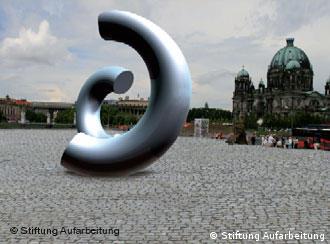
The winning design for the "Memorial to the Freedom and Unity of Germany" was by Bernadette Boebel, a 25-year-old student. It consists of two steel semi-circles 10 meters apart which appear as a full circle when viewed from a certain perspective.

Norbert Lammert, president of the Bundestag, said at the award ceremony for Boebel's design that a monument to post-Cold War German freedom and unity was "long overdue" in a city full of memorials recalling the Nazi and communist dictatorships.

But not everyone shares his enthusiasm.

Nikolaus Bernau, a prominent architectural expert, says a steel monument can never hope to evoke abstract concepts like freedom and unity, let alone the euphoria of the 12 months leading up to reunification in 1990.

"Based on all the experience people have with building and preserving monuments, this concept is at best naive," Bernau wrote in the Berliner Zeitung newspaper.

He said 1989 would be better remembered in celebrations, exhibitions, museums, films and other works of art.

Luc Jochimsen, cultural spokeswoman for the Left party, said the monument focuses on unification and ignores more important aspects of the 1989 revolution.

"We think Berlin is the wrong place. We think its focus should be on Leipzig, not Berlin, and on Oct. 9 (1989), not Nov. 9," she said, referring to demonstrations in the eastern city of Leipzig that marked the beginning of the end of Communist rule.

Others say Berlin already has more than enough monuments.

Within a stone's throw of the Brandenburg Gate in central Berlin are the new Holocaust Memorial, a permanent exhibition honouring Germans killed trying to cross the Wall and a monument commemorating the Soviet army's liberation of Berlin.

A new center remembering Germans and others expelled from eastern Europe after World War II is also planned.

One reason why a memorial marking German unity is under discussion may be that most traces of the Wall that separated east and west Berlin for nearly three decades are gone.

Many Germans still have mixed feelings about reunification, making the debate over the new monument even more complicated.

Klaus-Peter Schoeppner of the Emnid polling institute says the majority of Germans still think of the former Communist east as a "second class Germany."

A recent survey showed that one out of five Germans would like to have the Berlin Wall back.

© Stiftung Aufarbeitung

KJ (2008) German Reunification Memorial Initiators Awarded National Prize. [Online] http://www.dw-world.de/dw/article/0,,3417566,00.html [15/05/2010]

The New York Times (2007) Plans for Monument to German Unity Cause Some Division. [Online] http://www.nytimes.com/2007/11/09/world/europe/09iht-09wall.8269616.html?_r=1 [14/05/2010]