Thursday, 27 May 2010

Tate Symposium: Stillness and Movement

Vietnam, 1967, near Duc Pho (Reconstruction after Hiromishi Mine) 2001
Large-screen video projection, 576 x 720 cm
PAL interlaced, color, silent, 3' 30"

The symposium Stillness and Movement reflects on "films structured around the still photograph and how they address the perception of time and memory, and the nature of cinema" [Tate, 2010]. It will also explore "the wider discourse around photo films in the contemporary context of photography, film and digital media", and "the changing relationships of stillness and movement and the ways in which we conceive and experience time" (University of the Arts London, 2010).

Raymond Bellour, David Campany, Ian Christie, Dieter Daniels, Laura Mulvey and pioneering artists James Coleman, David Claerbout and Leslie Thornton 

Jean Eustache, Hollis Frampton, Dryden Goodwin, Chris Marker, Nagisa Oshima, Sean Snyder, Alain Resnais, Agnès Varda

Tate [2010] PhotoFilm: Friday 5 March – Sunday 14 March 2010. [Online]
http://www.tate.org.uk/modern/eventseducation/film/photofilmseasonseries.htm
[27/05/2010]
University of the Arts London (2010) Stillness & Movement Symposium at Tate Modern. [Online] http://www.arts.ac.uk/newsevents/6610/stillness-movement-symposium-at-tate-modern/ [27/05/2010]

Tacita Dean and Berlin


Tacita Dean, Fernsehturm (two stills), 2001:
 16MM color anamorphic film, optical sound, 44 minutes.

As Searle (2001) visited an exhibition by Tacita Dean, he became "supremely, and sometimes excruciatingly, aware of time. How long can you look, stay mesmerised, picking up the details?" He notes that "it takes about two and a half hours to watch the entirety of Dean's films" and another half an hour to listen to her audio tape of her journey in search of the Spiral Jetty" sitting on an uncomfortable corner bench, and questions, "well, how much time have you got?"

The following is an excerpt of Searle's article:
Fernsehturm, her latest work, is a 44-minute film set in the revolving cafe of the east Berlin television tower, completed in 1969 on Alexanderplatz. For years, east Berliners and tourists could visit the Telecafe to watch the divided city turn below them, as they drank their warm advocaat (this being the only thing on offer, according to one friend who visited before the Wall came down). For much of the movie, the camera is static, looking across an arc of the cafe, with its stuffy atmosphere, the fiddly details, the slanted, light-filled windows. We watch the light play across the room as we slowly sweep the city.
But Dean doesn't really give us a view of Berlin, so much as of Berliners coming and going, looking at the view, minding their manners. Dust motes and smoke, beer glasses and gold-chromed light fittings catch the ever-changing light. Sometimes the camera takes a stroll past a waiter's galley, peeking through a grille that partitions off the doors to the toilets. And then it is night, with an organist ruining The Girl From Ipanema and a Strauss waltz on his once ultra-modern keyboard. Then the shutters go down, the lights go up, and we are in a wretched centrifugal room churning through history.
The square on which the TV tower sits was immortalised in Alfred Döblin's novel Berlin Alexanderplatz, which was later filmed by Fassbinder. Even the novel is written as though it were a movie - short chapters, brief scenes, clockwork motivations and action. Dean's single, widescreen film almost preserves strict unities of time and place. You are here, the film tells us. But we are also in a kind of clockwork world, the shadows ratcheting round, like the frames of a film clicking through the projector's gate. The room is a clock, a camera, a projector, a world within worlds. The human activity is desultory, banal, ritualised in cafe time, drinks time, dinner time. Glasses are raised, heads nod, hair haloed in tobacco light.
Long and uneventful though it at first seems, Fernsehturm is Dean's most accomplished work to date. In fact, I believe it is a masterpiece, in an age when even the mention of the word makes toes curl. Yet the possibility of such consummate artworks still exists. They sneak out from their prisons of style and intention, loaded with more than the stamp of familiar destinations in their passports. They are stateless. They won't lie down, they are not compliant. We are in Germany, we are here. What goes around comes around.
"Dean can eat your day", writes Searle (2001), and concludes, "we are rarely asked to give any art so much time. How long can you look at a painting or a sculpture? I remind myself that it takes even longer to read a novel. Art takes the time it needs".

Palast [Still], 2004
16mm colour, optical sound
10 minutes 30 seconds
Edition of 4

Dean (2005) on Berlin:
Wonder: Fernsehturm Tower, Berlin
The Fernsehturm Tower was built between 1965 and 1969, in the former GDR. It is a revolving sphere in space that somehow retains something of the optimism of the 1960s. You can see it from anywhere in Berlin, and from the aeroplane when you land. It's a real landmark. It always changes with the weather: when the sun shines it catches the light and projects a huge cross, called the Pope's Revenge - ironically pointing towards the west - and when the weather is cloudy, it becomes a stem that disappears into the sky. Inside there is a revolving restaurant, which was sped up after the fall of the Wall: it used to take an hour to do a full rotation of the view, and now it takes half an hour. It's a beautiful allegory of progress - the speeding-up for capitalism.
Blunder: Potsdamer Platz, Berlin 
I visited the Potsdamer Platz in 1987, when it was just a wasteland. It was a huge architectural opportunity to regenerate a large part of central Berlin, which has been completely wasted. They brought in lots of top architects, including Renzo Piano, but it hasn't worked at all. Everything is very ugly. It looks extremely corporate, with towering buildings. Even the cafes and restaurants don't work very well.

From a Tate [2010] St. Ives exhibition description:
A leading artist of her generation, Dean works in a variety of media including prints and drawings but most notably film and sound. She is fascinated by the close relationship between film, the passing of time and the possibilities they present in the construction of narrative.
Exploring Berlin, her films sensitively capture the complex histories imbued in the material culture and architecture of this formerly divided city and its people. Evocative, melancholy and mysterious, her work suggests a personal experience wrapped up in the larger rhythms of history. The first presentation of her work in a public gallery in the UK since 2001, this exhibition includes her first major Berlin work Fernsehturm 2001. An atmospheric film made in the revolving restaurant of former East Berlin's famous Television Tower, Fernsehturm captures the changing atmosphere of this landmark place as day turns to night, revealing shifting perspectives of locality, social history and politics.

Palast 2004

Palast 2005
Palast 2004
Shown at the Venice Biennale this year, in her latest film Dean reflects Berlin's divided history in the jaded façade of the once iconic Palast, the government building of the former German Democratic Republic.

And an excerpt from Winterson's (2005) article, about Dean's work, space and time:
"Everything that excites me no longer functions in its own time. I court anachronism - things that were once futuristic but are now out of date," she says.
…
In the communist part of Berlin, a revolving cafeteria allowed diners exactly an hour to eat cream buns and drink tea while watching a 360-degree panorama of their city, looking out towards the forbidden Berlin of the West. The Fernsehturm resembles a lighthouse or the prow of a ship. It is a relic of a particular regime, a particular time. It is marooned in its own past, and it beams out futuristically across the skyline. Like so much else, what was once a symbol has become a tourist attraction, and, significantly, a full rotation has been sped up from one hour to just 30 minutes.
Life has moved on. There is no wall, no GDR, but though the Fernsehturm can turn faster, it can only be caught at its own pace. In 2001, a year after she went to live in Berlin, Tacita Dean made the interior of the Fernsehturm into a 44-minute film - in which nothing happens. Unlike other film artists, such as Bill Viola or Billy Innocent, Dean is the genius of Nothing. Nothing needs a capital letter, because it is a Sartre Nothing, or a Beckett Nothing.
Her genius, with her slow, steady, held frames, is to allow the viewer to dream the Fernsehturm; to enter it without hurry, without expectation, and to accept, as we do in a dream, a different experience of time, and a different relationship to everyday objects. The glasses, the cutlery, the windows, the light, the shapes of people, the geometry of the tables ask, through the medium of the film, to be noticed, and to be understood. Time slows, then slips its loop altogether. The restaurant revolves, but we are outside of time - observers in space, with a weightlessness that contrasts to the solidity of what we are asked to observe.
I have watched people watching this film - one of her longest - and some walk away quickly, some lie down and have a snooze, some surrender themselves to the intensity of the experience. Others watch half of it, then complain bitterly in the cafe, because they waited and waited, and nothing happened. But climbing out of the nothing, like shy creatures, trodden-on and overlooked, is the curious life of objects freed from their everyday imprisonment. We understand that when Cézanne paints an apple, or Vermeer a milk jug, it is as though we had never seen these objects before.
On film, which has become the medium of action, contemplation is anathema. Yet when film allows a moment to unfold in real time, we realise that a moment is agonisingly long and that our perception of time is both subjective and approximate.
Dean can draw beautifully, and some of her drawings will be on show at the Tate, but 16mm film is her preferred medium because she is attracted to its relationship with time. She likes the beginning, middle and end that film allows, but far from reaching for a conventional narrative, she uses the time-line of the film to release her subject into its timeless state.
One of her new short films, PIE, is eight minutes of magpies in the trees outside her window in Berlin. Their restless squawking and hopping gives no sense of time passing, or of any purpose but their unplanned choreography becomes a dance of life - life that can only be found in the moment, but which depends on the illusion that the moment will last forever.
"I do not think I am slowing down time, but I am demanding people's time," she says. In a busy world, that is a big demand, but one of the many reasons why art matters is its ability to stop the rush. Art on film makes us conscious of the time and space we occupy, and give us an insight into the nature of time itself.
…
Dean takes great care with her film soundtracks, but her sound-alone installations open a world where hearing becomes our only radar. She turns us into bats or moles, dependent on just one of our senses, and that sense heightened to a painful acuteness.
There is discomfort in Dean's work - and no getting away from it, except by refusing it the time or the concentration. If you want a quick fix, she will seem superficial; you can't just pop in and have a look, as you can, say, with Damien's shark or Tracey's bed, or the Mona Lisa. The films and the sound installations need something of surrender to get the best out of them, and the gallery space is ideal for this. Although when she projected her Sound Mirrors on the wall of the National Theatre in 1999, it was a spectacular success, perhaps because the theatre is a dedicated building and her work has a sense of the sacred, and the dedictated.

Dean, T. (2005) Architecture: Wonders and Blunders. [Online]
http://www.guardian.co.uk/artanddesign/2005/may/30/wondersandblunders.architecture [27/05/2010]
Eugenides, J. (2006) Tacita Dean. [Online] http://bombsite.com/issues/95/articles/2801 [27/05/2010]
Frith Street Gallery (2008) Tacita Dean: Works. [Online]
Searle, A. (2001) Age and Beauty. [Online] http://arts.guardian.co.uk/critic/feature/0,,728587,00.html [27/05/2010]
Tate [2010] Tacita Dean: 8 October 2005  –  15 January 2006. [Online] http://www.tate.org.uk/stives/exhibitions/dean/default.shtm [27/05/2010]
Winterson, J. (2005) Much Ado about Nothing. [Online] http://www.guardian.co.uk/film/2005/sep/29/1 [27/05/2010]

Tacita Dean: German Christmas, Trees & Candles


"There is nothing more beautiful than a candle." (Dean, in Tate, 2009)
Tacita Dean talks about the christmas tree commissioned by Tate Britain. Dean is based in Berlin and this installation was inspired by her experience of christmas in Germany. 

Tate (2009) Tacita Dean's Christmas Tree. [Online] http://channel.tate.org.uk/media/57856598001 [27/05/2010]

Propaganda across Intra-Korean Border


The Korean peninsula has been divided between South and North Koreas since the end of the Korean War in 1953, with Demilitarized Zone (DMZ) stretching 2km on each sides of the border: it is "the most heavily armed border in the world", and a popular tourist destination [Korea Tourism Organization, 2010].


Since the sinking of the South Korean navy corvette Cheonan, both sides have intensified propaganda operations across the border in attempts to reach citizens across the border, broadcasting through loud speakers and radio. Activists in South Korea have been floating helium balloons with leaflets, in an effort to deliver messages to citizens in North Korean (BBC, 2010), where the government threatening to close up its border (Branigan, 2010).

A BBC news clip from 2008

BBC (2010) Inter-Korean Crisis: Propaganda Fight. [Online]
http://news.bbc.co.uk/1/hi/world/asia_pacific/10161184.stm [27/05/2010]
BBC (2008) Propaganda balloons Enter N Korea. [Online]
http://news.bbc.co.uk/1/hi/world/asia-pacific/7719064.stm [27/05/2010]
Branigan, T. (2010) North Korea Threatens to Close Border with South as Relations Worsen. [Online] http://www.guardian.co.uk/world/2010/may/26/north-korea-border-south-relations-worsen [27/05/2010]
Korea Tourism Organization [2010] DMZ Tours. [Online]
http://www.visitkorea.or.kr/ena/SI/SI_EN_3_4_1.jsp [27/05/2010]
Thatcher, J. (2009) Border Tension: N. Korea Tries to Push Obama with S. Korea Threat. [Online] http://www.welt.de/english-news/article3118038/N-Korea-tries-to-push-Obama-with-S-Korea-threat.html [27/05/2010]

Getz, A. (2010) War Tour. [Online] http://www.newsweek.com/2010/04/15/war-tour.html [27/05/2010]
Troy, T.M.Jr. (2008) The Cultural Cold War: The CIA and the World of Arts and Letters. [Online] https://www.cia.gov/library/center-for-the-study-of-intelligence/csi-publications/csi-studies/studies/vol46no1/article08.html [27/05/2010]

Street Art at Tate Modern

Tate Street Art [Tate, 2010a]

Case Study: Street Art sponsored by Nissan

Background
Nissan's current marketing campaign for their Qashqai model focuses on Street Art as a way to engage their target audience of 35-45 year-old urban males. They also pioneer free riding: urban biking using ramps and jumps.

Objectives
Tate Modern provided a venue for the final of the ‘Nissan Qashqai Urban Challenge' free-riding event as it tied into the Fluxus Olympics theme of the Long Weekend which opened at the same day as the Street Art exhibition. The Street Art exhibition offered an opportunity to reinforce and validate their association with the art movement.

Partnership
The exhibition reaches new audiences, broadening the socio-economic and ethnic mix of visitors and targeting urban youth and street cultures in London and beyond. The addition of the Nissan Challenge also encouraged a much younger audience to visit the gallery, often for the fist time.

Successes
The fit with Nissan's wider marketing campaign is ideal and the sponsorship has been leveraged in several ways including additional advertising, advertorials, cycling and driving tours highlighting other street art in London, and an information ‘tunnel' at the front of Tate Modern housing information about the exhibition and the street art movement in general. All messages are consistent across all media and together create a powerful integrated campaign about the exhibition and the sponsorship.
[Tate, 2010b]

Tate [2010a] Street Art at Tate Modern. [Online]
[27/05/2010]
Tate [2010b] Case Studies – Sponsorship [Online] 
[27/05/2010]

Where is Where? by Eija-Liisa Ahtila

Where is Where?
Eija-Liisa Ahtila
Where is Where? 2008
6 Channel projected installation with 8 channel sound; 53min 43sec. [Marian Goodman Gallery, 2010]

Where is Where? by Eija-Liisa Ahtila is "a haunting and layered consideration of how history affects our perception of reality" [MoMA, 2010], with the story of a poet seeking to understand and to interpret an event of two Arab boys killing their French friend during the Algerian war. The images are projected by "highly original use of multiframe images", displaying "the expressive power of cinema." [MoMA, 2010]


Marian Goodman Gallery [2010] Installation View: Eija-Liisa Ahtila. [Online] 
http://www.mariangoodman.com/exhibitions/2008-03-29_eija-liisa-ahtila-chantal-akerman/#/images/8/ [27/05/2010]
MoMA [2010] MoMA Presents: Eija-Liisa Ahtila’s Where Is Where? [Online]
http://www.moma.org/visit/calendar/films/993 [27/05/2010]

Christoph Niemann and MoMA

An Average Day at the Museum recreated by Christoph Niemann

"While the activities stayed roughly the same, the physical space has changed drastically" (Hoffmann, 2009) at MoMA between 1940 and 2009. Christoph Niemann was commissioned to update the concept of An Average Day at the Museum for the MoMA exhibition season in 2009.

An Average Day at the Museum which appeared in the MoMA annual report

There is also an interactive version online, with links to artworks and facilities of MoMA.


Hoffmann, J. (2009) An Average Day At the Museum Reinterpreted by Christoph Niemann. [Online] http://www.moma.org/explore/inside_out/2009/11/27/an-average-day-at-the-museum-reinterpreted-by-christoph-niemann [25/05/2010]

Wednesday, 26 May 2010

Christoph Niemann and his Audience [2]

"I don’t fix a broken bone of a person. I just sit there, think about ideas, whether somebody who’s 5000 miles away would understand this." (Niemann, 2010)

Christoph Niemann, the graphic designer living in Berlin and author of the New York Times' blog Abstract City, talks about how clients' opinions influence and improve his work. In his interview, Niemann (2010) states "my work is all about working with images that people can relate to... it's just a language, almost like a visual dialect that a lot of people speak".
"I’m really obsessed about how other people people see my work. 'What’s their experience?'  'Can they relate to what I do?' 'Do they have a shared visual universe?' I really think about that a lot."
"It’s all about the audience. It’s not about fulfilling your own creativity - even though that’s always a part of it - but it’s about the reader understanding what you do. And my credo really is; if I make a joke and I think it’s funny but the audience doesn’t laugh, it’s not funny."
(Niemann, 2010)
He also notes that it's probably the "favourite sport of designers, especially illustrators, to bitch about clients. Of course they’re the ones who kill ideas, who give you a hard time with deadlines, with changes" but admits, "the clients have made my work a lot better" (Niemann, 2010).


Kelly, K. (2009) The New Socialism: Global Collectivist Society Is Coming Online. [Online] http://www.wired.com/culture/culturereviews/magazine/17-06/nep_newsocialism?currentPage=all#ixzz0p2wMCy00 [26/05/2010]
Niemann, C. (2010) Christoph Niemann: Visual Reduction. [Online]
http://www.gestalten.com/motion/clipHiRes?id=120 [26/05/2010]

Glei, J. [2010] Christoph Niemann: Short Deadlines Make You Think Straight. [Online]
http://the99percent.com/articles/6003/christoph-niemann-short-deadlines-make-you-think-straight [26/05/2010]
Sellers, J. A. (2010) Q & A with Christoph Niemann. [Online]
http://www.publishersweekly.com/pw/by-topic/authors/interviews/article/43239-q--a-with-christoph-niemann.html [26/05/2010]
Sinclair, M. (2010) Christoph Niemann: Visual Reduction. [Online] http://www.creativereview.co.uk/cr-blog/2010/february/christoph-niemann [25/05/2010]

Tuesday, 25 May 2010

Berlin Wall "a Great Gift for Any Occasion"


"Give a gift which will be treasured  for life--Berlin Wall makes a great gift for any occasion including Christmas, anniversaries, birthdays and corporate recognition, or for that special 'thank you'!" (Berlin-Wall.net, 2010)

Berlin-Wall.net (2010) http://www.berlin-wall.net/orderform.htm [25/05/2010]

"Longest Stretch of Berlin Wall outside Berlin"


"The longest stretch of the Berlin Wall in the world, outside of Berlin" (a voice, in Brian1979d, 2009) was constructed in Los Angeles for the 20th anniversary of the opening of the Wall. The event was organised by the Wende Museum to honour "the cultural and historical implications of the fall of the Wall" including Thierry Noir, who was one of the first artists to paint on the Berlin Wall in 1984, and Shepard Fairey, whose "HOPE" portrait of Barack Obama became an "iconic image and helped inspire an unprecedented political movement" [The Wende Museum, 2010].

Shepard Fairey for The Wall Project
"The two sides of the Berlin Wall segment that stands outside the Wende Museum in Culver City speak volumes. The side that once faced West Berlin is painted with colorfully interlocking cartoon faces by Thierry Noir, a French artist, but the other side, which the East would have seen, is dull gray concrete. It's a tidy encapsulation of the polarities of the wall." (Cheng, 2007) 
Speaking of the exhibition "Facing the Wall: Living With the Berlin Wall" which had been curated in the previous years, the founder of the museum Justinian Jampol claims "We begin to come to terms with our own past by seeing what was going on on the other side as well" and that "there's no way you can come away without with a certain amount of self-reflection" where (Cheng, 2007).

Berlin Wall 20th Anniversary Celebrations. [Online]
http://www.germany.info/Vertretung/usa/en/__pr/GKs/LOSA/2009/11/02WallEvents.html [25/05/2010]
Brian1979d (2009) Berlin Wall Installation Ceremony in Los Angeles. [Online]
http://www.youtube.com/watch?v=GhL16zI14eo [25/05/2010]
Cheng, S. (2007) On View: In the Wake of the Wall. [Online]
http://articles.latimes.com/2007/oct/07/entertainment/ca-wende7 [25/05/2010]
German Missions in the United States (2009) A Day that Changed the World: Be a Part of the Fall of the Wall. [Online]
http://www.germany.info/Vertretung/usa/en/09__Press__InFocus__Interviews/03__Infocus/04__Without__Walls/__Main__S.html [25/05/2010]
Wende Museum, The [2010] The Wall Project. [Online]
http://www.wendemuseum.org/downloads/WallProject_JAN14_2010.pdf [25/05/2010]

digital displays

Freestanding Portrait Display

 82" LCD Landscape Advertising Display - PF82H1

AllSee Technologies. (2010) 82" LCD Landscape Advertising Display - PF82H1. [Online]
http://www.allsee-tech.com/TFT-LCD/digital-advertising-display-82inch.html [25/05/2010]
AllSee Technologies. (2010) Freestanding Portrait Display. [Online]
http://www.allsee-tech.com/poster/digital-poster-l-series.html [25/05/2010]

Sam Taylor-Wood, Travesty of a Mockery and Third Party


Travesty of a Mockery (1995), is a 10 minute film by Sam Taylor-Wood - who frequently uses film and photography to illustrate psychological/emotional states - portraying a man and a woman having an argument, "enacted simultaneously on two separate projected screens... each participant is isolated within his and her own screen, the borders from one to the other being crossed by thrown objects such as a glass of milk or a frying pan and, occasionally, by one of the participants, who, unable to contain their rage, launches an attack across the divide. A soundtrack of tuning into a series of different radio stations accompanies the film, seeming to articulate the switching emotional tenor of the scenario as it moves through confusion, anger, sadness and resignation" [White Cube, 2010]. 

Travesty of a Mockery
"This is one of several works in which Taylor-Wood locates her subjects in emotionally heightened or distressing situations, and then monitors their responses." [White Cube, 2010]
Third Party

The 10-minute film sequence, Third Party, is shot with 7 cameras simultaneously, is accompanied by an sound installation, and "the simultaneous presentation in the installation space asks the visitor to individually synthesize the scenario" [Württembergischer Kunstverein, in Medien Kunst Netz/Media Art Net, 2010].

Medien Kunst Netz/Media Art Net [2010] Sam Taylor-Wood, «Third Party», 1999. [Online] http://www.mediaartnet.org/works/third-party/ [24/05/2010]
White Cube [2010] Sam Taylor-Wood: Travesty of a Mockery. [Online] 
http://www.whitecube.com/exhibitions/travestyofamockery/ [24/05/2010]
WVIZPBS (2008) Brief Applause: Artist Sam Taylor-Wood. [Online]
http://www.youtube.com/watch?v=gzuWjwcqTcs [24/05/2010]

The Solomon R. Guggenheim Foundation (2010) Sam Taylor-Wood [Online]
http://www.guggenheim.org/new-york/collections/collection-online/show-full/bio/?artist_name=Sam%20Taylor-Wood&page=1&f=Name&cr=4 [24/05/2010]
White Cube [2010] Sam Taylor-Wood. [Online]
http://www.whitecube.com/artists/taylorwood/video/37/ [24/05/2010]

2 Berlin Wall Digital Maps

Map by Senate Chancellery

Map by LiveMap

Senate Chancellery [2010] The Wall inside the City. [Online]
http://www.berlin.de/mauer/verlauf/index/index.en.php [24/05/2010]
LiveMap GmbH [2010] Verlauf der Berliner Mauer. [Online] http://www.die-berliner-mauer.de/index.php?option=com_google_maps_vision&category=52&Itemid=119&lang=en
[24/05/2010]

Monday, 24 May 2010

Sam Taylor-Wood and Decaying Still Life


Still Life

A Little Death

Two still life imageries by Sam Taylor-Wood, both capturing decaying processes. 

Taylor-Wood, S. [2010] Still Life (2001). [Online] http://www.ubu.com/film/tw_still.html
[24/05/2010]
Taylor-Wood, S. [2010] A Little Death. [Online] http://www.ubu.com/film/tw_death.html
[24/05/2010]

Sunday, 23 May 2010

Berliner Republik Bar

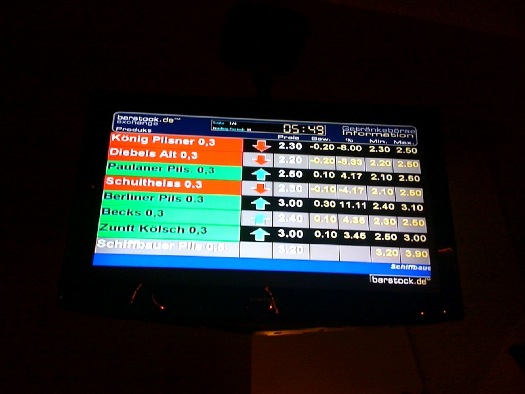
"18 different draught beers are on offer on our 'beer market', and, after 6pm. the price depends on how popular the beer is at the moment." (Die Berliner Republik, 2010)

Trades screen at Berliner Republik

At the Berliner Republik bar, the price of beers change depending on supply and demand at the bar (Connolly, 2010). The beer price is also shown online. 

Carroll, T. (2009) Berlin Day 2, Part 1: Sun, Oct 25, 2009 at 10:46 AM. [Online]
http://www.foodgps.com/tomm-carroll’s-european-beer-dispatches/ [23/05/2010]
Connolly, K. (2010) Berliners Dream of Return to Deutschmark. [Online]
http://www.guardian.co.uk/world/2010/may/23/euro-crisis-dispatch-berlin-mark [23/05/2010]
Die Berliner Republik (2010) http://www.die-berliner-republik.de/en/ [23/05/2010]

Photosynth and Jean-Gabriel Périot

I've looked into Photosynth last year, as it allows ways of digitally mapping photographs online (BmB, 2009). There are similarities between Photosynth and Nijuman no Borei by Jean-Gabriel Périot, which I find them interesting ways to rearrange photographic images to create something new.

Nijuman no Borei

Photosynth

BmB (2009) Photosynth. [Online]
http://berlinmitberlin.blogspot.com/2009/12/photosynth.html [23/05/2010]
Périot, J.-G. (2007) Nijuman no Borei (200000 phantôms). [Online] http://www.jgperiot.net/FILMS/NIJUMAN%20NO%20BOREI/nijuman.htm
[23/05/2010]
Photosynth [2010] Bernauer Strasse. [Online] http://photosynth.net/view.aspx?cid=ba599ffa-4d1d-4909-b04c-3e1f20b938f0 [23/05/2010]

Under Twilight by Jean-Gabriel Périot

A scene from Under Twilight

Short archival clips are mirrored and overlapped, as they are projected onto one screen.

Périot, J.-G. (2006) Under Twilight. [Online] http://www.jgperiot.net/FILMS/UNDER%20TWILIGHT/UnderTwilight.htm
[23/05/2010]

HSBC Adverts

"HSBC has been communicating its understanding of its customers and the world they live in by recognising their different values. From courage to status and trust, HSBC strives to celebrate the diversity of these values." (HSBC, 2010)

freedom; status symbol; polluter

fate; fear; fairy tale

As HSBC claims to be "the world's local bank" (HSBC, 2010) their adverts promo their message that they understand the diversity of values. The adverts fames two of three photographic images with divverent, sometimes conflicting values, to show how people perceive differently. At the end of their two short clips, Integrity and Responsibility, a mosaic map of the world appears from a collection of portraits - which is similar to a Berlin mit Berlin ident I produced for Hybridised Practices unit last year. 


HSBC (2010) Advertising. [Online] http://www.hsbc.com/1/2/about/advertising#
[23/05/2010]

Nijuman no Borei by Jean-Gabriel Périot


Jean-Gabriel Périot produces a 10-minutes long photo-essay Nijuman no Borei from images shot in Hiroshima, around the site of the A-Bomb Dome (Périot, 2007). The memorial in 1996 was inscribed as a World Heritage [UNESCO, 2010].

Périot, J.-G. (2007) Nijuman no Borei (200000 phantôms). [Online] http://www.jgperiot.net/FILMS/NIJUMAN%20NO%20BOREI/nijuman.htm
[23/05/2010]
UNESCO [2010] Hiroshima Peace Memorial (Genbaku Dome). [Online] http://whc.unesco.org/en/list/775 [23/05/2010]

Open-Air Exhibition

Kulturprojekte Berlin
Open-air exhibition at Alexanderplatz

The exhibition tells the story of the Peaceful Revolution and its main participants. In fascinating pictures it shows how complex this process developed and that its outcome was neither inevitable nor self-evident. The exhibition is open twenty-four-seven; free entry.

A project by Robert-Havemann-Gesellschaft e.V. in collaboration with Kulturprojekte Berlin GmbH; sponsored by Stiftung Deutsche Klassenlotterie Berlin and the Federal Government's representatives for culture and media. [Kulturprojekte Berlin, 2010]

Kulturprojekte Berlin. [2010] 2010 – 20 Years Since the Fall of the Berlin Wall: Peaceful Revolution 1989/90 – Open-Air Exhibition. [Online]  http://www.kulturprojekte-berlin.de/en/projects/20-years-since-the-wall-came-down/20-years-since-the-fall-of-the-berlin-wall/ [23/05/2010]

The Art of the Two Germanys during the Cold War / Deutsche Kunst im Kalten Krieg

Kulturprojekte Berlin
This exhibition will present the art of former East and West Germany in the United States for the first time. It is financially supported by Germany’s foundation for culture and by the German lottery. Starting in January 2009, it will be the first special exhibition to be presented in the newly built Broad Contemporary Art Museum, and is being organized by the Los Angeles County Museum of Art and Kulturprojekte Berlin GmbH.


On 23rd May 2009 the exhibition will open in the “Germanisches Nationalmuseum” in Nuremburg to mark the 60th anniversary of the foundation of the Federal Republic of Germany; it will be on display in Berlin from 3rd October 2009. There, it will be at the centre of events celebrating the 20th anniversary of the fall of the Berlin wall, when the Cold War came to an end.

The exhibition shows how much the two art histories were fused with one another despite their extreme ideological differences. Memorial competitions took place in the early fifties and late eighties to mark the beginning and end of the Cold War. In 1953 there were competitions for the “unknown political prisoners” in the West (Bernhard Heiliger took part amongst others), and for the victims of Buchenwald concentration camp in the East (Fritz Cemer). At the end of the Cold War, the Federal Republic of Germany and the German Democratic Republic were united in artistic projects that looked to discover an identification of their respective state’s creation: Werner Tübke with his panorama of the Peasant War in Bad Frankenhausen, and Johannes Grützke with his depiction of the “Peoples’ Representative in the 1848 revolution” in the Paulskirche in Frankfurt am Main.

The confrontation between opposing images of humanity at the start of the fifties has turned into a coexistence of self-critical discussion about the historical legends of the two Germanys.

Kulturprojekte Berlin [2010] The Art of the Two Germanys during the Cold War / Deutsche Kunst im Kalten Krieg. 


BmB (2009) Art of Two Germanys Exhibition. [Online]

"The Most Difficult Time" since Germany's Reunification

Photograph by Carsten Koall

Europeans face "the most difficult time in the EU since the collapse of communism and Germany's reunification, with the huge difference that the situation is now depressed and pessimistic in contrast to the air of possibility and optimism when the Berlin Wall fell", claims Traynor (2010).

Ian Traynor is the Guardian's European editor.

Traynor, I. (2010) David Cameron and Angela Merkel: A Candid Relationship. [Online] http://www.guardian.co.uk/uk/2010/may/21/david-cameromn-angela-merkel [23/05/2010]

Koall, C. [2010] http://www.carsten-koall.com/ [23/05/2010]

Polish Airlines Hijacking


Barbara Galonska was a passenger on board Polish Airlines flight 165 heading for East Berlin. The flight was hijacked by Hans Detlef Tiede who demanded it to land in West Berlin. Galonska chose to return to the GDR, rather than to defect (Scheuermann, 2010). A US court was set up in the Tempelhof airport departure lounge to prosecute (Deutsche Welle, 2008).

Judge Stern (right)

Deutsche Welle (2008) US Judge: Berlin Plane Hijack Trial Had Parallels to Guantanamo.
[Online] http://www.dw-world.de/dw/article/0,,3587971,00.html [23/05/2010]
Scheuermann, C. (2010) Hijacked to Capitalism: Unwitting East German Defectors Revisit Decision to Stay or Go. [Online]
http://www.spiegel.de/international/germany/0,1518,695710,00.html#ref=nlint
[23/05/2010]

Taiwanadvice.com [2010] US v. Tiede Summary: United States Court for Berlin, March 14, 1979. [Online] http://www.taiwanadvice.com/westberlint.htm [23/05/2010]

The Art Of Conversation: London—Berlin


1 chain of exchanging ideas. 
10 London design studios.
10 Berlin design studios. 
20 original works.
[The Art of Conversation, 2010]

The Art of Conversation (2010) The Art Of Conversation: London—Berlin. Trailer / Half way teaser. [Online] http://vimeo.com/9699994 [22/05/2010]
The Art of Conversation [2010] The Art Of Conversation: London—Berlin. [Online]http://www.theartofconversation.org/face.html [22/05/2010]
Dazed Digital (2010) Art of Conversation. [Online]
http://www.dazeddigital.com/ArtsAndCulture/article/7555/1/Art_of_Conversation [22/05/2010]

Berliner Morgenpost Animation


Berliner Morgenpost [2010] 20 Jahre Mauerfall in Berlin. [Online] http://appl.morgenpost.de/bm_flash/21_Mauerfall/index2.html [22/05/2010]