Friday, 4 June 2010

East German Cinema

Heinz Leo Kretzenbacher
acmi
In the 40 years of its existence, from 1949 to 1990, the German Democratic Republic (GDR) was widely perceived as "the other German state", the drab and dreary one, the poor relative. This perception was shared - if unacknowledged - by GDR officials whose constant self-praise of the "world class" of everything in the GDR just showed the size of the chip on their shoulders.
In hindsight, there were very few fields where the GDR could compete with West Germany, but one of these was the arts. Fine art, literature and film, in spite of having to deal with the censorship of a mistrustful bureaucracy, produced not only the mass of escapist kitsch and mandatory ideology that could be expected, but also many works of solid quality and a substantial number that reached international standing.
As a medium with mass appeal, the cinema played a special role in the art landscape of the GDR. Geography and politics gave it a running start: The Babelsberg studios of UFA, founded in 1917, former workplace of Fritz Lang and Billy Wilder and later the hub of cinematic propaganda in Nazi Germany, were situated in Potsdam in the Soviet occupation zone that would become the GDR in 1949. It was at these studios in 1946, three years before the separate states were founded, that the first German feature film after World War II was shot (Wolfgang Staudte's The Murderers are Among Us). The UFA's successor, the GDR monopolist DEFA, went on to produce around 700 full-length features, around 750 animated films and more than 2000 shorts and documentaries before German reunification in 1990.
ACMI's Focus on East German Cinema gives a broad panorama spanning the time from Wolfgang Staudte's mentioned The Murderers are Amongs Us, shot in the stark landscape of post-war Berlin, to Helke Misselwitz's documentary After Winter Comes Spring (1988), which gave voice to the overwhelming atmosphere of stagnation and the hope for change in the dying years of the GDR. Between these extremes of the anti-fascist and humanist ambitions that marked the ideological and hopeful beginnings of the state that understood itself to be the "better" Germany, and the weariness and resignation of people living under a fossilized regime, the ACMI retrospective shows many different facets of GDR cinema. It is this diversity that makes the retrospective so attractive.
While many of the films in this program have found international acclaim, ACMI wisely refrains from showcasing only the most internationally successful films and also avoids the cringeworthy output of Stalin-era GDR propaganda. So while Solo Sunny (1980), Konrad Wolf's film about a young woman's struggle for autonomy in a rigid and boring society, represents the top level of GDR films, others of the same standing, such as Frank Beyer's Traces of Stones (1966), are not part of the retrospective, and neither are embarrassing communist hagiographies such as Kurt Maetzig's two films on Ernst Thälmann from 1954 and 1955.
A great variety of genres is represented in Focus on East German Cinema. While After Winter Comes Spring is the only example of the rich documentary tradition in the GDR, Frank Beyer's Naked Among Wolves (1963), set in the Buchenwald concentration camp, and Konrad Wolf's autobiographical I was 19 (1968), dealing with his return to Germany as a Red Army soldier in 1945, join The Murderers are Among Us as examples of anti-fascist films. And just as Wolf's Solo Sunny observes the struggle of a young woman to find her place in a rigid society in the year 1980, so does Herrmann Zschoche's Carla in 1965.
Kurt Maetzig's The Silent Star (1960) and Gottfried Kolditz's In the Dust of the Stars (1976) showcase the unique GDR take on science fiction. The former, adapted from a novel by Stanislav Lem, paints a bleak picture of a planet devastated by nuclear war - a prospect not entirely improbable at the height of the nuclear brinkmanship in the Cold War - while the latter is most remarkable for the ABBA-style clothing and hairstyles on show. Richard Groschopp's Chingachgook - The Great Snake (1967), based on James Fenimore Cooper's novel The Deerslayer, is representative of the GDR's considerable output of westerns, while Konrad Wolf's Sun Seekers (1958) deals with the Soviet uranium mining in Saxony after WWII - a chaotic period that has been described as the GDR's own "Wild West".
For the artists, producing films in a dictatorship often meant testing the limits of varying (and sometimes suddenly tightened) censorship. Sun Seekers appeared to question the leading role of the Communist Party and was not released until 1972, 14 years after it was made. Karla, along with almost all of the DEFA productions of 1965, fell victim to a sudden rollback in cultural policy after a short period of liberalization inspired by Khrushchev's Post-Stalin reforms in the USSR, and was not released until after the fall of the Berlin Wall 25 years later. Even in 1988, the documentary After Winter Comes Spring, enthusiastically received and awarded a prize at the Festival of Documentary Film at Leipzig that year, was not released for broadcast by GDR TV.
For audiences, watching films in the GDR often meant reading between the lines for things the censors might have overlooked. So while we might enjoy the involuntarily comical futurist costumes and sets of In the Dust of the Stars, a GDR audience would be aware of its ambiguous ending, which does not conform to the rules of socialist heroism. The fact that in I was 19 a young German woman seeks the protection of the protagonist out of fear of being raped by Soviet soldiers was a daring breach of a taboo subject. Even the teenage musical Hot Summer (1968) owed its phenomenal success not only to the leading couple, played by the most popular singers at the time, and the fiction of a spontaneous group holiday on the Baltic coast (unheard of in the strictly regulated and rationed system of distribution of holiday accommodation in the GDR). The film was also a welcome relief from the dark reality outside the cinema: in the summer of 1968, the armies of "socialist brother countries," including the GDR, crushed the short phase of liberalization in Czechoslovakia known as "Prague Spring."
Although some East Germans tend to compensate for their problems in getting along in the competitive world of unified Germany by looking back at the GDR through rose-tinted glasses of nostalgia, there is not much this 'other' German state produced that will stand the test of time. However, most of the art produced in the 40 years of the GDR's existence will remain valid and valued; including it's rich legacy of film.
Heinz Leo Kretzenbacher was born in Graz, Austria, and grew up in Munich, where he completed his PhD in German, English and Portuguese Studies. He is currently a senior lecturer and convener of the German Studies Program at the University of Melbourne.


Kretzenbacher, H.L. (2009) East German Cinema. [Online]
http://www.acmi.net.au/east_german_essay_english.htm [04/06/2010]

Acmi [2010] Focus on East German Cinema. [Online]
http://www.acmi.net.au/fo_east_german.aspx [04/06/2010]

The View from the Wall

The View From the Wall

Huang et al (2009) created The View from the Wall, where the New York Times readers could upload their personal memories of the Wall before and after its opening. 

Huang, J., Tarchak, L., FANG, C., & Delviscio, J. (2009) The View From the Wall. [Online] http://www.nytimes.com/interactive/2009/11/09/world/europe/20091109-berlin-wall-reader-photos.html#/0 [04/06/2010]

candles


Amnesty International logo
"The symbol of the candle highlights perfectly the hope that Amnesty gives to so many people around the world by improving human rights." (Temperley, in Amnesty International UK, 2009)
Amnesty International adopted the candle logo which "continues to mobilise people of all religions, nationalities, cultures and customs to shine the light on the world's darkest corners", nearly 50 years after Diana Redhouse - a lifelong Amnesty member - designed an emblem based on a candle encircled in barbed wire. Peter Benenson, the organisation's founder, had the idea from a Chinese proverb, "Better to light a candle than curse the darkness" (Amnesty International UK, 2009).

Amnesty International (2008) Amnesty International Logo. [Online]
[04/06/2010]
Amnesty International UK (2009) Amnesty International and Alice Temperley launch limited-edition Amnesty scented candle. [Online] http://www.amnesty.org.uk/news_details.asp?NewsID=18480 [04/06/2010]
Rvf0elendil (2007) Schindler's List (theme). [Online] 

Baron, Y. & Baron, D. (2007) Obituary: Diana Redhouse. [Online]

German Short Films in Shanghai


Cartoon and Animation (2009) Das Rad (“Rocks – English Subtitles) Academy Award Nominated Film by Chris Stenner, Arvid Uibel and Heidi Wittlinger. [Online] http://cartoonandanimation.com/165/das-rad-rocks-animated-short-film/ [04/06/2010]
Cibernautajoan (2009) Die Aussicht. [Online] http://www.youtube.com/watch?v=WCGIbjNe_N4 [04/06/2010]

Kontrastfilm (2009) Edgar Trailer. [Online] http://www.youtube.com/watch?v=OyiBur9UutM

interfilm Berlin Management GmbH [2010] interfilm Berlin Enriches the 2010 EXPO with German Short Films. [Online] http://www.interfilm.de/expo_2010_eng.php [04/06/2010]
Pine Tree Pictures (2007) Schwarzfahrer (with English Subtitles) [Online] http://www.youtube.com/watch?v=XFQXcv1k9OM [04/06/2010]
Shortstv (2009) Toyland - Interview with the director of the Oscar Nominated Short Film 2009. [Online] http://www.youtube.com/watch?v=VEtrrGwzQX8 [04/06/2010]
aniBOOM (2008) Our Wonderful Nature - 1st Place Animation: Jury Category Aniboom Awards 2008. [Online] http://www.youtube.com/watch?v=0aFKSvw4bjU [04/06/2010]

East German artist encourages painting against the grain

As an artist in East Germany, Hans-Hendrik Grimmling painted himself out of "socialist realism" in the GDR. He and five other artists were pioneers in organizing an uncensored exhibition: the First Leipzig Fall Salon.

Author: Nadine Wojcik
Editor: Kate Bowen
Deutsche Welle
Hans-Hendrik Grimmling was practically born with a paintbrush in his hand. By 14, he and a friend had already set up their own studio in Grimmling's hometown Zwenkau, near Leipzig.
The two boys did not just have art on their minds, though. Although they painted, copied works by artists including Franz Marc, and even sold a couple of pieces, the studio served more as a sanctuary of freedom. They used the space to drink and throw parties, and would rent the room to young couples in exchange for a glass of beer. Everyone else kept their distance.
"It felt great," recalled Grimmling. "At such a young age, we had already carved a niche and tried to free ourselves from convention."

The soldier with the painting kit
Grimmling, seen here in his studio, is now an art professor in Berlin
After finishing school, Hans-Hendrik Grimmling joined the National People's Army (NVA), as all young men in East Germany were required to do. He later described the experience as the most terrible time of his life, full of humiliation and hidden tears.
During his service, Grimmling's painting kit was one of the only personal items he was allowed to keep. He retreated to his room each night to paint and avoid the problems he faced in the military. "There, I painted just for myself as an escape and to feel a kind of tenderness. Painting saved me from the reality I faced and helped me survive," he said.
Upon completing his military service, Grimmling was accepted to East Germany's most renowned university for artists, in Leipzig. He and his classmates gained a reputation for being wild - but also unbelievably productive. 

"Completely strange imagination"
Grimmling finished his basic studies with Werner Tuebke, one of the most famous GDR painters, and was accepted along with five other students for the advanced class called "Free Art." It was led by Wolfgang Mattheuer, another important figure in the Leipzig art scene. Mattheuer's class provided Grimmling with an important forum where he could enjoy artistic freedom.
However, Grimmling was prevented from graduating just before the end of his studies. The faculty cited his "completely strange imagination" and the influence of "imperialistic decadence" in his work as reasons for his failure. There was nothing of the proletariat to be found in his paintings, they criticized.  
Faced with expulsion, Grimmling accepted an assignment to paint two miners in a piece called "Working Heroes." He explained that he had not yet developed a radically alternative perspective and still wanted the official recognition that a diploma confers.
"Working Heroes" led Grimmling to graduate with the grade of "very good" and he was offered a position at the Association of Visual Artists. The job provided for his basic needs and offered opportunities to take part in state-sponsored art projects and deals.

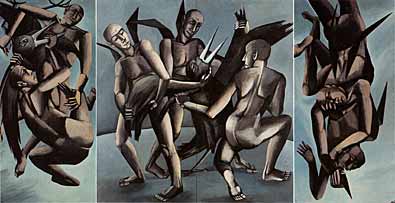
  "Umerziehung der Voegel" (Reeducation of the Birds),
 by Hans-Hendrik Grimmling, 1978

Catching the censors' attention
Alongside his official role, however, Grimmling was developing his own vision. He painted birds without wings or with contorted bodies turning in on themselves, while experimenting and testing boundaries with fellow artists.
His work began to draw attention from the East German censors. In particular, a line from a poem he and artist and friend Olaf Wegewitz posted above a gallery door raised concern. The line ran "The word ruins the way," and the censors wondered whether Grimmling meant to implicate the ruling SED party.
Government officials cancelled the gallery's planned exhibition one day before its opening date and ordered that it be taken down. The episode frustrated Wegewitz and Grimmling, who recalled, "We were humiliated, but, at the same time, we felt a sort of pleasure in being able to define ourselves differently and not belong to 'them.'"

Beyond the state's imagination
Another of Grimmling's exhibits was forbidden a year later, but the artist did not give up. He sought new ways to exhibit his work, and finally he had a stroke of genius.
Together with five other artists, Grimmling organized the "First Leipzig Fall Salon." The 1984 event became the first uncensored exhibition to take place in East Germany.
Due to their membership in the Association of Visual Artists, Grimmling and fellow painter Guenther Huniat were able to rent a space for the exhibit from a government agency in Leipzig. The state officials couldn't imagine that the artists were not planning to show official works from the Association, but their own independent creations.
Eventually, the Stasi - the East German secret police - caught wind of the group's plans and documented the work of Grimmling and his peers as hostile and negative. Security officials wondered, however, whether banning the exhibition would draw too much attention to the artists.
In light of these concerns, the exhibit was allowed to take place but with an important proviso: No more than six visitors could see the exhibition daily. Nevertheless, the show was a hit and attracted more than 10,000 visitors in the course of four weeks.

A threat to communism
Despite the exhibition's success, it proved to be a defeat for Grimmling. It became clear to him that the state would never permit a second installment of the Fall Salon. This conclusion led him to a significant decision: He filed an official request to be allowed to travel out of East Germany.
The Stasi file on Grimmling reveals that he was viewed as a lost cause who could not be won back for the good of society. As such, Grimmling's request to leave the country was processed and approved in an unusually quick manner.
In 1986, the artist traveled into West Berlin, together with his wife and young daughter. They lived with friends while Grimmling created a makeshift studio and began to paint with limited materials on packing paper from a hardware store. He was also able to sell a few paintings left over from his time in Leipzig.

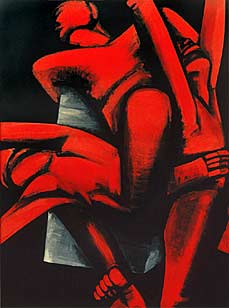
 "Mauerbild" (Picture of the Wall),
by Hans-Hendrik Grimmling, 1983

Moving forward in Berlin
Gradually, Grimmling established himself more and more in West Berlin. He had begun offering painting courses by 1988. In 2001, he became a lecturer and later a professor at the Technical University for Art in Berlin.
He said of his work there, "Now and again, I try to explain to my students that it makes sense and can even bring a kind of joy to get mixed up in things that you think might be manipulated. And even after the fall of the Wall, there's still plenty of manipulation."

Grimmling, H.-H. [2010] Arbeiten: Auswahl. [Online]
http://www.h-h-grimmling.de/seite6.html [04/06/2010] 
Wojcik, N. & (Ed.) Bowen, K. (2009) East German Artist Encourages Painting against the Grain. [Online] http://www.dw-world.de/dw/article/0,,4860853,00.html [04/06/2010] 

German Pavilion in Shanghai


Buntgrau (2010) Shanghai World Expo 2010 - German Pavilion unveils "Balancity". [Online] http://www.youtube.com/watch?v=BC90siIpA8o [04/06/2010]

The Cold War may be over, but it is still being fought in terms of its artists

Must the Americans once again show Germans how to handle a dual heritage?

Eduard Beaucamp
The Art Newspaper
In the new year, Germans will be looking to California with some excitement: at the end of this month the Los Angeles County Museum of Art (LACMA) opens its comprehensive panorama exhibition, “Art of Two Germanys/Cold War Cultures” (25 January-19 April). The exhibition completes the three-part German series at the museum, designed by its curator, Stephanie Barron, following “Degenerate Art” (1991) and “Exiles and Émigrés” (1997).
Announcing the first exhibition since the end of the Cold War, she promises that it will look beyond western claims to sole legitimacy and polemic clichés, beyond commercial interests and political stigmatisation, to do justice to the intrinsic qualities of both traditions.
But this raises questions: must the Americans once again take the Germans by the hand and show them how to handle such a dual heritage, its duplication the consequence of the country’s fatal division that is nonetheless a source of great riches? Can the Californian exhibition help to resolve the intra-German artistic tension or will its Cold War theme reignite or perpetuate the Cold War?
It is a tragedy: nearly 20 years after the wall came down the two post-war art histories have still not been reunified. For nearly half a century the two art scenes went their separate ways. They hated, insulted and fought with each other. In no other sector of the arts world was the opposition so radical or so embittered as in the fine arts. Art was taken seriously as a weapon in the “battle of the systems” and was used for the purpose of mutual abuse and proselytisation.
Post-1945, the free art scene of the west was blessed: it was more diverse, varying and experimental than the eastern scene, which had to wrest itself more slowly and painfully from the clutches of dictatorship, circumventing or eluding its prescriptions and only gradually formulating alternatives. The first Stalinist decades were politically rigid: at this time the GDR sought to bend art to its aims of “re-education” and “agitation” and persecuted and banished artists who resisted.
This is the image that became fixed in the minds of the west’s opinion-forming art circles. The concept of “state art” is still invoked today to kill off discussions. Only the art of exiles and dissidents is regarded as free and self-determined. There is a refusal to acknowledge the different qualities and radical changes in the art of the east from the 1960s onwards.
The key year was 1965 when the Leipzig artists Bernhard Heisig, Wolfgang Mattheuer and Werner Tübke articulated the contradiction with historical and parable pictures full of latent critical independence of mind. Their works provoked vigorous objections from the authorities and resulted in disciplinary measures.
The story of the misunderstandings and polemic confrontations is long and rather ugly. The first altercation, which set the tone for later conflicts, occurred in 1977 when the new art of the east appeared at that avant-garde showcase, Kassel’s Documenta, and the star painters of the west took their pictures down in protest against the competition from the east.
After the wall came down the eastern artists were easy prey for their western counterparts, who called for boycotts, and for a ruthlessly commercial art business that discovered political morality and claimed to have a monopoly on progress.
When West Berlin’s Nationalgalerie merged with its East Berlin counterpart in 1993 and incorporated 16 East German artists, right-wing politicians were outraged and threatened to intervene. Yet the museum stood its ground and ten years later, in 2003, presented a retrospective of GDR art that unexpectedly aroused great public admiration.
In contrast, a Weimar exhibition of 1999 with the title “Aufstieg und Fall der Moderne” (the rise and fall of modernism) crudely lumped GDR painting together with Nazi art, dismissing it as a phenomenon of decline and relegating it to the dustbin of history. The battle over the decoration of the new Bundestag (German parliament) in Berlin’s rebuilt Reichstag, from which the representatives of the east were to be excluded, has not been forgotten, either. After fierce disputes a highly dramatic narrative work by Heisig was accepted and consigned to the cafeteria.
The battle over two opposing belief systems and histories within German art was a conflict devoid of equal opportunities. Hardly any traces of the “other” German art are to be found in West German museums today. Even those institutions which inherited the best art from the GDR, like the Museum Ludwig in Cologne, continue to practise censorship today, rigorously marginalising these works and keeping them in store under lock and key.
The western public cannot form its own picture of the controversial east in its own museums. In the museums of the east, where western curators generally hold sway, the great painters are kept to a statutory minimum. These missionaries took their re-education drive seriously: they wanted to bring these institutions into line with the latest western standards as quickly as possible. Internationally the older art of the east remains almost unknown today, because after 1989 the art networks of the west conspired to keep a lid on the competition, excluding it from its cultural exports and its international cultural programmes.
This rather bitter summing-up would be incomplete without a mention of the helpful spirits. Alongside committed dealers, the collectors Peter Ludwig, Bernhard Sprengel and Henri Nannen should be named. Intellectual sympathisers were Golo Mann, Günter Grass, Helmut Schmidt, who entrusted Heisig with his chancellor portrait, Joachim Fest and the son of Max Beckmann, who recognised in the Leipzig artists the legitimate heirs to his father’s tradition.
Emphatic solidarity came from an unexpected quarter—from the churches. The spectacular renaissance of Christian iconography and altarpieces in the painting of the later GDR was not lost on them. And so the commission-less commission artists of the east found support from their oldest advocates, the churches. The important art of the GDR has survived attacks, boycotts, intrigues and harassment.
What its enemies so fervently hoped for after 1989—that the GDR’s decline would also dispose of its art, permanently—has not come about. The Leipzig School is still going strong, in its third and fourth generation.
Eduard Beaucamp is a contributor to the Frankfurter Allgemeine Zeitung

Beaucamp, E. (2009) The Cold War may be over, but it is still being fought in terms of its artists: Must the Americans once again show Germans how to handle a dual heritage? [Online]
http://www.theartnewspaper.com/articles/The-Cold-War-may-be-over-but-it-is-still-being-fought-in-terms-of-its-artists/16775 [04/06/2010]

Berlin Trilogy by Amelia Atlas

Amelia Atlas
n+1
Chloe Aridjis. Book of Clouds. Grove/Atlantic, Inc. March 2009.
Iris Hanika. Treffen sich zwei. Literaturverlag Droschl. February 2008.
Anna Winger. This Must Be the Place. Riverhead Books. August 2009.
The Berlin U-Bahn, like the New York subway, is a surprisingly easy place to feel alone. People avoid eye contact in the crush, and the German announcer’s voice has a lilting softness at odds with the language’s guttural reputation. For the year I lived in Berlin, the U-Bahn was where I spent time in my own head, easing into the day. A life-long city-dweller, I was used to the tacit communal pact of public privacy, a pact that made it okay to treat the worn vinyl benches like the armchair in my living room. It was unusual when, riding the U1 through Kreuzberg one day, my faux-solitude was interrupted by the onset of paranoia. I couldn’t stop worrying that people were appalled by what they were seeing over my shoulder. I was reading The Kindly Ones, Jonathan Littell’s ghastly novel of Nazi sadomasochism. The issue wasn’t so much the brutality of the novel—though it certainly didn’t help matters—as that I was reading about Nazis, in English, in Berlin. I was afraid of being taken for one of those tourist voyeurs, unable to see Germany for anything but swastikas.
Two recent novels by Berlin expats take up the outsider’s relationship to the city’s past: Chloe Aridjis’s quietly contemplative Book of Clouds and Anna Winger’s hopelessly pat This Must Be the Place. Published just months apart, both take as their subject young expatriate women in Berlin, unsure of quite how they got to where they are. When Book of Clouds opens, Tatiana has been in Berlin for five years, working odd jobs and test-driving life in the various trendy new neighborhoods of the former East. In This Must Be the Place, we meet the equally directionless Hope, a New York transplant who has followed her businessman husband abroad. For both characters, positioned at a break point from their own pasts, Berlin might as well be Narcissus’s pool.
That Berlin should start cropping up in novels is not surprising. With the wall now twenty years fallen, the city has somehow managed to stay the Next Big Thing for a near decade running. Rent is remarkably cheap—the city is still about a million short of its pre-war population of 4.4 million—and the range of readily convertible industrial architecture makes Williamsburg look like a hipster LegoLand. Gentrification, while certainly under way, has been slow simply because there was, and still is, so much ground to make up. The bohemian dream of the writer-artiste comes off as limitless, not only existentially but spatially: the occasional squatters-vs-Polizei skirmish notwithstanding, it’s easier to pretend development doesn’t mean rising costs like it would anywhere else. Everybody you meet is either a graphic designer or a DJ.
No article on Berlin is complete without the media’s favorite sound bite from the city’s mayor, Klaus Wowereit, so here it is: Berlin is “poor but sexy.” It is, in fairness, a reasonable assessment of the city’s economy. Unemployment currently stands at about 12.5 percent, and that’s without the aimless expat populace for whom work is a relative term. Berlin has transformed its poverty into a kind of cultural capital—its rough edges keep the city at the artistic vanguard, a bastion of cool within a nation that has otherwise assumed economic leadership of the E.U. This is not, for obvious reasons, a sustainable situation: with art comes money comes development, and already the city has made way for new condo complexes. (One particularly egregious example, on the city’s famed boulevard Unter den Linden, calls itself “Upper Eastside Berlin.”) But at least for now, Berlin remains the best of both worlds—a playground with gravitas on its side.
Behind office buildings on side streets in Mitte, the grassy path of the divided city’s death strip—the stretch of empty land studded with menacing watch towers between the wall’s parallel ribbons of concrete—still slices through the cityscape, not so much a scar as a parenthesis. Cities tend to have their apex of glam, at least where literature is concerned—the Bohemian dereliction of 19th century Paris, Bloomsbury London, New York with its Jazz-Age sheen. History’s aggressive march through Berlin has meant that its moments of self-fashioning are always cut short; somehow, it manages to teeter always on the cusp of transformation, without ever quite arriving. The advantage of this suspended state is that the city never gets fixed in time, leaving its image available for reimagining.
Book of Clouds, the first of the two English-language variants on the “Berlin-Roman,” can feel like an essay disguised as a novel; there is little in the way of event. Aridjis’s interests seem to lie less in fiction-making than in exposing the ominous layers of Berlin’s history and how they hide in plain sight. Tatiana, inward and solitary and closed off to anything that might demand emotional investment, is Aridjis’s perfect set of eyes. A Mexican Jew freed of ties to her home, her only real relationship is with Berlin. She spends her days in a willful isolation, wandering streets and documenting the urban landscape with an attention that verges on anthropological. Her job as a research assistant to Doktor Weiss, a once-famous historian of war-scarred Berlin, only encourages her preference for the morbid.
Part of the pleasure of Book of Clouds (at least, admittedly, for the self-indulgent expat) is its catalogue of Berlin minutiae: the yellow tramcars of the former East; the looming orb of the TV tower at Alexanderplatz; the Prenzlauer Berg Altbauten, Berlin’s pastel answer to brownstones, which line the gentrified quarters of the city’s erstwhile cultural frontier. But these details are never without their ghostly counterparts. The converted water tower in Tatiana’s neighborhood, now housing condos, turns out to have been a torture site for anti-fascist prisoners of the SA. (This happens all the time in Berlin: I spent a summer living opposite a former Stasi interrogation center without realizing it.) For every cozy local bar in Book of Clouds, there is another space that can’t quite hide its latent creepiness. Tatiana’s only foray into Berlin’s youthful nightlife, a party in an abandoned post office, ends with her lost underground in a former Gestapo bowling alley.
History’s hold on the city is, as Aridjis has it, inextricable from Tatiana’s own stasis. “Ever since arriving in Berlin, I’d become a professional in lost time,” Tatiana muses. “It was impossible to account for all the hours. The hands on clocks and watches jumped ahead or lagged behind indiscriminately. The city ran on its own chronometric scale. Days would draw to a close and I would ask myself what had been accomplished, how to distinguish today from yesterday and the day before.” “It wasn’t,” she observes later, “an industrious kind of solitude … but rather a stagnant, infertile one which bred only more stagnation and infertility.” Hers is the quintessential expat experience: time spent on the spending of time.  
It’s a dilemma I sympathize with. It is easy, in Berlin, to find oneself in the grip of an uncommon inertia. The city’s topography, at once absorbing and alienating, makes for a distracting plaything. It’s hard to capture the physical strangeness of Berlin, but I’m confident that it’s the only cosmopolitan European capital where you can get lost in a sandpit for several blocks in the middle of the city on the way to a party. This bizarre openness—the feeling of expansive space in an urban environment—has the additional effect of distending time. There is none of the compressed bustle that keeps a city like New York moving forward.
For Tatiana, the city’s playful side holds less interest. In place of people and relationships, she feeds her obsessions with the city’s macabre shadows, abetted by Doktor Weiss. Into this gloom steps Jonas Krantz, a meteorologist from the former East, whom Weiss sends Tatiana to interview about some childhood drawings he’d done: ants crawling beneath the Berlin Wall towards freedom. Krantz is a stalwart representative of the Berlin of now. “Weiss dwells too much on the spaces that were,” he observes. “But Berlin can’t just be a museum of horror. There has to be a regeneration.”
In Aridjis’s novel, those who would have the city remain a museum of horror win the day. As Tatiana and Weiss make their way from Jonas’s remote apartment, two thugs attack them only to be cast into confusion by the onset of a mysterious fog—the clouds of the title come to ground. The cover of this strange weather prompts record-breaking crime in a city where bike theft is usually the worst threat. Journalists seize upon the fog’s symbolic potential, drawing, in Aridjis’s words, “the obvious parallels between the city’s past and this bizarre meteorological phenomenon.” (“Berlin in New Crisis of Erasure,” reads a heavy-handed headline.) And Tatiana? She moves away. She doesn’t overcome her ghosts so much as leave them behind.
Like Book of Clouds, This Must Be the Place wears its metaphors heavily. But while both books rely on German history to provide the scenery, Winger’s has none of Aridjis’s grace. Hope has arrived in Berlin, grieving after a miscarriage in the wake of September 11th. With her husband off running a pornography-meets-microfinance scheme in Poland, Hope finds herself, like Tatiana, in the company of the city’s phantoms. The novel opens with a description of a typical pre-World War I Berlin apartment building, whose history is that of Germany writ small.
Its architect had designed the apartments to be Villenetagen, villas on every floor, prime real estate, because Berlin’s future had been promising in those days. Although most of the building had since been blown up or burned down, ninety years later its balconies and trellises, mullioned windows and inner courtyards designed to provide views from almost every room still hinted at the optimism of its origins…In other places, such a building might have seen only the soft swell of progress, but here? Ninety years of drama, followed only by this.
What “this” is is not entirely clear, but given that these words close the prologue, one can only assume that “this” means the rest of the novel. And here begins the problem with This Must Be the Place: Winger presents German history (and September 11th) as if Hope’s arrival in Berlin represents the culmination of the city’s teleological destiny. She is in New York, hibernating in despair over her lost baby, when the planes hit. “When she came out of her downtown building to see people covered in white powder running for their lives, she had not been entirely surprised to find the outside world finally reflecting her inner chaos. Maybe Berlin was an opportunity to start again.”

A Berlin at peace with its ruinous past—this is how Hope learns to see the city. She knows little of its history when she arrives, and the filling in of these details can take on a didactic quality. Her neighbor Walter, a washed-up actor whose friendship with Hope gives the novel its center, doubles as a guidebook. “The city was divided into four zones: Russian, British, American, and French,” he lectures. Hope discovers that the walls of her home aren’t made of plaster but of Rauhfasertapete—a kind of white, textured wallpaper beloved by cheap German landlords—and that beneath the walls are layers and layers of old wallpaper, witnesses to the lives of past inhabitants, which Hope begins—wait for it—to peel away.
The problem with expatriotism is that it is, by nature, recursive. The whole point of the experience is to experience the experience. Ironically, it was I, and not my German roommates, who suffered from that famous German syndrome: Mauer-im-Kopf, or “wall in the head.” I knew the path the Berlin Wall had traced only two blocks from our Kreuzberg apartment; my roommates did not. They took their out-of-town guests to the natural history museum; I took my bewildered visitors to barren patches of park where the concrete Mauer used to stand. I got the distinct sense during my year in Berlin that the preoccupation with history’s physical imprint on the city was an Auslander phenomenon.
The strangeness of this paradox didn’t fully sink in until I got home, settled back into a world that didn’t beg for constant interpretation. I was reading a recent Berlin novel in German—a requisite exercise in nostalgia, perhaps—and kept noticing how much more organically history found its way into the pages. Held up against Aridjis’s and Winger’s novel, Iris Hanika’s Treffen sich zwei, makes for a study in contrasts. Writing from a local vantage, where the city is and has always been engrained in the texture of daily life, Hanika has a luxury her foreign counterparts do not: she can allow Berlin as metaphor to take a backseat to Berlin as setting. Unlike Tatiana and Hope, Hanika’s characters—Senta and Thomas—move through their Kreuzberg environs as if it were any other place. They are Berliners on the cusp of middle age, settled into their routines if not quite their futures. Senta is a gallery-worker with a troubled relationship behind her, Thomas an IT consultant absorbed by the latest developments at work. Berlin is present, but not as a conceit.
Still, history is not altogether absent in Treffen sich zwei—it can’t be. Of the border between Kreuzberg and Mitte, Hanika writes: “This was once the Death Strip, where there’s now a garden—the most vital bond you can imagine cementing together, perhaps forever, two parts of [the city] that knew nothing of each other for so long that they now face each other as strangers.” Surely there is more than a hint of metonymy here—this aside is sandwiched between longer descriptions of Senta and Thomas—but Hanika writes with an ironic distance that reminds us that her characters are only characters, with no real selves at stake. It’s her metaphor, not theirs.
To a certain extent, Berlin’s secondary role in Treffen sich zwei isn’t so much a function of Hanika’s being German as it is of her distinctly postmodern touches. The title—loosely translated as “When two meet,”—hints at her preference for the schematic. Where Aridjis and Winger work within a traditional arc of self-discovery, Hanika is dealing in archetypes: her characters are not individuals trying to construct their own self-image, but cogs in the cyclical machinery of meeting, misunderstanding, and reconciliation that are the sentence of every relationship. The novel begins with a scene cut straight from a slow-motion romantic comedy fantasy sequence: Senta and Thomas meet in their local bar, immediately fall for each other, and just as quickly mess the whole thing up. Senta has a melodramatic propensity for tears; the technologically minded Thomas is oblivious to her emotional highs and lows. Their relationship proceeds pretty much as you’d expect.
Hanika’s Berlin history also dares to venture beyond the familiar destruction of the 20th century. Instead of abandoned Nazi torture sites, the novel gives us the Landwehrkanal, the commercial shipping channel, dating from the 19th century, which cuts through Kreuzberg. Such historical asides are simply one of many formal games. In addition, we get song lyrics, a sex manual, a script, a disquisition on computer programming, and an overwrought impression of Elfriede Jelinek. Hanika’s experimental gamesmanship can be irritating; her riffs on stock forms of language may be deliberate in their hollowness, but that doesn’t make them more digestible. When Hanika describes Senta and Thomas imagining they’ve been struck by Cupid’s arrows—“lodged in their hearts with unsurpassable precision”—she’s still dealing with Cupid’s arrow.
As players in Hanika’s fragmented pastiche, Senta and Thomas read as linguistic vehicles, empty of past. Hanika on Thomas: “It had still never occurred to him that he had an exclusive place in the world.” And in a way, it’s because he doesn’t. Senta and Thomas are but two iterations of a pattern that will doubtless repeat itself. They lack the permanence that Tatiana and Hope try to claim for themselves by linking themselves indelibly to the city.
Of the three novels, Book of Clouds wins for literary merit. But there is something uncomfortable in the English versions of the “Berlin-Roman” that Hanika’s novel, with its aggressive playfulness, avoids. That Aridjis and Winger put a traumatic history at the service of an individual psyche—and an outsider’s psyche at that—raises questions of appropriation. Do they, and by extension the expat, get to make a claim on this particular history? Berlin is not Paris or Rome; it doesn’t have the romance of a dusky Montmartre or the faded glory of antiquity. The smoky demimonde of Isherwood’s Berlin came and went with the war and Bowie’s jangling counter-culture with the Wall—much as the city’s new artistic face may approximate them. What is unique to Berlin is how much its history is still living. It remains visible, and not merely as an artifact of times long past. There is, of course, more to Berlin than just history, but part of its contemporary image is the calculated interplay between past and present: the recently reopened Neues Museum with its preserved bullet wounds; strips of worn concrete Mauer along the Spree; the Holocaust memorial, just blocks from the former site of Hitler’s bunker, deliberately striving to isolate and disorient its visitors. The city asks us to remember what it was.
The Berlin of the present exists in a state of rare double-consciousness, hurtling into the future while keeping a steady grasp on its past. From a writerly perspective, the coexistence of multiple selves is inspiring—what writer wouldn’t want to summon so many layers of injury and experience when creating a character? Aridjis and Winger have both, for better or worse, written books representative of their expat brethren—the city is just one more instrument in the arsenal of their (our?) solipsism. It can’t possibly stay that way forever. As manicured greens and glassed-in apartment complexes crop up in all those empty lots, they need not represent loss or erasure, but simply the city moving on.
Atlas, A. (2010) Berlin Trilogy: New East Side Novels. [Online] http://nplusonemag.com/berlin-trilogy [02/06/2010] 

Wende and Wetter

Charles McPhedran
n+1
Old Berliners in the media complained that twenty years ago even the Wetter was better. In 1989, the stars apparently shone down on revelers dancing on the Brandenburger Tor as they tore the wall to pieces. And the next day, when the East Berliners chugged onto the Kurfürstendamm—then the main drag in West Berlin—in their gas-guzzling Trabbies, the sky was blue. 
Of course, when I flip through photos from the famous day, the newly reunited Berlin of twenty years ago looks as grey as grey can be. Helmut Kohl (the then Chancellor) and Willy Brandt (the Social Democratic Party hero who partially reconciled East and West through his Ostpolitik) stood on a balcony above the Schöneberger Rathaus, in the midst of mist and rain, in front of thousands of people.
Yesterday, the sky was perhaps even more unrelenting. Rain fell on a hundred thousand people as they elbowed each other for a view of the big screens that relayed images of the Tor (next to which a puffy Bon Jovi bawled out something about freedom). Although the ceremony seemed designed to rev Germans up, all around me I could hear a burble of other languages. While a kitschy German boy band performed a song about freedom, Spanish students enthusiastically noted how German the whole thing seemed. Americans ordered pizzas to go at a stand nearby; clumps of French tourists debated where to party after the ceremony. 
Meanwhile, a woman who (as a 20-year-old in 1989) spent nearly a year in jail for dissenting against the East German regime told twenty-year-olds in the crowd to “dream, and do everything to turn your dreams into reality.” That rebellious girl, Katrin Hattenhauer, is now a decidedly unprovocative artist in Berlin. She paints work that reminds one of Cezanne. In retrospect, the 1980s seem appealing as a time of political clarity: on both sides of the wall, countercultures challenged state authority. Meanwhile, without a clear adversary—the social after-effects of fascism in the west, party bureaucrats in the east—post-Wall Berlin has grown ever more complacent. In the left-libertarian Berlin weekly Jungle World, Christoph Villinger recalled the over two hundred houses occupied in winter 1980 by West Berliners. The Berlin police back then presaged the occupations by declaring that they would not prevent them. 
On the other side of the Wall, the civil rights movement was closely linked to a counterculture in East Berlin that was every bit as vibrant as its Western counterpart. Sven Marquardt’s photos (exhibited over the summer at the Akademie der Künste) show that the gloomy gothic sensibility of Wim Wender’s Der Himmel über Berlin was also to be found in the communist East. Today, almost every formerly occupied house in Kreuzberg has a contract with the City or a landlord. Meanwhile, Marquardt (the rebel photographer from Prenzlauerberg) is now the door-lackey at Berghain, a largely gay club that costs nearly twenty dollars entry. And Venissagen (art openings) in Berlin galleries have apparently taken on the political significance that demonstrations once had as gathering points for social groups. A demonstration against the hype surrounding the commemorations attracted a scant few hundred people in black hoodies. 
What last night’s anniversary really seemed to commemorate was an era in which the people (for better or for worse) wrought effects upon politics through action in the streets. There are many reasons to be discouraged and even angry about the course Germany has taken since the Mauerfall—persistent unemployment resulting from the privatization of East German industries; the end to Germany’s post-war status as a haven for political dissidents and refugees; resurgent neo-nazi violence—but the culture of mass direct engagement vanished with the Wall. A professor at the Humboldt University who was living in East Berlin when the Wall fell told a class yesterday that the twentieth anniversary celebrations obscured the significance of the Mauerfall. “During those days, the slogan that we chanted at the demonstrations was ‘We are the people,’” he told us. “When they reunified Germany, they told us, ‘You are one people.’” With melancholy in his voice, he recalled the tenth anniversary of the Mauerfall. “A banner hung over Alexanderplatz [once the main square in East Berlin]. It read: ‘You were the people.’”
McPhedran, C. (2009) Wende and Wetter. [Online] http://nplusonemag.com/wende-and-wetter [02/06/2010]

Perceptions of Time by Markus Nücklich


Nücklich, M. (2010) Perceptions of Time. [Online] http://vimeo.com/11930297 [04/06/2010]

The Times ad

Heimat Berlin Projects


Heimat Berlin works on corporate advertising campaigns. This clip shows a CNN slogan launch project in Berlin. "Go Beyond Bordwers" not only tied in with the 20th anniversary for the Berlin Wall's opening, with interactive digital media in Berlin, but also targeted global audience "beyond borders" [GoBeyondBorders, 2010]. Below is the "Vielfalt ohne Ende" (variety with no end) advert for Deutsches Tapeten-Institut GmbH, which through series of still images shows change of time, as well as endlessness of the company's wallpaper stock. 


GoBeyondBorders [2010] CNN Go Beyond Borders Tape Art Project - Case Film [Online]
http://www.youtube.com/user/GoBeyondBorders [03/05/2010]
Heimat Berlin (2009) Tapenverband_Endless. [Online] http://vimeo.com/3298352 [03/05/2010]
http://vimeo.com/user484894/videos [03/05/2010]

Unemployment: Berlin & Germany


"Although the national unemployment level is around 11.5%, in each region the unemployment level vary dramatically. If you collectively look at the former Eastern German states, then you have an unemployment level around 15%, whereas the former Western German states average around 7,5%." [John G, 2010]
"This is a very complicated issue as not only is there a huge deficit of job openings in East Germany, but employers are often heard complaining about the "quality" of employees. The debate often centers around attitudes of employees in East Germany that had been used to a lifetime guaranteed job before the reunification. After the reunification, the social state was dramatically changed and in modern business, employees are asked to take initiative and to be much more ambitious. After so many years living in a different culture, this is very hard to change." [John G, 2010]
Berliner Morgenpost (2010) Arbeitslosigkeit in Berlin: Zahlen und Quoten in der Stadt in den Bezirken. [Online]
http://www.morgenpost.de/berlin/article1166322/Berliner_Arbeitslosen_Atlas.html [03/05/2010]
Bundesagentur für Arbeit [2010] Arbeitslosenquoten im Jahresdurchschnitt 2009: Länder und Kreise. [Online]
John G [2007] Unemployment Statistics in Germany. [Online]
http://deutschlandfuerdummies.blogspot.com/2007/08/unemployment-statistics-in-germany.html [03/05/2010]

Wednesday, 2 June 2010

Jonathan Harris on Collecting Stories [2]

We Feel Fine, created by Jonathan Harris and Sep Kamvar, scans the internet searching for blog posts with the phrases "I feel" or "I am feeling" and presents a mosaic of images. Another project by Harris, Whale Hunt, also collects photos and presents the photographs. 

We Feel Fine


Whale Hunt: Mosaic


Whale Hunt: Timeline


Whale Hunt: Pinwheel


Harris (2007) describes that montage, sometimes a "photographic heartbeat" montage compositions allows "partial glimps". He also notes that "fundamental components" of any narrative and argues:
"the thing about stories though, most of the existing mediums we’re accustomed to, things like novels, radio, photographs, movies, even lectures like this one, we’re very accustomed to this idea of the narrator, or the camera position: some kind of ammunition to external body through which, through whose eyes you see the story. We’re very used to this. But if you think about the real life, it’s not like that at all. I mean, in real life things are much more nuanced and complexed and all these overlapping stories intersecting and touching each other."
Harris, J. (2007) Jonathan Harris Collects Stories. [Online]

Tuesday, 1 June 2010

Trendsmap

Trendsmap, 31st May, 2010

Trendsmap is a real-time map of Twitter trends, and it displays popular topics on Google map [PPKW Teleatlas, 2010]. The image above was captured hours after the German president Horst Köhler announced his resignation. He had previously commented on radio that the German military was deployed in Afghanistan to "protect our [German] interests, for example, free trade routes" (Köhler, in Connolly, 2010).

Connolly, K. (2010) German President Horst Köhler Quits over Afghanistan Gaffe. [Online]
http://www.guardian.co.uk/world/2010/may/31/german-president-horst-kohler-quits [01/06/2010]
PPKW Teleatlas [2010] http://trendsmap.com/ [31/05/2010]

Sunday, 30 May 2010

Malcolm Gladwell

"Cultural legacies are powerful forces. They have deep roots and long lives. They persist, generation after generation, virtually intact, even as the economic and social and demographic conditions that spawned them have vanished, and they play such a role in directing attitudes and behaviour that we cannot make sense of our world without them." (Gladwell, in Ross, 2010)
"If no one ever bought any of my books, I would still have written exactly the same thing... I can’t tell you why they do well. I just write what I want to write, and then – very happily – lots of people seem to agree with me." (Couric, 2010)
Couric , K. (2010) @katiecouric: Malcolm Gladwell. [Online]
Ross, D. (2010) Malcolm Gladwell: I wanted to be an academic but then I realised that academics are hedgehogs and I am a fox. [Online] http://www.independent.co.uk/news/people/profiles/malcolm-gladwell-i-wanted-to-be-an-academic-but-then-i-realised-that-academics-are-hedgehogs-and-i-am-a-fox-1983375.html [30/05/2010]

La Jetée by Chris Marker

La Jetée (dir: Chris Marker) released in 1964 is a science-fiction film about time and memory, and is considered to be among the greatest experimental films. The story is based on "an experiment in recovering and changing the past through the action of memory" after a nuclear apocalypse, and composed almost entirely of black-and-white still photographs [MIT, 2010].

ElMariachi333 [2010] La Jetée (1962). [Online]
http://www.dailymotion.com/video/xz5cs_la-jetee-1962_creation [30/05/2010]
MIT [2010] La Jetée. [Online]
http://mitpress.mit.edu/catalog/item/default.asp?ttype=2&tid=4947 [30/05/2010]

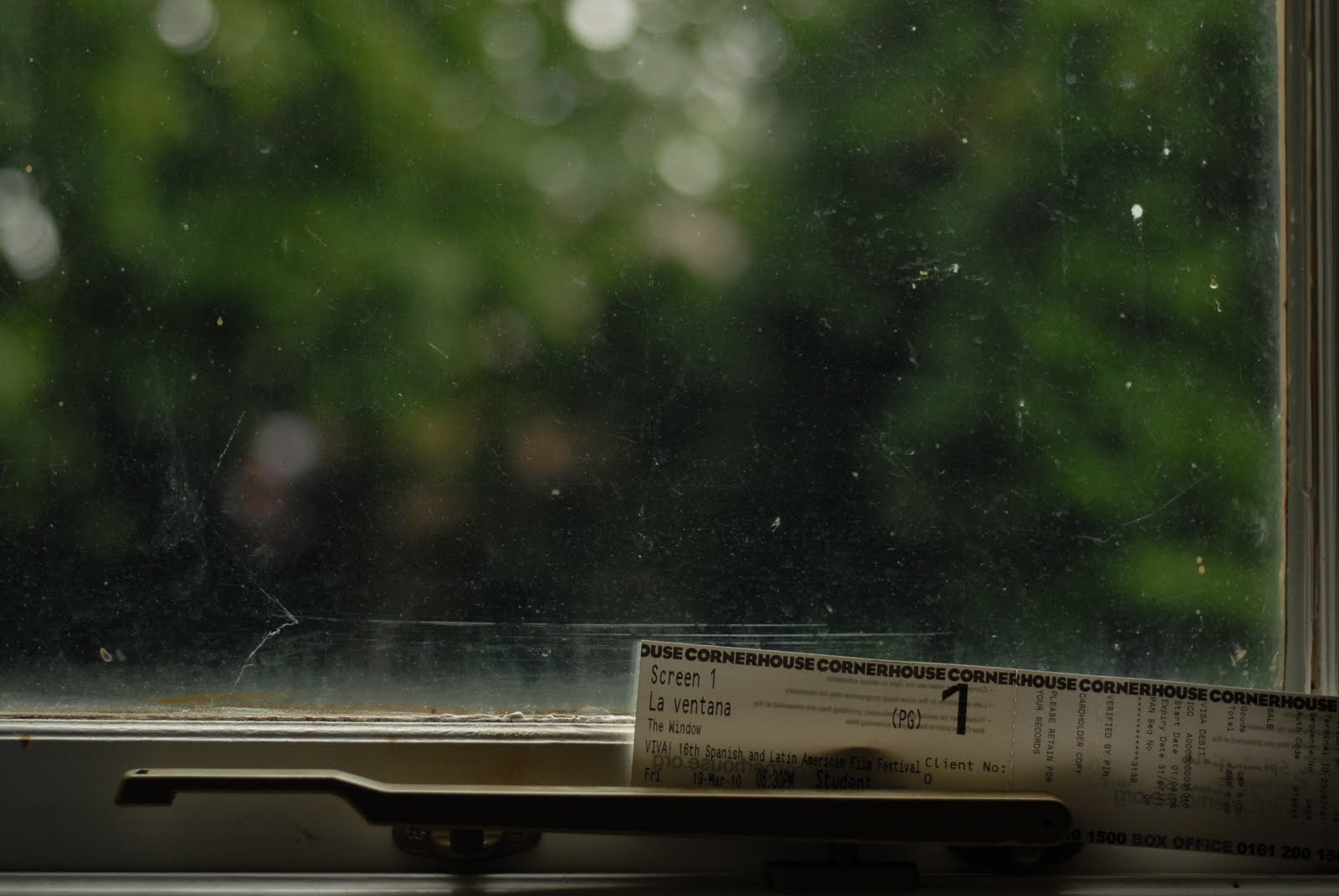
La Ventana by Carlos Sorin

"He looks out his window at the Patagonian landscape and sees light and life, the past and the present, while sensing the future." [AZ Movies, 2010]
Antonio is preparing a for day with all his expectations, and he wants everything right. Antonio's son, a celebrated pianist, is visiting him after an absence of many years. Now 80 years of age and having suffered a stroke recently, Antonio prepares this day with a very special champagne, asks a piano tuner to adjust his neglected piano, whilst being told by his nurse not to drink and to stay calm. Above all, he must wait.


In his 2007 film La Ventana (the window), the director Carlos Sorin focuses on the day that "the small stories written by life, on the humanity behind human beings... establishes a link between fiction and reality that makes the protagonist’s fears, hopes and wishes even more palpable" [AZ Movies, 2010].


AZ Movies [2010] La Ventana. [Online]
http://www.azmovies.net/la-ventana.html [30/05/2010]

More Projects by Aram Bartholl

The first one is 256², "an intervention in Public Space" (Bartholl, 2007),  Bartholl marks the outline of the virtual NewBerlin in Second Life in physical space at Alexanderplatz Berlin: the idea was "to make the first Sim of Second Life's NewBerlin visible in real life Public Space at Alexanderplatz Berlin". Bartholl, with 64 pieces of plain chalk drew the 256 × 256 meter square. The line of chalk, representing the virtual copy of Alexanderplatz crossed a McDonalds, a Church, two housing blocks, a trainstation and a mall, among other objects and surfaces.


The second project is Map.
"Transferred to physical space the map marker questions the relation of the digital information space to every day life public city space. In which way will location related data from the net become ‘visible’ in physical space? How is reality and truth balanced between the physical world and the net data space?" (Bartholl, 2006)


Bartholl, A. (2007) 256²: Intervention in Public Space 2007. [Online]
Bartholl, A. (2006) Map: Installation in Public Space 2006-2009. [Online] http://www.datenform.de/mapeng.html [30/05/2010]

Bartholl, A. (2007) Sandbox Berlin: Workshop and Exhibition 2007. [Online]
BERLINin3D.com [2010] Home. [Online] http://www.berlinin3d.com/ [30/05/2010]


During Sandbox Berlin 2007

Neuroscience: Empathy and Experience

"When we get to the 19th century - the industrial revolution - we extend markets now to larger areas and create a fiction called the nation state. And all of a sudden, the Brits start to see others in Britain as extended family; the Germans start to see Germans as extended family; the Americans as Americans. There was no such thing as Germany, there was no such thing as France: these are fictions, but they allow us to extend our families so we have can have loyalties and identities based on a new complex energy communication revolution we have that anihilate time and space." (Rifkin, in RSA, 2010)
Jeremy Rifkin then asks with new technological development, whether people can create empathy among human race. Jeremy Rifkin's lecture, The Empathic Civilisation in full.

RSA (2010) RSA Animate – Empathic Civilisation. [Online]