Monday, 21 June 2010

Innaccessible Display of Posters


This passageway at Notting Hill tube station, with advertisement posters from late 1950s, has not been publicly accessed since it was cut off and replaced by another. It was officially photographed by London Underground, remaining "wholly inaccessible" and posters left "intact" (Ashworth, 2010).

Ashworth, M. (2010) Disused passageway with vintage 1959 posters, Notting Hill Gate tube station, London, 2010. [Online]
http://www.flickr.com/photos/36844288@N00/4669837848/in/set-72157624079183751/
[21/06/2010]

Eric Fisher: The Geotaggers' World Atlas

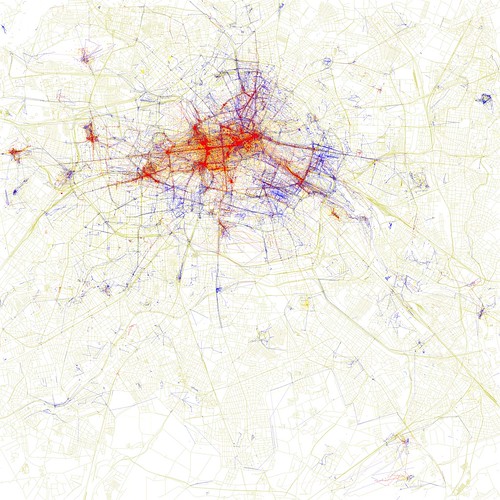
The Geotaggers' World Atlas #5: Berlin

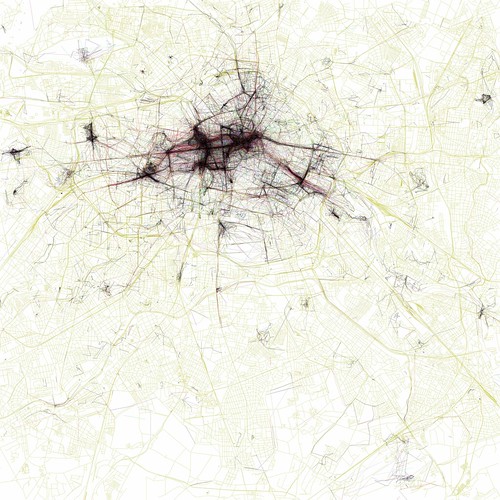
Eric Fisher composed maps of various cities showing highly-photographed locations, a project which developed from his London map based on 73000 photographs taken from Flickr and Picassa overlaid on an OpenStreetMap (Brown, 2010, and Fisher, 2010). There are also maps which categorise photos taken by tourists from those photographed by locals (below).

Locals and Tourists #13 (GTWA #5): Berlin

Visualisation based on geo-tagging enables locational data to illustrate people's behaviour. This work used Flickr and Picassa to collect data, then combined it with OpenStreetMap, a collectively edited online map.

Brown, M. (2010) Which Bits Of London Get Photographed The Most? [Online]
Fisher, E. (2010) The Geotaggers' World Atlas #5: Berlin. [Online]

Fisher, E. (2010) Locals and Tourists #13 (GTWA #5): Berlin. [Online]

Sunday, 20 June 2010

Joachim Gauck: the dissident hero who holds the destiny of Germany in his hands

In a blow to chancellor Angela Merkel, a pastor who defied East Germany's bosses may be elected president instead of her candidate. But he says he has no wish to see her ousted as a result
The Observer, Sunday 20 June 2010
He is the colourful pensioner at the heart of the most important presidential election in postwar German history. But Joachim Gauck insists that he never expected his race for high office to cause such a stir.
A Protestant pastor and anti-communist civil rights activist from east Germany, Gauck could be elected German president in 10 days' time in a vote that is widely being seen as an unofficial poll on Chancellor Angela Merkel's leadership. The silver-haired 70-year-old is being backed by the opposition Social Democrats and Greens, who believe that a defeat for Merkel's candidate, Christian Wulff, could lead swiftly to her own political demise.
At a time when the German government finds itself in a state of turmoil, riddled by rows over its handling of the debt crisis and the controversial bailout of the Greek economy, Gauck appears a little nonplussed to find himself the man of the moment. "I was surprised and flattered to be asked to run for the post," Gauck said. "But I didn't seek it, and it definitely wasn't my intention to unseat Merkel, and I'm sure she doesn't see it like that either – I just want to do what's best for the country."
The unexpected election is taking place following the shock resignation of President Horst Köhler this month. "We are at a crossroads in Germany," Gauck said. "There's a deep-seated sense of anxiety right now, and we need a new impetus. I notice that people aren't just interested in consumption and football, they also want to be able to believe in people and institutions again."
Many see Gauck as something of a moral authority who can bring fresh blood to German public life. Momentum is growing for the former dissident who, particularly as someone who stands outside party politics, is seen as a much more attractive figure than Wulff, a clean-cut, tanned, media-savvy career politician who is 20 years the priest's junior.
While the government factions – Merkel's Christian Democrats (CDU) and the Free Democrats (FDP) – hold a potential majority of at least 21 in the 1,244-seat special federal assembly that will choose the president, it is far from clear that the chancellor's candidate will win. Several members of the government faction, including members of the FDP, who have clashed repeatedly with Merkel since entering a coalition with her in October, have said they will vote for Gauck.
"He is a figure who is closely associated with the peaceful revolution in the GDR [East Germany] in 1989," said Holger Zastrow, head of the FDP in Saxony, in the former East. "He fought courageously and fearlessly for his convictions … he speaks from the soul and what he's done for this country, it's not something we can easily forget."
With his fascinating Cold War history, Gauck, a father of four who was born in the port city of Rostock, is undoubtedly one of the most interesting Germans alive. He says his political conscience was initially awakened by the arrest, when he was 11, of his sea-captain father on suspicion of espionage. He was taken from the family dinner table to a gulag in Siberia and the Gaucks did not see him for almost five years.
"The fate of our father was like an educational cudgel," Gauck said. "It led to a sense of unconditional loyalty towards the family which excluded any sort of idea of fraternisation with the system."
Banned by the regime from studying German and history because of his political opposition, he was forced to study theology and later trained to become a pastor. He led huge peaceful opposition marches in 1989, which partly led to the fall of the regime. His sermons from that time are famous.
Following reunification, Gauck was in charge of the state-run archives on the Stasi secret police, and won both recognition and enemies for exposing their crimes and espionage techniques.
He describes himself as a "leftwing liberal conservative," but did not vote for the first time until he was 50, having spent most of his life living under the GDR dictatorship. The experience, he said, had made him passionate about democracy. What makes his candidacy particularly awkward for Merkel is that the two are friends who have always shown deep respect for each other.
The chancellor even read the tribute at his 70th birthday, praising him as an "outstanding personality". Having both grown up in East Germany, Gauck and Merkel – herself a priest's daughter – have had similar life experiences.
Of Merkel, Gauck only has words of praise: "She's powerful, innovative, imaginative, and unlike many in this country she doesn't immediately take the position that everything is doom and gloom. She's an optimist," he said.
Yet it is the 70-year-old pastor who could yet bring her down. Some commentators have described it as a "Shakespearean scenario".
Connolly, K. (2010) Joachim Gauck: the dissident hero who holds the destiny of Germany in his hands. [Online] http://www.guardian.co.uk/world/2010/jun/20/joachim-gauck-angela-merkel-president [20/06/2010]

Friday, 18 June 2010

Tacita Dean on Boots

"Berlin Project was the most personal work I had ever done up t that point. I think the reason why I am getting a bit more autobiographical, ant The Uncles is totally autobiographical, is because I've moved to Berlin and suddenly it has given me permission to make work about England, because prior to that I would travel the world for my subject matter. It is something that I hadn't noticed - the autobiography in Boots, 2003, is subliminal when you encounter the work, but when you read my texts yo then see the connection and Boots's association to my family. Berlin Project includes Boots - I interviewed him about his father's life in Berlin - basically Boots had this legacy of being the son of a minor traitor. He was born in London but lived in Munich and Berlin as a boy during the whole Nazi period." (Dean, in Walsh, 2007, pp.568-569)


Maria Walsh I saw Boots in Paris at the Musée d'art moderne de la Ville de Paris. How is it set up at RIBA?  
Tacita Dean The RIBA room that we have has three doors so it absolutely invites Boots. Also the building is so much like Casa de Serralves, that same period. It is from the thirties and a bit fascist in a way, so it is a perfectvenue. I wanted to show it here at Firth Street as it is the principal work I've made in the last year but needed more space." (Dean, in Walsh, 2007, p.570)


Maria Walsh Why are there three versions of Boots?
Tacita Dean I wanted to use Boots's perfect ated urbanity, that in some ways he carried in his body that period of western culture when many were polyglot and somehow Europe was less divided in a strage sense even though now we have the European Community. Then, people would freely move between cultures and be multilingual." (Dean, in Walsh, 2007, p.571)


Tacita Dean "I wanted to film him in all these different languages without knowing I was going to do three versions... What I imposed on it was obviously the language seperation but also that he would take a different walk around the villa for each version. So in the English version he goes into the study, in the French, the dining room, in the German, the library and then they all go upstairs to the pink bathroom... what i love is that he changes with the language, which is so beautiful. In the German version, he is a bit fascist in a way, isn't he? Whereas the French version is much more romantic, the English is very wistful." (Dean, in Walsh, 2007, p.571)


Maria Walsh Boots's cahracter doesn't take over the building in the way that a character usually dominates place in mainstream fictional narratives.
Tacita Dean They both have parallel stories. An empty house of tha beauty is poignant anyway and Boots becomes an empty house also to some extent." (Dean, in Walsh, 2007, p.571)


Tacita Dean "People's perception of sound is extraordinary. It is so muted by image...
I put in everything. I always record sound live and collect sound while I am in the location, so most of it is recorded in situ but was just placed differently. It is another ingredient that adds to the visual because of course image in 16mm is recorded mute. And that for me is one of the primal seperations between video, digital media and film - the muteness of film, of cinema, and that everything has to be added." (Dean, in Walsh, 2007, p.571)


Walsh, M. (2004) "Tacita Dean" in Bickers, P. & Wilson, A. (eds.) (2007) Talking Art: Interviews with Artists since 1976. London: Art Monthly and Ridinghouse. pp.567-573.

Richard Serra on Installations

"I was talking to one of the engineers yesterday. To make sure that everything is done properly, they've overloaded the space with safety precaustions and I think they've used more hardware than they needed. It's okay with me, but I think that counts for the fact that when you go to watch the installations, you may think there's an assult being made on the Tate. After the big steel I-beam rails come out and the piece is set, I don't think the installation process is of concern nor do I think it's of any consequence.
To tell you the truth the nature of installations for me differ with each job or with each site. This isn't the first time that I've had to prop underneath. I did it in Berlin for the Berlin Block in 1978..." (Serra, in Bickers, 2007, p.386)

Bickers, P. (1992) "Richard Serra" in Bickers, P. & Wilson, A. (eds.) (2007) Talking Art: Interviews with Artists since 1976. London: Art Monthly and Ridinghouse. pp.386-392.

Irit Rogoff on Immigration

"...nationalism, one of the hallmarks of which is the perpetuation of the notion of belonging. If there are people who belong, there are those who do not. Nationalism and migration are connected around notinos of aspiration or protection.

"One of the things art allows us, that most academic discourses might not, is to start in the middle, and migration always starts in the middle. As a migrant, you're not of that place or this place; you're somewhere in-between."

"People who have been European for generations have a very structured formal language for their shared passions. People who have arrived from else where, and lived between several cultures, their shared passions are coming into being in different languages." (Rogoff, in Potts, no date)

Potts, R. (no date) "Terra Infirma: Towards a New Understanding of the Visual Culture of Geography" in Garageland, Issue 9, pp.40-41. 

Sunday, 13 June 2010

Glasnost: Soviet Non-Conformist Art from the 1980s

Haunch of Venison


Another exhibition I went to was Glasnost: Soviet Non-Conformist Art from the 1980s, at Haunch of Venison (above). I was one of the first ones in that morning, and there were more space to walk and observe than at Tate Modern. I was able to talk to a staff at the door, who described the opening night's event where guests were ordered around by actors dressed as officers; and another staff at the gift shop who informed me of an artist who'd worked on the theme of Berlin Wall, and also posed for an idea I had (below). 

"3,000 pounds, excluding V.A.T."

I found the Anton Henning exhibition as exciting as the Glasnost one, with video installation and lowered lights. I realise exhibitions are not only venues that display art work, but offer experiences. This seems too obvious now, but it was a striking thought at the time.


Haunch of Venison [2010] Glasnost: Soviet Non-Conformist Art from the 1980s. [Online]
http://www.haunchofvenison.com/en/#page=london.current.glasnost [13/06/2010]

Exposed: Voyeurism, Surveillance and the Camera

This exhibition at Tate Modern focuses on images, mostly photographs, taken without "the explicit permission of the people depicted" [Tate Online, 2010a]. Sophie Calle's Room series, where the artist became a temporary cleaner of a hotel and photographed guests' belongings, were also on display.
  
The Hotel, Room 47
"Tuesday 24. 10:30 a.m. They are going to leave. The suitcases are packed. They are set in front of the door. They leave behind the balloon, which is hanging limp, and stale biscuits." (from Sophie Calle's Room 47)
This line leaves the viewer some sense of a departure and transition of the guests of Room 47, and is accompanied by photographs, including that of a wilted balloon.

I asked a staff if I can take photos at the exhibition - as I usually do - who then pointed at a sign with an image of camera crossed out. How can Tate charge visitors for tickets (£10/8.50 concs) for an exhibition based on images discreetly captured, and not allow visitors to take photos? Are they encouraging visitors to to take photographs by prohibiting it?

Room 47 at Tate Modern

Tate Online [2010a] Exposed: Voyeurism, Surveillance and the Camera. [Online] 
http://www.tate.org.uk/modern/exhibitions/exposure/default.shtm [12/06/2010]
Tate Online [2010b] The Hotel, Room 47:  1981. [Online]
http://www.tate.org.uk/servlet/ViewWork?cgroupid=999999961&workid=26559&searchid=11571&tabview=text [12/06/2010]

Friday, 11 June 2010

Transitland

"Transitland is a collaborative archiving project initiated on the occasion of the 20th anniversary of the Fall of the Berlin Wall. Its main outcome is a selection of 100 single-channel video works, produced in the period 1989-2009 and reflecting the transformations in post-socialist Central and Eastern Europe. Transitland is not only the widest-spanning presentation of video art from Central and Eastern Europe but also a unique attempt to address and reflect upon an extensive period of transformation and changes." [Transitland, 2010]
Transitland [2010] Archive. [Online] http://www.transitland.eu/archive/
[11/06/2010]
Transmediale [2010]Transitland Destination Berlin Participants. [Online]
Rensselaer Polytechnic Institute (2009) Transitland: Video Art from Central and Eastern Europe 1989 - 2009. [Online]

Jonathan Borofsky

"For me, this hundred-foot tall aluminum sculpture composed of three figures meeting in the center, not only refers to the lightness inside our own solid bodies, but also the figures joining in the center, refer to the molecules of all human beings coming together to create our existence. This symbolism is especially poignant for this 100-foot Molecule Man on the Spree River in Berlin since the river marked the division between East and West Berlin." [Borofsky, 2010a]
In 1997, Jonathan Borofsky constructed the 30 meters tall Molecule Man, a permanent installation made of aluminium, on Spree River. His large sculptures, created by a team of multi-professionals, connect with wide range of audiences internationally; from boardrooms to public spaces, from tourists to politicians. Borofsky engages with audience through these installations, "reminding us that our shared commonality, our humanity, is the knowledge that we are here to achieve" and "his sculpture ensemble serves also as a respite—a place to go and reflect, separate from the teeming crowds and the din that surrounds and fills the site" [Klein, 2010].


The artist had also worked on the Berlin Wall in 1982, "Running Man at 2,541,898", which was carried out under cover of night, and was torn down with the Wall in 1990. 
"That 'Running Man' took me about two hours to make. I had a ladder so I could paint the image all the way up to the top of the wall. Three quarters of the way through the image, the patrol truck came. We all scattered and hid behind some rubble. We left our ladder leaning up against the wall. The British [patrol was] trying to figure out what the heck is this ladder doing here. They were about to take it away, and we came out from hiding. I said I was an artist working in an exhibition in this space next door called the Martin-Gropius Bau, an international exhibition space, doing this project on the outside. They said, 'Well, have you gotten permission to do this?' And I said, 'Not really. But I’m almost finished.' They gave in. 'Don’t tell anybody that we said you could do it.' I think the painting went down with the wall [in 1990]. Somebody sent me a chip from it." (Borofsky, in Curran, 2002)
Borofsky, J. [2010] Molecule Man. [Online]
http://www.borofsky.com/index.php?album=moleculemanberlin [11/06/2010]
Curran, A. (2002) Informatin about the Artist. [Online]
http://www.borofsky.com/pastwork/info.htm [11/06/2010]
Klein, M. [2010] Jonathan Borofsky On a Grand Scale. [Online]
http://www.borofsky.com/pastwork/info.htm [11/06/2010]

Berlin: Symphony of a Great City by Walter Ruttman

This silent film Berlin: Symphony of a Great City [Berlin: Die Sinfonie der Grosstadt] was directed by Walter Ruttman, and released in 1927. While documenting a day of Berlin, Ruttman deploys aesthetic camera angles, actively creating his image of the metropolis (Crang, 1998). 


Crang, M. (1998) Cultural Geography. London: Routledge.
Internet Archive [2010] Berlin: Symphony of a Great City. [Online] 

Tuesday, 8 June 2010

Right life in the Wrong Life

Joachim Gauck talks about Ossis and Wessis, opposition, conformism, and the long-term psychological effects of a dictatorial regime. An interview with Joachim Güntner.
signandsight.com
Neue Zürcher Zeitung
Joachim Gauck rose to international fame after 1990 as "Lord of the Stasi Files". Born 1940 in Rostock, at the age of eleven, he witnessed the deportation of his father to a Russian Gulag. Typical for opposition figures under the SED regime, he studied theology and became a pastor: His political sermons in the spirit of the civil rights movement contributed to the fall of the Wall. As a member of Bündnis 90, he became a member of the first freely elected East German Volkskammer, in the final chapter of GDR history before German reunification. His autobiography "Winter in Sommer – Frühling in Herbst" was published in 2009. Since the publication of this article, Joachim Gauck has been nominated as the candidate for the SDP and the Greens to replace Horst Köhler as the next German president in the Federal Assembly elections on June 30.
NZZ: Herr Gauck, as a oppositional pastor in the GDR in Rostock, you gave a voice to the civil rights movement, between 1990 and 2000 you were the first Federal Commissioner for the Stasi Files. Now, at 70, you are something of a travelling democracy teacher. The eternal activist?
Joachim Gauck: I cannot retreat quietly and enjoy my retirement. I need to be engaged in dialogue, otherwise I can't enjoy life. Then there's the political element. I lived most of my life under a dictatorship, I played a role in bringing it to an end, and then, as a member of our first freely elected parliament, I was assigned the job of working through the past. So political discourse became very important to me. I love freedom and I live in a country which certainly likes freedom but, as Heinrich Heine said in his day: while the Frenchman loves freedom like his betrothed, the Englishman like a demure wife, the German loves freedom like his old grandmother. It is this rather limited affinity for freedom that I must grapple with.
Have you experienced hostility at your lectures or when you talk in schools as a witness of the time?
Especially in the East, people react very differently to me. They either expect almost too much of me or they want nothing to do with me. It it not necessarily hurtful to be fought by the counter-Enlightenment. Sometimes things can get very emotional but I don't encounter that much hostility because my enemies rarely attend my events. 
You must meet a lot of young people who know almost nothing about the history of the GDR, and who don't want to know.
There is a certain ignorance among the young. For them I am an old man talking about something they know nothing about. Before, when I was still with the federal commission, I focussed my energies almost exclusively on the Stasi. Repression, arbitrariness, corrosion were the key words. I would talk about political justice and I used plenty of data and life stories to illustrate my point. Of course people were shocked, but the learning process was limited. To create more empathy, I started to use different examples and now I only talk about everyday life situations. How does one become part of a society like that? In the West I say somewhat bluntly: I will now tell you how to become an Ossi. I list all the steps towards socialisation in a completely intransigent system. First school, and the party's Pioneer organisations, the Young Pioneers with their blue kerchiefs, the Thälmann Pioneers with their red kerchiefs, and the Free German Youth (FDJ) with their blue shirts. Then I explain where it goes from there, how you get a degree or not, as the case may be, how you get into high school, or not – like my children who never belonged to these organisations.
Permanent education in conformism.
Which did not end with school. I talk about compromises and humiliating gestures of deference. What it is like to have to join a party just to become a foreman in a industrial plant, or a head engineer on a boat or a forester in the woods. Then silence engulfs the room, and I feel an intensity among the people which was not greater when I was talking about Stasi brutality. People can relate very closely to these life stories. None of them will have been in a secret police prison but all of them went through school or have pursued a profession or a job. Suddenly the people can imagine themselves as part of a uniform society. Everyone can accommodate to a dictatorship.
You are excusing the Ossis.
Not excusing them. I just want people who have not gone through these experiences to understand how people can change. We have two political cultures in Germany: the culture of a society in transformation in the East, and a halfway stable structure of a civil society in the West. When the two meet, of course misunderstandings occur. In my opinion, these differences stem more from the way mentalities are shaped than from participation in the communist ideology. Only a few people really believed in communism. But many people still feel that a free society is something very alien.
Even after three years in Leipzig, as someone born in West Germany I still come up against differences in habit, and I feel I stick out like a sore thumb.
You are immediately recognisable because you talk differently. You look at things differently too. Why is this a problem? A attitude that says, the world is my oyster. And this manifests itself in an open-mindedness and a readiness to chat about anything at any time. And lots of people here cannot relate to that. 
Perhaps these are nothing more than differences between Friesians and Swabians.
Regional differences certainly play a role, but the East-West divide dominates. There is a reason why I like talking about schools so much. Very little repression remained in the education system in the West. Teaching methods in the communist countries, however, can only be described as black pedagogy in red. Add to this, that no school encourages its pupils to be individuals. The ones that still risk saying "I", that stick their necks out, that question everything "only have themselves to blame" when they are not allowed to take their school leaving exams. This is why, among the generation which went to university in the GDR, people so readily exercised immense self control. It was all internalised. This constant observation of one's social surroundings results from something I call the fear-conformation syndrome, a signal system which tells the individual: don't let yourself be too easily recogniseable, it could be dangerous.
The amazing thing is how long it takes, even in conditions of freedom, to shake off the GDR mentality.
This is a result of what historians refer to as the longue duree phenomenon. The brown dictatorship lasted 12 years in the West, but the red one continued in the East for a further 44 after that. The length of the period of powerlessness plays a role. The complete absence of communication forms normal to civil society, the absence of discourse, the absence of individual autonomy. The strongest imprint left by a dictatorship is not the "seduced thinking" that Czeslaw Milosz talked of, it is in the attitudes. We can talk about a different East Germany when everyone who lives in it has gone through a school where they vote for class representatives instead of FDJ secretaries. It will all change with time. 
Your parents were members of the Nazi party. And in your autobiography it says that you come from an anti-communist family. But aren't these completely unrelated?
Yes, absolutely. My parents were tacit supporters of the Nazis. Life made us anticommunists. Perhaps I should say here that there aremany different types of anticommunism in Europe and throughout the world. One type comes into being far away from communism, in the heights, for example the Bavarian heights of conservative life and a confidence of thought. It is an attitude. But it does result in an intellectually well-founded form of anticommunism. The other type to which I am referring, is one that grows out of communism. It is born of suffering, of the absence of justice and freedom. It is a form of humane thinking. In South America or South Africa I would never have become an anticommunist, because I often felt very sympathetic to the communists who fought injustice there. 
In 1951, the Russians packed your father off to a Gulag and he did not return for four and a half years. In your autobiography you write that it is not easy for a teenager to challenge his parents when the father has been a victim.
Later, when I came into contact with the families of opposition figures, I learned how difficult it is for families who have built an altar to their patriarch. In my case, it delayed the generation conflict. I didn't talk to my parents about the Nazi era until I had started studying theology and was already developing my own form of anti-fascism. I wanted nothing to do with the anti-fascism of the regime. They had lied to me and betrayed me to such an extent that I did not want anything of theirs. It was through the church that I learned about anti-fascist issues, the persecution of the Jews and the endless murdering, and it was then that I retreated emotionally from everything, my parents included. It was very strange. It was not till much later that it all came out. I was an adult, a pastor already, I went to visit them one evening in their home and they were sitting in front of the TV, weeping. They had just been watching "Holocaust", a sort of soap opera series about a Jewish family which was most effective at the time. 
You were a pastor, but it was not piety, it seems, that brought you to the church, it was more to do with civil rights activism and the protected space for free speech that the church provided in the GDR.
This was certainly the layer of motivation that I find easiest to pinpoint. Below that was the longing for a spiritual home, which even a child can sense is not of this earth, and it longs for something beyond the worldly horizons. This is just the conditio humana. This sort of yearning religiosity existed independently of any experience of suffering. My book describes my first encounter with biblical texts, listening to the Christian teachings of a man in a chilly garage somewhere on the outskirts of town, who told incredibly moving stories, some of which lodged themselves firmly in my childish dreams and imaginings. But it's true that my decision to study theology was ultimately based on my experience of the church as a place of greater freedom – and of Christians as more trustworthy that the people who had the say in my country.
The Evangelical pastor Joachim Gauck, a thorn in the side of the SED (Socialist Unity Party) state, founded a community in a pre-fab housing estate in Rostock-Evershagen. With remarkable success.
People can do more than they believe. There is power to be gained in distancing yourself from the system. It gives you the sense of being somebody, if you stay true to your values. You might not get very far in society, but you will be your own person and other people will recognise that you "have something". And they will thank you for this because they also dream about being someone. Young people in particular – young people ask about the meaning of life much more than the older generation, who have already learned what you have to do to get ahead in this world – and they believe in alternatives, in 'living in the truth' as Vaclav Havel put it. One of the accepted dictates in Western political-philosophical discourse says "there is no right life in the wrong life". But Adorno was wrong when he wrote this.
A question of perspective.
It was a foolish statement, or at least confusing one. There are many forms of right life in the wrong life. It is an experience shared by lots of people in situations where, in worldly terms, it is counter-productive to stay true to your values or beliefs or – in another sphere – your art. Artists who refuse to compromise their view of the world or, in the case of composers, their music. Others made a living with their Stalin cantatas, but they refused. This reconnecting with one's core can be quite infectious.
This article originally appeared in German in the Neue Zürcher Zeitung on 22 May, 2010.

Güntner, J. (Trans.: LP) (2010) Right Life in the Wrong Life. [Online]

Cammann, A. (2010) Joachim Gauck: Winter im Sommer – Frühling im Herbst. [Online]

Saturday, 5 June 2010

Lærke Lauta: Motion, Still & Dual Channel

Lærke Lauta [Laerke Lauta] is a Danish artist who works with video installations as well as still images, and her works have been exhibited in various settings from galleries to internet. The following are some of her video works. 

Hun Mødte Sig Selv (2006)
Super 8 transferred to video, 1 channel, 12 sec loop


Hamsterbegravelse (2007)
DV-cam, 1 channel, 1 min loop

Both Hun Mødte Sig Selv and Hamsterbegravelse combine still and motion images into one. Lightsleeper places two channels of videos adjacent to each other.


Lightsleeper (2008)
HD, 2 channels, 6:30 min loop

Lauta, L. [2010] Video. [Online] http://www.lauta.dk/video.html [05/06/2010]
MCASD [2010] Lærke Lauta. [Online] http://www.mcasd.org/exhibitions/609/ [05/06/2010]

Museum Calls for Walls

The Museum of Contemporary Art San Diego (MCASD) is looking for sites, building walls, in the downtown San Diego to be used by artists for its exhibition Viva la Revolución: A Dialogue with the Urban Landscape [Obeygiant.com, 2010]. MCASD will organise "a multifaceted exhibition that explores the dialogue between artists and the urban landscape" at its galleries as well as urban sites, as it claims the majority of the world's population lives in urban areas for the first time in history and "the urban setting and its corresponding lifestyle are major sources of inspiration in contemporary culture" [MCASD, 2010].
"This is an historic revolution in visual culture, in which the codes and icons of the everyday—found on the streets in graffiti, signage, waste, tattoos, advertising, and graphic design—have been appropriated and used as an integral part of contemporary art-making. The urban landscape inspires and serves as both a platform for innovation and a vehicle for expression for many artists. The city itself, its buildings, vehicles, people, and advertisements, are not only the surface where the art is applied. The city fuels the practice." [MCASD, 2010]
Shepard Fairey, Street Mural Miami, 2008, stencil and mixed media collage

MCASD [2010] Viva la Revolucion: a Dialogue with the Urban Landscape. [Online]
Obeygiant.com [2010] Museum of Contemporary Art San Diego Calls for Walls. [Online]
http://obeygiant.com/headlines/museum-of-contemporary-art-san-diego-calls-for-walls [05/06/2010]

South Korean Election Result

"There is no winner if war breaks out, hot or cold," (a South Korean voter, in Harden, 2010)
South Korean voters are said to have rejected the hostile campaign against the North Korean government during the local elections held this week, and supporting dialogue offered by the main opposition Democratic Party (Harden, 2010, & Yonhap News Agency, 2010). The rhetoric pitched by the ruling Grand National party seemed too high-strung and sent voters to opposition Democratic Party, which ran a successful campaign. 

"Experience teaches South Koreans not to overreact" claimed a professor at the University of North Korean Studies Ryoo Kihl-jae, analysing "people here interpreted Lee's response to the Cheonan to be like a new Cold War... and that kind of thinking is seen as old-fashioned, as well as harmful to the economy and people's standard of living" (Harden, 2010)

Harden, B. (2010) South Korean Voters Opt for 'Reason over Confrontation' with the North. [Online]
http://www.washingtonpost.com/wp-dyn/content/article/2010/06/04/AR2010060404659.html and
page 2 of the same article: http://www.washingtonpost.com/wp-dyn/content/article/2010/06/04/AR2010060404659_2.html?sid=ST2010060404845 [05/06/2010]
Yonhap News Agency (2010) (LEAD) (News Focus) Election defeat casts gloom over Lee administration, ruling party. [Online]

The Hankyoreh (2010) Military Leadership Adding to Cheonan Chaos with Contradictory Statements. [Online] http://english.hani.co.kr/arti/english_edition/e_national/413450.html [05/06/2010]

Thomas Hoepker


The Magnum photographer Thomas Hoepker's work is being exhibited at Galerie Hiltawsky in Berlin. Hoepker "shaped the German magazine scene, working for the magazines such as "Stern" and "Geo", and "he was among the first with a special permit to travel freely between West and East Berlin, managing to tell the everyday life in the 'brother country' (East Germany) as realistically and impartially as possible" [Magnum Photos, 2010].

Below is a video by The Economist magazine, that shows Hoepker's still images alongside his narrative. 


EconomistMagazine (2009) Life behind the Berlin Wall. [Online]
Magnum Photos [2010] May 1 - June 19, 2010, Berlin, Germany Thomas Hoepker. [Online]

Galarie Hiltawski [2010] Thomas Hoepker: Cate. [Online]
http://www.hiltawsky.com/ [05/06/2010]
Usuda, T. (2009) 2 Narratives by Thomas Hoepker of Magnum. [Online]
http://berlinmitberlin.blogspot.com/2009/12/magnum-photographer-thomas-hoepker-life.html [05/06/2010]

photo animation idea


Lemeh42 (2009) abcd. [Online] http://www.youtube.com/watch?v=HJxf1e6Fva8 [04/06/2010]

Soviet Union’s forbidden art unveiled

St Petersburg’s first private art museum opens, showing Soviet underground and Russian contemporary art

John Varoli
The Art Newspaper
A private Russian collector is due to open St Petersburg’s first private art museum on 4 June. Novy Museum, the brainchild of Aslan Chekhoev and his wife Irina, is devoted to Soviet underground and Russian contemporary art. The museum is centred on the Chekhoevs’ collection of nearly 300 paintings, works on paper and photographs assembled over the past five years.
The couple has spent E1m renovating three floors in a 19th-century building on the historic Vasilievsky Island, not far from St Petersburg State University and the Russian Academy of Fine Arts. The collection features works by 69 artists—including Yevgeny Rukhin, Evgeny Mikhnov-Voitenko, Komar and Melamid and Oscar Rabin—and the inaugural exhibition features a sample work by each artist.
When asked why he embarked on this project, Chekhoev said: “We see this as something for history and for St Petersburg, because around 70% of our collection is comprised of important Moscow artists whose works are not well represented in our local museums.”
Chekhoev will rotate the exhibition around three times a year, and he also wants to collaborate with other collectors. The Chekhoevs have been active buyers at major European and US auction houses, spending around E5m to build the collection. Their most notable purchase was Komar and Melamid’s Yalta Conference: the Judgment of Paris, 1985-86, which they purchased at MacDougall’s in London in November 2007 for £184,400. The three-metre-wide canvas depicts the conference that divided Europe during the second world war in the guise of Greek mythology. The painting shows Churchill, Roosevelt and Stalin as Greek goddesses and Hitler as the shepherd-prince Paris.
“Russian art of the second half of the 20th century is truly unique, but it is not appreciated in Russia and abroad,” said Chekhoev. “Underground art arose in extreme situations of dictatorship; never mind the censorship and repression, it was simply difficult to get materials. While this slowed them down, it also forced them to be more creative and resourceful, and this spurred an incredible level of originality.”
Varoli, J. (2010) Soviet Union’s Forbidden Art Unveiled. [Online] http://www.theartnewspaper.com/articles/Soviet-Union-s-forbidden-art-unveiled/20914 [04/06/2010]

Friday, 4 June 2010

Fighting Over the Past: Former Stasi Headquarters Provide Headache for Berlin

Wiebke Hollersen
Translated by Christopher Sultan
Spiegel Online International
The former Berlin headquarters of the East German secret police, the Stasi, are in a sorry state of disrepair, but no one can agree on what to do about it. Civil rights activists, the federal government and local politicians all have their ideas in a dispute that revolves around how to deal with the communist past.
Maybe the police will show up, says Jörg Drieselmann, sounding as if it might not be such a bad thing for the authorities to come and evict them, the people who, for the last 20 years, have been occupying the former office of Erich Mielke, East Germany's head of state security for more than three decades.
Drieselmann looks nervous as he perches on the edge of the old couch in his conference room in Berlin's Lichtenberg neighborhood. He glances at the window and the yellowed curtains. The curtains, the light switches, the linoleum -- all the furnishings, in fact -- are "all still genuine East German." Drieselmann, 53, is a gaunt man with a gray beard. As a teenager, he spent time in a Stasi prison in the East German city of Erfurt. Since German reunification, the office of Erich Mielke, the former East German minister of state security, has been his museum.
But now he is being asked to get out, and to take his exhibits with him. According to a letter that Drieselmann and his organization, "Anti-Stalinist Action" (Astak), have received, they are to vacate the building "immediately, by no later than May 31, 2010, complete with your personal effects." As of Thursday, however, Drieselmann had not been evicted.

The Right to Interpret History
The German government wants to take over the building where Mielke had his office, Building 1 in the former Stasi headquarters complex. The government plans to renovate the building and turn it into a national memorial.
The government's plans have civil rights activists and the Chancellery's culture specialists battling over every detail. Ultimately, they are arguing over who has the right to interpret East German history. Government officials are worried about things like water damage and fire safety, and they have threatened to shut down Building 1 if it is not renovated. Civil rights activists, on the other hand, are concerned about things like light switches and linoleum. They want to make sure that everything will look the same after the renovation, and that the building isn't turned into yet another slick, modern museum.
What should happen to the former Stasi headquarters complex? How much of it should offer a glimpse into history? Who should do the work? And what will happen to the many other Stasi buildings, most of which are now empty and dilapidated? Twenty years after citizens stormed the grounds in January 1990, the two sides are fighting over the past and future of the buildings that were once at the center of the East German surveillance state. The government no longer wants private initiatives to be in control of the monument to the East German state and its apparatus of control. But the activists are unwilling to allow the federal government to simply take away their life's work. A third group, in the form of local politicians in Lichtenberg, is anxious to finally shed the district's image as the home of Stasi headquarters.

Associated with the Stasi
The people of East Berlin associated certain street names-- Magdalenenstrasse, Normannenstrasse, Ruschestrasse -- with the Stasi. The organization's most important buildings were located between these streets, and Building 1, where the minister's office was located, was at the center of the complex. The office of Markus Wolf, the former head of the General Intelligence Administration, was in Building 15. At the other end of the complex was Building 18, with facilities catering to the needs of Stasi employees, including cafeterias, a supermarket and a travel office.
The headquarters complex consisted of more than 20 office buildings that housed the offices of Mielke's and Wolf's organizations, as well as another 13 auxiliary buildings. A total of 7,000 full-time employees worked there, where they managed the business of keeping all of East Germany under surveillance.
After reunification, Deutsche Bahn, the German national railway, took over the Soviet-era building once occupied by Wolf's foreign division. The federal agency responsible for the Stasi archives now uses Buildings 7 to 11 to store its files, and the Finance Ministry and a medical center now have offices in Building 2, the former counterintelligence headquarters. But now the biggest tenant, Deutsche Bahn, is moving out, and others have already left. The facades of many of the buildings are beginning to crack, and there are no prospective new tenants.
What should be done? This is the burning question for Jörg Drieselmann, the civil rights activist, for Helge Heidemeyer, an official who works for the agency that oversees the Stasi archives and who represents the government in the dispute, and for Andreas Geisel, the Lichtenberg city council member in charge of urban development.

Part 2: The Silent Terror of the Stasi
Heidemeyer is sitting in the high-end restaurant Borchardt in Berlin's Mitte district, wearing a dark suit. He is friendly and cautious, like a diplomat discussing a difficult part of Southeast Asia. He talks about the old Stasi headquarters, which, though less than half an hour away by subway, feels very distant.
Heidemeyer heads the Department of Education and Research at the Office of the Federal Commissioner for the Stasi Archives (BStU). His agency will be responsible for developing the new memorial in Mielke's office building after renovations are complete. "Building 1 will be the place where we address the subject of repression in the East German dictatorship," he says. For Heidemeyer, it is important to point out that the federal government and the German parliament, the Bundestag, have passed an official "memorial plan," and that Bernd Neumann, the German government's commissioner for culture and the media, is charged with implementing the plan. In a certain sense, Heidemeyer has come to this meeting at the restaurant as a representative of the entire German government.
The German capital already has a Berlin Wall museum at Checkpoint Charlie, a colorful museum of East German culture and sightseeing tours in the iconic East German Trabant car, all of which are privately run. Together, they make up a sort of East German theme park for tourists in the German capital. The federal government does not want to leave the task of interpreting history completely up to entrepreneurs and private associations, which is why it has introduced its strategy for the Stasi memorial. "No other place in Germany symbolizes the silent terror of the Stasi in quite the same way," the strategy paper states, referring to Building 1, and Heidemeyer says that this is the guiding principle for his work.
But neither does he want to be Drieselmann's adversary. No one does. He says that planning something in collaboration with Drieselmann's organization is "a great opportunity." He talks about "interactive elements" and says that the BStU has an exhibit that would be very well-suited for Building 1, as well as a wide range of education programs. Unfortunately, he says, Anti-Stalinist Action is currently unwilling to cooperate with his agency with the planning.

Another Government Agency
Drieselmann, sitting on his couch in Lichtenberg, laughs hoarsely when he hears this. He is convinced that the government wants to turn him and his agency into a mere appendage, possibly even part of its exhibition: the last civil rights activists.
He is skeptical about a documentation and education center created together with the BStU. "One government agency shouldn't be replaced with another," he says.
Drieselmann picked a fight with East Germany early in life. He went to prison at 18, and the West German government later paid for his release. Although he was no longer living in East Germany, he still considered himself an East German dissident, and he returned shortly after the end of the dictatorship.
Perhaps this is why he is so attached to the role of someone who opposes authority. If he had his way, nothing would change. He would simply like to continue running his museum, with the 34 people in his group -- but not with the government agency -- and continue to conduct tours of the building in his own way. Although Drieselmann lacks modern museum technology, he is a good storyteller. The "interactive elements" in his museum are the tours he and his colleagues conduct.
And they have been successful at it. In 2009, 100,000 visitors came to his museum. The numbers have been going up every year, particularly after 2006, when the Stasi-themed movie "The Lives of Others" was in theaters. Some of the scenes in the film were shot on the floor where Mielke had his offices.
Drieselmann bristles at the federal government and its "memorial plan." He has written angry letters, made demands and refused to comply with the order to vacate the premises. But the officials from the Chancellery have coldly reminded him of the parliamentary resolution. As of June, his museum will no longer receive public funding, which represents two-thirds of its budget.

Part 3: Alternative Plans for the Complex
For all too long, hardly anything happened in Drieselmann's quarrel with the German government. Meanwhile, the grounds surrounding Building 1 have become dilapidated, creating a burden for the Lichtenberg administration.
"A city needs to continue to develop," says Andreas Geisel. He is standing next to a snack bar across the street from the museum, wearing jeans and a blue jacket. This is his district. A member of the center-left Social Democrats, Geisel grew up in Lichtenberg and has been a member of the district council for 15 years. He is responsible for urban development, which to him means the future, not the past. He wants to see his district finally shed its old image of being home to "the Stasi, neo-Nazis and Soviet-era tower blocks," as he himself puts it.
The district itself has developed relatively well, he says. He points out that most of the old tower blocks have been renovated, there is a lot of green space and many families are living there. Then he looks at the surrounding Stasi buildings: 101,000 square meters (1.1 million square feet) of office space, with a 50 percent vacancy rate that is likely to soon rise to 90 percent. Things cannot continue like this, says Geisel, who points out that vacancy leads to deterioration and vandalism. "This affects the surrounding community," he says.

Bold Ideas
Geisel has already heard many proposals. Students from the Technical University of Cottbus, southeast of Berlin, have just designed plans for the site, which include turning the offices into apartments and putting in a park. Other ideas have included artists' studios and rehearsal space for bands. Geisel shrugs his shoulders, and says: "First you'd have to find that many artists and bands."
Geisel is more in favor of a large government agency using the space in the office buildings. Installing the Bundesnachrichtendienst (BND), Germany's domestic intelligence agency, as the Stasi's successor would be a bold and rather defiant idea. It is, however, entirely unrealistic: The BND is already building a new €1.5 billion headquarters complex in Berlin's central Mitte district.
Instead, a completely new way of thinking is needed. Geisel wants to have the complex declared an official redevelopment area. If all goes well and Berlin's Senate approves the plan, it could happen as early as this summer. One of the first steps then would be to hold an international architectural competition.
Geisel doesn't want to anticipate the outcome, particularly as the German capital, plagued by a high vacancy rate for commercial buildings, is having a tough enough time with investors at the moment. For this reason, Geisel could imagine entire buildings being demolished, leaving very little of the old complex standing. In his opinion, the best solution would be to simply tear down the entire, useless former Stasi complex.

Money Available
However, Building 1, which contains the museum with Mielke's office and which has protected status as a historic monument, will undoubtedly remain standing. Drieselmann and the federal government will have to come to an agreement soon, because the roof is leaking and the basement is already under water. Besides, money for the renovation happens to be available now, in the form of €11 million from the government's economic stimulus program. The construction work will have to begin soon, or the money will go to another project.
Members of culture commissioner Bernd Neumann's staff are now trying to reach a compromise. In a new "rough plan," they propose that Drieselmann and his group, as well as the BStU, each receive one floor in Building 1, and that the Drieselmann group manage the floor where Mielke's offices were. Besides, they have suggested that both sides work together to develop a new overall strategy that they can agree on. It looks like a relatively good offer.
But Drieselmann, the old civil rights activist, is still putting up a fight. Now he wants to see the construction plans and have a say in the renovation, "down to the last detail," as he says. He simply has a hard time trusting the government.
Hollersen, W. [Trans. Sultan, C.] (2010) Fighting Over the Past: Former Stasi Headquarters Provide Headache for Berlin. [Online]
http://www.spiegel.de/international/germany/0,1518,698267,00.html#ref=nlint
[04/06/2010]