Saturday, 3 July 2010

A Day.5 in London

I arrive outside the Royal Albert Hall to see my friend's final Show at the RCA and to attend his convocation. I've known Roli and his father Albert since my time at Summerhill, and I'd also photographed Roli's project earlier. I had left Norwich on the 5:40 National Express, after an argument at the coach station taking an unpredictable turn with the driver retracting his argument, allowing an Indian family to board the coach after all. 

The Royal College of Art convocation ends

I meet Michael to borrow his keys at the Whitechapel Art Gallery (he had suggested to meet at this gallery the night before, and it's then I find out on the gallery website that The Berlin Wall by Lars Laumann is being shown until the weekend). When we sit in the gallery cafe I mention Eija-Riitta Berliner-Mauer, and we talk mostly about other things looking at the anarchist book store outside the window.
"In his films Norwegian artist Lars Laumann tells singular stories of obsessional fantasy and desire. The Berlin Wall, 2008, is a documentary of Eija-Riitta Berliner-Mauer, a Swedish woman who describes herself as ‘objectum-sexual, emotionally and sexually attracted to objects, things’. The film follows her story as she narrates her ongoing relationship with the Berlin Wall." [Whitechapel Gallery, 2010] 
Eija-Riitta Berliner-Mauer at the Whitechapel Art Gallery 

I drink a latte and eat an expensive baguette, he shoots off to catch the train to go to Summerhill, I pick up an event guide and decide to go to "Whose Map is it? New Mapping by Artists" and I take the underground to go to the Black Dog Space to see the Modern British Posters exhibition. I came here 3 weeks ago, on the day I saw the Glasnost and Exposed, without knowing the exhibition hadn't begun. I find the University of London Centre for Creative Collaboration building few metres down from the Black Dog, looking very modest.

The CCC entrance

Whose Map is it? had gathered work by artists covering a wide range of issues: immigration, border policies and cultural identity. There are two analogue interactive maps where visitors are asked to stick a white dot on the location they were born in,  and to draw their route to the gallery.
   
A hand from Amsterdam

Those who travelled to the gallery

Oh, I went to the White Cube as well, to see the Marc Quinn exhibition, but the venue is boiling and there was  a TV crew who had more rights than I did. It was okay in a sense that the guy I asked my way to the gallery was the manager of the Flowers Gallery, and we had a short chat on his way back to his gallery. I visit the Flowers also, just because I was now curious about the gallery and I had some time before I met up with Mark and Kate. I've not seen them since the launch of the School & Family Works at 11 Downing Street in March. We eat Thai, they go to a theatre, and I head to Tate Britain.

This is my first visit to Tate Britain, only because of an article I read in the Guardian about Fiona Banner's commission. I feel as if I mostly watched the people interacting with her work, than her actual work. "This work is more about how people react to it, rather than a big black and white statement" she said (Brown, 2010).


Then I head back to Michael's flat.


Fighting off the London transport's engineering works and suspensions the following morning, I arrive at the RCA to meet Roli again. We have a window of 25 minutes before I leave to catch my train up to Summerhill. He takes me to his work Shizaru, developed on the concept of the three wise monkeys, in which its 4 participants are made to collaborate with others. 

Roli and 4 monkeys


Roli then plays a tune on his Seaboard in the exhibition room, I take some photos, we talk about fonts, I pack up my camera and we walk to the station talking about our Summer plans.

Brown, M. (2010) Tate Britain: Fiona Banner Exhibition. [Online] http://www.guardian.co.uk/artanddesign/2010/jun/28/tate-britain-fiona-banner [04/07/2010]
Whitechapel Gallery [2010] Lars Laumann & Aida Ruilova: 20 April - 5 July 2010 Zilkha Auditorium. [Online] http://whitechapelgallery.org/exhibitions/lars-laumann-aida-ruilova [01/07/2010]

Flowers Galleries [2010] What a Relief: Group Show. [Online]
Iniva [2010] Introduction to Whose Map is it? New Mapping by Artists. [Online] http://www.iniva.org/exhibitions_projects/2010/whose_map_is_it/whose_map_it_it [04/07/2010]
Lamb, R. (2010) The designer. [Online] http://anewsoundscape.com/The_Designer.html [04/07/2010]
O'Hagan, S. (2010) Signposts to the Modern Age. [Online] http://www.guardian.co.uk/artanddesign/2010/jun/06/modern-british-posters-paul-rennie [04/07/2010]
The School & Family Works [2010] http://theschoolandfamilyworks.co.uk/ [04/07/2010]
White Cube [2010] Marc Quinn: Allanah, Buck, Catman, Chelsea, Michael, Pamela and Thomas. [Online] http://www.whitecube.com/exhibitions/MQ%202010/ [04/07/2010]

Thursday, 1 July 2010

Faculty of Invisibility: Assembly

Shedhalle

Faculty of Invisibility:
Assembly
10 July – 8 August 2010

Shedhalle
Rote Fabrik, Seestrasse 395
8038 Zürich, Switzerland

www.shedhalle.ch
Share this announcement on:  Facebook | Delicious | Twitter

With: Laurie Cohen, Benjamin Cölle, Maaike Engelen, Clemence Freschard, Jeanne van Heeswijk, Ingela Johansson, Achim Lengerer, M7, p-r-o-x-y, Dagmar Reichert, Darren Rhymes, Jan Rolletschek, Elske Rosenfeld, Simone Schardt, Johan Siebers, Tanja Widmann et al

Curated by Sönke Hallmann, Inga Zimprich


EXHIBITION
In its curatorial guest project the Faculty of Invisibility engages with the political place of the assembly. Along moments of institutionalisation it traces the question which possibilities of assembly the contemporary art institution suggests and allows for. The Faculty of Invisibility proceeds by investigating forms of political speech, moments of inscription and acts of enforcement that make social articulations binding and recognizable. If the institution marks the threshold where articulations are inscribed into the realm of the visible and communicable, to question the institution's political capacity today requires to exercise the institutional as a function of speech and to assemble within its mechanisms of showing and issuing.

The exhibition room conveys a series of settings similar to those that direct roles and spaces of speech in institutional entities. These spatial set-ups draw on such acts as the address, the foundation, the protocol, the delegation and the declaration to ask: What does it mean to gather within the language-based apparatus of the institution –– within those places the institution provides, but which in turn reproduce the institutional itself? What can it mean to gain articulation in them, to have a voice within them? How could one open a space of speech inside the institutional realm in which one's own being-in-language becomes apparent and available?

Within this exhibition materials from archives of political entities are on display such as the United Nations, the Central Round Table of the GDR, personal peace-treaties of the GDR's oppositional movement (both from the Robert Havemann Gesellschaft), the founding congress of the West-German Greens (from the Archiv Grünes Gedächtnis der Heinrich Böll Stiftung), records of meetings of Zürich's city council as well as of the Shedhalle itself. In the video piece Staging Cities / Cuidades en Escena, M7red (Mauricio Corberlan, Pio Torroja, AR) develop a scenario of negotiation between human and non-human actors.

(e-flux newsletter, 01/07/2010)

data 3D visialisation

Live data and visualisation, plotting it on 3D cyber spare.

Team Cloudkick (2010) Real-time server visualization with canvas and processing.js. [Online] https://www.cloudkick.com/blog/2010/apr/27/cloudkick_server_visualization_in_html5_canvas/ [01/07/2010]

screen

A wide screen.

120 Feet of Video Art: Final Exams at NYU's Big Screens Class. [Online] 
http://gizmodo.com/5110633/120-feet-of-video-art-final-exams-at-nyus-big-screens-class [01/07/2010]

software, filtering

Looking for "data that is hidden in various social network information streams – Facebook & Twitter updates in particular." (Jer, 2009)

http://twitter4j.org/en/index.html
http://www.metacarta.com/
http://cycling74.com/

Jer (2009) Just Landed: Processing, Twitter, MetaCarta & Hidden Data. [Online]
http://blog.blprnt.com/blog/blprnt/just-landed-processing-twitter-metacarta-hidden-data [01/07/20910]

Pure Data

"Pd (aka Pure Data) is a real-time graphical programming environment for audio, video, and graphical processing... Pd was created to explore ideas of how to further refine the Max paradigm with the core ideas of allowing data to be treated in a more open-ended way and opening it up to applications outside of audio and MIDI, such as graphics and video." (Zmoelnig, 2009)

This could possibly be a tool to control the images which is collected from the internet. Looks very complicated.

Zmoelnig, I.M. (2009) Pure Data. [Online] http://puredata.info/ [01/07/2010]

Christian Wulff elected German president

Christian Wulff, candidate of Germany's centre-right coalition to become president, narrowly won a cliffhanger election tonight despite the attempt of a group of rebels to turn it into a referendum on Angela Merkel's authority.
... 
His rival Joachim Gauck, a former East German dissident and Protestant pastor who had the support of the majority of the public, secured 494 votes. He fought back tears as the result was announced and he received a standing ovation from the opposition who had backed him.
The Linke (left) party withdrew its candidate, Luc Jochimsen, from the third round. The move might have paved the way for their members to vote for Gauck, but instead they abstained.
The leadership of the Linke had consistently expressed their disapproval of Gauck, who is the nemesis of a party that has its roots in communism, because of his strident anti-communist views as well as his support for Germany's involvement in Afghanistan. On the other hand, some had signalled they were prepared to support Gauck if it prevented Wulff's election, which would have weakened Merkel's beleaguered government further, and might even have brought it down.

Konnolly, K. (2010) Christian Wulff elected German president. [Online] http://www.guardian.co.uk/world/2010/jun/30/christian-wulff-elected-german-president [01/07/2010]

What’s the Time, Mahagonny?

Natascha Sadr Haghighian


3. Here in Mahagonny, life is lovely [Enter Volkseigentum, the squatter, and a water cannon]
In 1988 the Lennè-Dreieck (Lennè triangle), a piece of land on Berlin’s Potsdamer Platz, located on the west side of the wall, was squatted by a group of a few hundred people. In the course of the occupation the area was renamed “Kubat-Dreieck” after Norbert Kubat, who had died in police custody on May 1, 1987.8 Since 1938 the area had belonged to Berlin’s Mitte district, but when Berlin was partitioned into East and West, it fell into an administrative void. It was physically located on the west side of the Wall, while judicially and administratively falling under the part of Mitte belonging to East Berlin, which meant that the West German police were not allowed to enter the area to evict the squatters. Over a few months people built a village on the land, with huts, communal kitchens, and gardens. When the land was eventually handed over to the West in a barter transaction, the police could finally raid the village. When the inhabitants of Kubat-Dreieck began to climb over the Wall to escape the police, the East German border troops, who were apparently prepared for this illegal border crossing, helped the escaping two hundred squatters over the 3.6 meter-high concrete wall, loaded them into vans, briefly interviewed them over breakfast, and dropped them off at another checkpoint. The West German police seized and sealed off the land after the squatters had escaped, and today the area is owned by Otto Beisheim—a prominent businessman and former member of Adolf Hitler’s personal bodyguard regiment, the Leibstandarte SS Adolf Hitler (LSSAH)—who built the Beisheim Center on it in 2004.
This incident could be seen as a forerunner to the peculiar circumstances that surrounded unsettled buildings and land ownership after the fall of the Wall, and the various, divergent ways it was dealt with. In the GDR a great deal of land and real estate, including around 98 percent of industrial facilities, was Volkseigentum—literally “public property,” understood more specifically as a socialist form of public ownership distinct not only from private property, but from state ownership as well, and mainly accumulated through dispossession.
After the fall of the Wall, it became unclear what would happen to this public property. In February 1990 the activist group Demokratie Jetzt (Democracy Now) initiated the founding of a fiduciary organization called Treuhandanstalt, which set out to protect the rights of GDR citizens with regard to the Volkseigentum. In the course of Germany’s reunification the same year, the 8,500 publicly owned enterprises as well as other publicly owned real estate and land—including agricultural land and forests, but also the property of the Stasi, the army, and political parties—were handed over to the Treuhandanstalt by mandate. However, under the legislature of the now reunified Germany, its new objective was to work as quickly as possible to privatize and redistribute the public property of the former GDR according to the terms of the market economy. The German Federal government staffed Treuhand’s board with experienced, exclusively West German managers, and stated that due to the unprecedented scale of the undertaking, the board was to be exempt from any negligence liability. A privatization and restructuring of vast proportions took its course, which was mostly a matter of incorporating East German production facilities into West German companies, followed by the subsequent closing of many of those facilities (partly in order to eliminate competitors).
A few months before the Treuhand was founded, and very close to its headquarters in the former Nazi Air Ministry, a group of people squatted the former WMF (Württembergische Metallwarenfabrik) building. It was one of many squats in the former East German capital. The ambiguous ownership and apparent absence of law enforcement had led to a renewed squatting movement that had previously been strong in the West Berlin of the 1970s and ‘80s. Botschaft, the group that squatted the WMF building, worked collectively and between disciplines to provide a platform for activism and cultural practice outside the frameworks of traditional formats such as art, film, or politics.9 Botschaft’s first large public event was a weeklong series of performances, discussions, and presentations of various kinds addressing the privatization of Potsdamer Platz, city planning, and public space in the age of “Dromomania,” which was the title of the event. “Dromomania” took place just a few days after the police brutally evicted the inhabitants of several squats in the Friedrichshain district using 3,000 Federal Police (the Bundespolizei, or BPOL) and special forces (the Spezialeinsatzkommandos, or SEK), ten armored water-cannon trucks, helicopters, tear gas, stun grenades, and actual live ammunition. Among these squats were the houses of Mainzer Strasse, comprised of twelve units inhabited by a diverse community including a women’s center, a queer squat called “Tuntenhaus,” a community kitchen, a bookstore, and much more.10 As opposed to other squats, the inhabitants of Mainzer Strasse had decided to follow a non-negotiation policy with regard to the police and the municipality. The division between the squats opting for and those opting against negotiation had already led to tensions in the squatter assembly, and the fissure was by now a fait accompli.
“Dromomania” was shaped by these events as much as by the activities around Treuhand and friends. In a moment between the past and the future, a variety of possible worlds seemed feasible, and there was no doubt that one had to get involved. However, there were various opinions as to just how long such a moment should last and what measures should be taken. Whereas some insisted upon the wish that the moment would last forever, others fought to establish more sustainable models of collective ownership and communally run spaces. The moment in fact contained a multiplicity of truths—the truths of the commons as much as the truths of capitalism. (Haghighian, 2010a)

Haghighian, N.S. (2010a) What’s the Time, Mahagonny? [Online] http://e-flux.com/journal/view/157 [01/07/2010]
Haghighian, N.S. (2010b) #103 13.05.2010 (13' 08'') [Online]
http://rwm.macba.cat/en/sonia?id_capsula=678 [01/07/2010]

e-flux journal no. 17: In Search of the Postcapitalist Self

 
On the cover: Akademik Fedorov, Leningrad, black/white photograph, 28x20 cm. Author and date unknown (found in 1994 in a locker of an abandoned Russian military base near Berlin). Private collection of Marion von Osten.
A number of alternate, informal approaches to art and economy that arose in the Berlin of the 90s created a great deal of space and potential for rethinking relations between people, as well as possible roles for art in society. Today, however, much of this hope has since been obscured by the commercial activity and dysfunctional official art institutions most visible in the city's art scene, and though many of the ways of living and working that were formulated in the 90s are still in practice today (not just in Berlin), many of their proponents acknowledge a feeling that the resistant, emancipatory capacities inherent to their project have since been foreclosed upon. Our interest in inviting Marion von Osten to guest-edit e-flux journal's issue 17 had to do precisely with this widespread, prevailing sense of rapidly diminishing possibilities in the face of capitalist economy, and her extensive issue offers a broad and ambitious reformulation of how we might still rethink resistance and emancipation both within, and without capitalism—even at a time when alternate economies move ever nearer to everyday capitalist production, and vice-versa.
—Julieta Aranda, Brian Kuan Wood, Anton Vidokle

The idea for this issue came about around a coffee table with Anton Vidokle. We were at a café in Berlin Mitte, a spot I wouldn't usually choose for an appointment—a sign of unfriendly changes in the city. Upon entering I immediately became aloof, but after a minute felt ashamed for assuming such a snobbish and unfriendly Berlin attitude, and had to ask myself how I could seriously claim to be a real Berliner in the first place—after all, for the last fourteen years, I've commuted almost every week to teaching jobs and projects. And most of my friends and colleagues have to organize their lives around similar routines (and there is less free will in it than the category of the "mobile class" might suggest). Anyhow, moving on from these ambiguous thoughts, our conversation gave rise to some interesting afternoon dérives: the recent histories of Berlin's leftist art collectives, and their interest in self-organization, self-publishing, electronic music, new forms of collective production, gender, postcolonial, and urban theory, as well as resistance and action against the monstrous reconstruction of Berlin in the 1990s, and the history of the Berlin Biennale as a marketing strategy for the city. We also reflected on the widespread university protests in Europe and the resistance to the implementation of the EU border regime, and the need for cultural institutions to find alternate means of establishing the grounds for more lasting forms of cultural production, education, and research beyond the "Become Bologna" and "Be Creative" imperatives. How can we find the finances and collective energy to begin this work immediately, while still placed at the center of so many contradictions? Finally, my own interest in contemporary feminist economists' engagement with new political imaginaries prompted the question of whether it would be possible to rethink contemporary and historical leftist cultural projects beyond the neoliberal horizon, and more specifically in relation to postcapitalist and postidentitarian politics.
This last shift in perspective gave rise to this guest-edited issue of e-flux journal, which can be understood as the beginning of a debate that asks whether the (cultural) Left is still capable of thinking and acting beyond the analysis of overwhelming power structures or working within the neoliberal consensus model. What would such thinking beyond the existing critical parameters disclose and demand? Wouldn't it call for spaces of negotiation and confrontation rather than of affirmation, cynicism, and flight? With the encouragement of the journal editors, I have invited artists, cultural producers, and theorists whom I know to be reflecting on these concerns, but who mostly have not articulated their thoughts publicly or alongside similar concerns; and yet, as readers will find, the authors provide few easy answers to the above questions—and conflicts resulting from alternate views and practices cannot be easily ignored. Rather than follow the exhausted master narratives of capitalism and crisis, this issue of e-flux journal investigates how cultural producers are already in the process of creating and reflecting new discourses and practices in the current climate of zombie neoliberalism. And what is disclosed and what changes if cultural production can be imagined precisely from the vantage point of postcapitalist politics?
For many, it might seem that cultural producers are not the most prepared to engage with these issues, that an activist approach would be more appropriate. But isn't the change in perspective, the intervention in common images and language, and the invention of a new ontological basis for decentering the common capitalocentric vision, already a possible ground? Wouldn't this call for other images and assumptions than that of a totalizing capitalism, victimhood, or the division of social groups into minorities? Wouldn't it call for forms of participation that do not remain symbolic, but would constitute new public spaces for political as well as cultural negotiation? Aren't artists' historical and current forms of self-organization, and interventions into the art system's historical division of labor, signs of a détournement within the actual distribution of wealth and value, whether monetary, cultural, or symbolic? Couldn't the emancipatory potential of aesthetic and cultural practices be enacted here?
It is no coincidence that the contributions to this issue focus not only on the constant privatization and capitalization of urban space, but also on ideas and concrete proposals of (urban) design as an aesthetic and spatial practice integrating manual and cognitive abilities, and in such a way that merits consideration through a postcapitalist lens. Taking this issue of e-flux journal as a platform for these concerns connects these debates with an international discussion, but to the extent that the issue is composed primarily of Berlin-based theorists, artists, and activists, it also asks whether the local is still relevant to these concerns. And it is likewise no coincidence that many of the contributions take the theses and proposals in Gibson-Graham's latest book as a leitmotif for a critical reading and revaluation of existing postcapitalist projects and cultural practices.
It is customary to note that postcapitalist practices act in the shadow of mainstream discourses and events, and this collection of essays intends to contradict that point on many levels, serving rather as an attempt to initiate a similar discussion, but with a sense of immanence: although the present is constituted by postcapitalist practices (and politics as well), we still have to engage in the discourse and establish a new language, whether textual or visual, in order to make these practices apparent, articulated, and applicable. Therefore, this issue of e-flux journal will endeavor to reflect upon the presence of the political against the backdrop of contingent aesthetic, social, and economic factors. It is not a call for a telos or a proclamation of the need for a new, completely different political design that asks, "What has to be done?" Rather, the contributions to this issue seek to promote a more empirical relationship to the presence of the political—one embedded in the genealogies of ongoing social struggles and postidentitarian subjectivity—and ask instead, "What has been done already? And how do we go on?"
—Marion von Osten
Aranda, J., Kuan Wood, B., Vidokle, A. & von Osten, M. [2010] e-flux journal no. 17: In Search of the Postcapitalist Self. [Online] http://www.artandeducation.net/announcements/view/1175 [01/07/2010]

Friday, 25 June 2010

Jonathan Harris on Collecting Stories [3]

"Generally, I try to use the most basic language that I feel can get the job done elegantly. For backend (data collection and analysis) work, I use Java, PHP, and Perl, with MySQL for databases. For frontend (visual) work, I use Processing (We Feel Fine, Universe), Open Frameworks (I Want You To Want Me), Adobe Flash (Sputnik Observatory, The Whale Hunt, 10x10, Wordcount), and good ol' HTML (justcurio.us, Threatmeter)" [Harris, 2010a] 
Harris mostly engages with online themes, "that reimagine how we relate to our machines and to each other",  with "computer science, statistics, storytelling, and visual art as tools". He claims the internet is "becoming a planetary meta-organism" which needs active involvement to shape its eveolution, "to shape it into space we actually want to inhabit - one that can understand and honor both the individual human and the human collective, just like real life does." [Harris, 2010b]

How important is online data for my work, or am I interested in people's stories and how they might feel and behave? What do I want to show, and what is my message?

Harris, J. [2010a] What tools do you use to make your projects? [Online]
http://www.number27.org/etc.html [25/06/2010]
Harris, J. [2010b] This is the website of Jonathan Harris. [Online]
http://www.number27.org/ [25/06/2010]

Thursday, 24 June 2010

Spatialised Practices Critical Evaluation

"Physical experience makes a much deeper impression than a purely intellectual encounter. I can explain to you what it's like to feel cold, but I can also have you feel the cold yourself through my art. My goal is to sensitize people to highly complex questions." (Eliasson, 2008)
The artist Olafur Eliasson’s comment highlight not only how the artist communicates with his audience, but also his aims about his work.  Eliasson is based in Berlin, and created The Weather Project at Tate Modern  in 2003. He also acknowledges that "there is no fixed interpretation of my works” and that his audience are free to interpret his work in their own way (Eliasson, 2008). The following is a magazine interview on the Weather Project.

SPIEGEL: Do you now know what fascinated so many people about your sun? Was it beauty?
Eliasson: Would that be so bad? I like beauty, but perhaps it means something completely different to me than to you. That's the point.

The Wall model at a gallery in Stuttgart

My intention behind creating Meanwhile was to explore diverse individual perceptions and behavior. Perceptions and values are influenced by the social environment in which people are surrounded by, and my aim was to portray conflicting emotions of Berliners regarding the construction of the Berlin Wall. I have created fictional individuals in East and West Berlin, and through their experiences expressed the conflicting opinions, often seen in the city after twenty years of reunification.

The story was based on historical fact, construction of the Berlin Wall in 1961 by the government of East Germany in an attempt to stop the mass emigration of its citizens the West. By creating the division of a city through the eyes of two individuals – a grandfather with poor health who awaits his grandson’s visit, and in the other part of the city, a teenager who fears her friends will not attend her birthday party due to their family fleeing across the border – I explored ways of highlighting how individuals with different backgrounds could experience the same event from contrasting angles.

One of the challenges I faced was to establish where Meanwhile would be best placed, and to recognise who my audience was. This was a task I have not taken on before, as my professional practices in journalism and education had fairly well-identified group of clients or audiences, and galleries and cinemas were not settings I considered my work to be in the past. My research was not only on what artists produced, but how and why their work became the piece that they are. There are numerous artists who have chosen to incorporate the Berlin Wall, or the division of Germany, into their practice. In exploring new field of my work with motion and still images, I have gained an insight of my target audience alongside identifying what field Meanwhile exists. The ideal setting I consider now is at a venue where its audience/clients have prior knowledge of modern history of Germany, thus specific venues such an auditorium in the German Embassy or the Goethe-Institut lecture hall will most likely meet the above criteria. However, the nature of the work with subtle audio feature and a clear non-open ending narrative, it is desired to be place in a facility where the audience are not distracted by noise, light or any other social variables.
"The Wall was ‘over there’ and didn’t seem to affect my day-to-day life. I was separated from that problem by an ocean, a language, my life station, imaginary country boundaries, and history. I had many walls between me and the Berlin Wall." (Tillman, 1990, p.11)
Tillman, the photographer and author of The Writings on the Wall: Peace at the Berlin Wall, notes that the Wall “communicated a message” which made him engage with what he originally thought as irrelevant to his life. His book offers “the reader the uncanny feeling of actually being in Berlin as the historic event [the opening of the Wall] unrolled” (Ferguson, in Tillman, 1990, p.9) through the graffiti he photographed.

Keith Haring at Checkpoint Charlie, online, and
Jonathan Borovsky's Zeitgeist in West Berlin (1982)
in an exhibition catalogue

Artist relate to the Wall in their own unique ways, as audience do to their artworks. Koolhaas (1993) argues the wall “was not imposed on the city as constant formula” (p.220) and that it “had generated its own sideshows/paraphernalia” (p.221) on each side. He notes that West Berliners and tourists being able to approach the Wall and the Eastern side a military frontline, and he further claims that “the wall suggested that architecture’s beauty was directly proportional to its horror” (p.226); contrary to Keith Haring who used the Wall as a canvas to create a 300 metre long painting to communicate “the absurdity of the city that had been cut in half” and divided [Pospiszyl, 2010]. Borofsky also used the Wall as part of his Zeitgeist installations, claiming: “no matter how personal I get about myself, my work is going to have meaning for somebody else. It has archetypal relevance” (Borofsky, in Rosenthal & Marshall, 1884, p.176)   
"Berlin of 1980s gave rise to Wim Wenders’s Wings of Desire. In this film mobility is again a key theme, yet this time restricted to insubstantial Angels who use the impossible vantage points of film to penetrate the spaces of everyday people. Floating across the city they listen to the alienation and solitude of people in the city, hearing not only speech but thoughts. The weightless mobility of the angels forms a contrast to the segregated spaces of flats and homes, the rooted repetitive life of ordinary people, the isolation and emotional divisions this causes." (Crang, 1998, p.87)
Crang (1998) also makes a reference to communities of television audiences, which may share “common message through a program” breeding collective identities among otherwise strangers in which he calls a global many-to-many interactions” (p.97)

Through identifying artists’ work in galleries or cinemas, I have become aware of unique features about those settings, and in relation it has broadened my practice. Photography has been my practice and through the process of my research and production, I have decided to incorporate sound and moving image. Artist Lærke Lauta’s video works, as well as Chris Marker’s La jetée, have provided ideas on how still and motion images could be combined, or to be differentiated; Amie Siegel’s work on how to project different perceptions and time; and Paul Cotter’s The Berlin Wall, in portraying diverse perceptions and behavior through objects and fictional settings.

Eva Meyer-Keller prepares to kill:
at a Death is Certain venue in Norwich

I have also interviewed the artist Eva Meyer-Keller, who as well as performing internationally, curates various events. She notes that it was difficult to relate to her audience – from theatre professionals to tourists – at the former East German parliament Palast der Republik, as she was blowing balloons for her performance. She has also stated that she is aware of cultural differences in various countries she had performed, and that her Death is Certain performance has been altered slightly over time. Other artists include a Berlin based model and actor Susanne Braun, who said her role is “a puppet with a lot of Make-Up” and “very changeable” in order to suit her roles and the setting scenes. 

Eliasson (2008) states “I am interested in reaching as many people as possible, and I know I will have to perform a balancing act… it will be an event” and the risk of his work being perceived as a tourist attraction. He also assesses that “this world of art and of museums can also be unbelievably elitist” even though the laws of economy still apply to artists as they do not “live in a space apart from politics and the market, and in many cases they even have very good strategies to market themselves. It would be hypocritical to claim otherwise”. 
"Every project is a risk. The things that count can't be tested first. You can simulate everything on a computer, but things are different in real life, and you can't predict how audiences will react. In other words, I am someone who in fact submits to chance." (Eliasson, 2008)
"Approaching a film, or a film scene, like a text or musical score, as performance. To approach a cultural output— images from a national film studio—as an index of time & place. Re-making cinematic spaces, shot architectures and angles, the movements of extras. Remaking but leaving things out. The shot pulls focus through emptiness. So the performance becomes a performance of the camera, a performance of estrangement. A performance of absence. A haunting, a doubling, a replica. The historical event that usually goes unseen suddenly so close at hand. A conjunction of virtuality & presence, correspondence & contradiction. A feeling of unease." [Siegel, 2010]

References
Crang, M. (1998) Cultural Geography. London: Routledge.
Eliasson, O. (2008) (trans. Sultan, C.) 'Museums Are Too Elitist'. [Online]
http://www.spiegel.de/international/world/0,1518,549819,00.html [02/05/2010]
Koolhaas, R. (1993) “Field Trip: (A) A Memoir” in Sigler, J. (ed.) (1995) S, M, L, XL. Rotterdam: 010 Publishers, pp.212-233.
Pospiszyl, T. [2010] Keith Haring and Czech Art. [Online] http://www.haring.com/cgi-bin/essays.cgi?essay_id=30 [24/06/2010]
Rosenthal, M. & Marshall, R. (1984) Jonathan Borofsky. Philadelphia: Philadelphia Museum of Art; & New York: the Whiteney Museum of American Art.
Siegel, A. [2010] Berlin Remake. [Online] http://amiesiegel.net/project/berlin_remake [09/05/2010]
Tillman, T. (1990) The Writings on the Wall: Peace at the Berlin Wall. Santa Monica, CA.: 22/7 Publsihing Company.

unused images


A timetable at a bus stop, to portray travel and departure. The image involved too much text and was too specific. Image below is also to visualise emigration. I created an army checkpoint, borrowing uniform, helmet, a gun and a shield (on top of the Landrover), and a spinning orange light. It took about an hour to get things right, including the light, and I am satisfied with th image too... but it didn't fit in with the other images.


This is a recently abandoned house, with a teddy bear, DVD cases and TV remote (somewhere in the photo). I like the light too, but there was another shot with a tiger and it seemed repetitive. Railway track is a direct link to travel, but I thought being able to walk on the tracks would indicate the line hasn't been in use for a while. The station below also looked uncared for.


This is a dog cage, and with its door open, I wanted to show that it had either fled, or was let loose by the owner. I used too many open doors, I think. I found these plates in a house I was shooting in. Well, technically, I'd walked passed them and the model for the old man told me they were from Berlin.


Balloons and cookies, a reference to Sophie Calle's Room 47. These balloons weren't "limp" as in Calle's work, and I wasn't sure what setting these would be in. I thought of shooting a balloon flying out of a kid's hand later, but never had the time for it. The cookies simply looked too much like a dog shit.


And these look like cardboard, and too plain to be cookies.


I like it. I might use it in the future. The lock on a gate and barbed wire (below) were too obvious, and the house (bottom) didn't feel empty enough.


Monday, 21 June 2010

British Museum, Guggenheim and Online Community

"Anyone with access to a video camera and a computer will have an opportunity to catch the eye of a Guggenheim curator and vie for a place in a video-art exhibition in October at all of the foundation’s museums: the Solomon R. Guggenheim in New York, the Deutsche Guggenheim in Berlin, the Guggenheim Bilbao in Spain and the Peggy Guggenheim Collection in Venice." (Vogel, 2010)

Whilst Guggenheim collaborates with the video sharing website, the British Museum looked towards the web-based collaboratively edited Wikipedia "to help ensure that the museum's expertise and notable artifacts are reflected in that digital reference’s pages", with Wikipedians in residence (Cohen, 2010). "I looked at how many Rosetta Stone page views there were at Wikipedia... that is perhaps our iconic object, and five times as many people go to the Wikipedia article as to ours" claimed the  Matthew Cock, who maintains the museum’s website. He also noted, "people are gravitating to fewer and fewer sites. We have to shift with how we deal with the Web" (Cohen, 2010).

Cohen, N. (2010) Venerable British Museum Enlists in the Wikipedia Revolution. [Online]
Vogel, C. (2010) Guggenheim and YouTube Seek Budding Video Artists. [Online] 
http://www.nytimes.com/2010/06/14/arts/design/14video.html?ref=arts [14/06/2010]
Lucas, G. (2010) Johnny Kelly for YouTube Play. [Online]
http://www.creativereview.co.uk/cr-blog/2010/june/johnny-kelly-for-youtube-play [21/06/2010]

The Election Project by Simon Roberts

Simon Roberts, the official general election artist, was commissioned by the Commons Speaker’s Advisory Committee on Works of Art, to document the campaign (Parliament.uk, 2010). The photographer travelled across the country in a motorhome capturing landscape and people's interaction with the campaign. His work will be part of the House of Commons' art collection and shown online along photos taken by the public (The Election Project, 2010).
"These landscape photographs will provide a sense of context, evoking people in their diverse habitats and surroundings while conveying a wealth of visual clues and signposts to facilitate in-depth readings of the image and the complexities within." (Roberts, in Coomes, 2010)

Coomes, P. (2010) Photographer chosen as the official election artist. [Online]
http://www.bbc.co.uk/blogs/photoblog/2010/03/photographer_chosen_as_the_official_election_artis.html [21/06/2010]
The Election Project (2010) Why does the upcoming General Election matter to you? Will you be influenced by the politicians canvassing in your local area? How will you vote? Indeed, will you vote? [Online] http://theelectionproject.co.uk/ [20/06/2010]
Parliament.uk (2010) Official election artist wants voters to get involved. [Online]
http://theelectionproject.co.uk/ [20/06/2010]

Simon Roberts: http://simoncroberts.com/simonroberts.html

Innaccessible Display of Posters


This passageway at Notting Hill tube station, with advertisement posters from late 1950s, has not been publicly accessed since it was cut off and replaced by another. It was officially photographed by London Underground, remaining "wholly inaccessible" and posters left "intact" (Ashworth, 2010).

Ashworth, M. (2010) Disused passageway with vintage 1959 posters, Notting Hill Gate tube station, London, 2010. [Online]
http://www.flickr.com/photos/36844288@N00/4669837848/in/set-72157624079183751/
[21/06/2010]

Eric Fisher: The Geotaggers' World Atlas

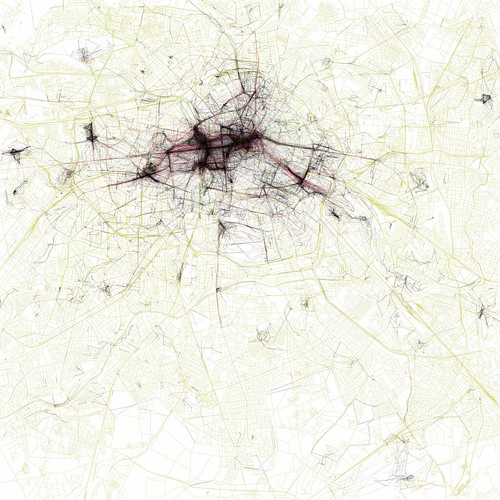
The Geotaggers' World Atlas #5: Berlin

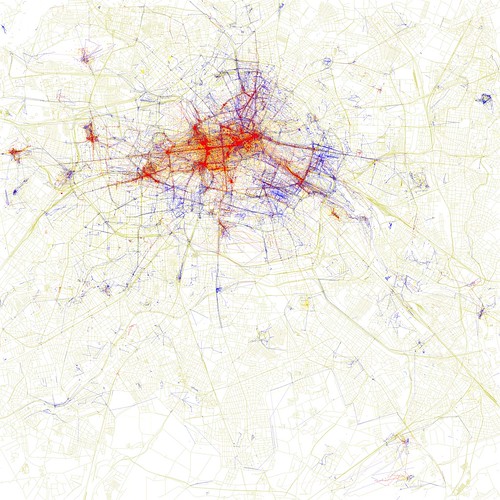
Eric Fisher composed maps of various cities showing highly-photographed locations, a project which developed from his London map based on 73000 photographs taken from Flickr and Picassa overlaid on an OpenStreetMap (Brown, 2010, and Fisher, 2010). There are also maps which categorise photos taken by tourists from those photographed by locals (below).

Locals and Tourists #13 (GTWA #5): Berlin

Visualisation based on geo-tagging enables locational data to illustrate people's behaviour. This work used Flickr and Picassa to collect data, then combined it with OpenStreetMap, a collectively edited online map.

Brown, M. (2010) Which Bits Of London Get Photographed The Most? [Online]
Fisher, E. (2010) The Geotaggers' World Atlas #5: Berlin. [Online]

Fisher, E. (2010) Locals and Tourists #13 (GTWA #5): Berlin. [Online]

Sunday, 20 June 2010

Joachim Gauck: the dissident hero who holds the destiny of Germany in his hands

In a blow to chancellor Angela Merkel, a pastor who defied East Germany's bosses may be elected president instead of her candidate. But he says he has no wish to see her ousted as a result
The Observer, Sunday 20 June 2010
He is the colourful pensioner at the heart of the most important presidential election in postwar German history. But Joachim Gauck insists that he never expected his race for high office to cause such a stir.
A Protestant pastor and anti-communist civil rights activist from east Germany, Gauck could be elected German president in 10 days' time in a vote that is widely being seen as an unofficial poll on Chancellor Angela Merkel's leadership. The silver-haired 70-year-old is being backed by the opposition Social Democrats and Greens, who believe that a defeat for Merkel's candidate, Christian Wulff, could lead swiftly to her own political demise.
At a time when the German government finds itself in a state of turmoil, riddled by rows over its handling of the debt crisis and the controversial bailout of the Greek economy, Gauck appears a little nonplussed to find himself the man of the moment. "I was surprised and flattered to be asked to run for the post," Gauck said. "But I didn't seek it, and it definitely wasn't my intention to unseat Merkel, and I'm sure she doesn't see it like that either – I just want to do what's best for the country."
The unexpected election is taking place following the shock resignation of President Horst Köhler this month. "We are at a crossroads in Germany," Gauck said. "There's a deep-seated sense of anxiety right now, and we need a new impetus. I notice that people aren't just interested in consumption and football, they also want to be able to believe in people and institutions again."
Many see Gauck as something of a moral authority who can bring fresh blood to German public life. Momentum is growing for the former dissident who, particularly as someone who stands outside party politics, is seen as a much more attractive figure than Wulff, a clean-cut, tanned, media-savvy career politician who is 20 years the priest's junior.
While the government factions – Merkel's Christian Democrats (CDU) and the Free Democrats (FDP) – hold a potential majority of at least 21 in the 1,244-seat special federal assembly that will choose the president, it is far from clear that the chancellor's candidate will win. Several members of the government faction, including members of the FDP, who have clashed repeatedly with Merkel since entering a coalition with her in October, have said they will vote for Gauck.
"He is a figure who is closely associated with the peaceful revolution in the GDR [East Germany] in 1989," said Holger Zastrow, head of the FDP in Saxony, in the former East. "He fought courageously and fearlessly for his convictions … he speaks from the soul and what he's done for this country, it's not something we can easily forget."
With his fascinating Cold War history, Gauck, a father of four who was born in the port city of Rostock, is undoubtedly one of the most interesting Germans alive. He says his political conscience was initially awakened by the arrest, when he was 11, of his sea-captain father on suspicion of espionage. He was taken from the family dinner table to a gulag in Siberia and the Gaucks did not see him for almost five years.
"The fate of our father was like an educational cudgel," Gauck said. "It led to a sense of unconditional loyalty towards the family which excluded any sort of idea of fraternisation with the system."
Banned by the regime from studying German and history because of his political opposition, he was forced to study theology and later trained to become a pastor. He led huge peaceful opposition marches in 1989, which partly led to the fall of the regime. His sermons from that time are famous.
Following reunification, Gauck was in charge of the state-run archives on the Stasi secret police, and won both recognition and enemies for exposing their crimes and espionage techniques.
He describes himself as a "leftwing liberal conservative," but did not vote for the first time until he was 50, having spent most of his life living under the GDR dictatorship. The experience, he said, had made him passionate about democracy. What makes his candidacy particularly awkward for Merkel is that the two are friends who have always shown deep respect for each other.
The chancellor even read the tribute at his 70th birthday, praising him as an "outstanding personality". Having both grown up in East Germany, Gauck and Merkel – herself a priest's daughter – have had similar life experiences.
Of Merkel, Gauck only has words of praise: "She's powerful, innovative, imaginative, and unlike many in this country she doesn't immediately take the position that everything is doom and gloom. She's an optimist," he said.
Yet it is the 70-year-old pastor who could yet bring her down. Some commentators have described it as a "Shakespearean scenario".
Connolly, K. (2010) Joachim Gauck: the dissident hero who holds the destiny of Germany in his hands. [Online] http://www.guardian.co.uk/world/2010/jun/20/joachim-gauck-angela-merkel-president [20/06/2010]

Friday, 18 June 2010

Tacita Dean on Boots

"Berlin Project was the most personal work I had ever done up t that point. I think the reason why I am getting a bit more autobiographical, ant The Uncles is totally autobiographical, is because I've moved to Berlin and suddenly it has given me permission to make work about England, because prior to that I would travel the world for my subject matter. It is something that I hadn't noticed - the autobiography in Boots, 2003, is subliminal when you encounter the work, but when you read my texts yo then see the connection and Boots's association to my family. Berlin Project includes Boots - I interviewed him about his father's life in Berlin - basically Boots had this legacy of being the son of a minor traitor. He was born in London but lived in Munich and Berlin as a boy during the whole Nazi period." (Dean, in Walsh, 2007, pp.568-569)


Maria Walsh I saw Boots in Paris at the Musée d'art moderne de la Ville de Paris. How is it set up at RIBA?  
Tacita Dean The RIBA room that we have has three doors so it absolutely invites Boots. Also the building is so much like Casa de Serralves, that same period. It is from the thirties and a bit fascist in a way, so it is a perfectvenue. I wanted to show it here at Firth Street as it is the principal work I've made in the last year but needed more space." (Dean, in Walsh, 2007, p.570)


Maria Walsh Why are there three versions of Boots?
Tacita Dean I wanted to use Boots's perfect ated urbanity, that in some ways he carried in his body that period of western culture when many were polyglot and somehow Europe was less divided in a strage sense even though now we have the European Community. Then, people would freely move between cultures and be multilingual." (Dean, in Walsh, 2007, p.571)


Tacita Dean "I wanted to film him in all these different languages without knowing I was going to do three versions... What I imposed on it was obviously the language seperation but also that he would take a different walk around the villa for each version. So in the English version he goes into the study, in the French, the dining room, in the German, the library and then they all go upstairs to the pink bathroom... what i love is that he changes with the language, which is so beautiful. In the German version, he is a bit fascist in a way, isn't he? Whereas the French version is much more romantic, the English is very wistful." (Dean, in Walsh, 2007, p.571)


Maria Walsh Boots's cahracter doesn't take over the building in the way that a character usually dominates place in mainstream fictional narratives.
Tacita Dean They both have parallel stories. An empty house of tha beauty is poignant anyway and Boots becomes an empty house also to some extent." (Dean, in Walsh, 2007, p.571)


Tacita Dean "People's perception of sound is extraordinary. It is so muted by image...
I put in everything. I always record sound live and collect sound while I am in the location, so most of it is recorded in situ but was just placed differently. It is another ingredient that adds to the visual because of course image in 16mm is recorded mute. And that for me is one of the primal seperations between video, digital media and film - the muteness of film, of cinema, and that everything has to be added." (Dean, in Walsh, 2007, p.571)


Walsh, M. (2004) "Tacita Dean" in Bickers, P. & Wilson, A. (eds.) (2007) Talking Art: Interviews with Artists since 1976. London: Art Monthly and Ridinghouse. pp.567-573.